
A Baltimore Oriole showing up in your life is one of the more vivid spiritual signals nature can send. That flash of fiery orange against dark wings is hard to miss, and many people feel immediately that it means something. In most spiritual traditions, it does: the Baltimore Oriole carries messages of joy, creativity, renewed hope, and bold self-expression. But the specific message for you depends on what the bird was doing, where it appeared, and what's currently unfolding in your life. This guide will walk you through all of it.
Baltimore Oriole Bird Spiritual Meaning and What to Do Next

Eliza Thornwick
7 Apr 2026
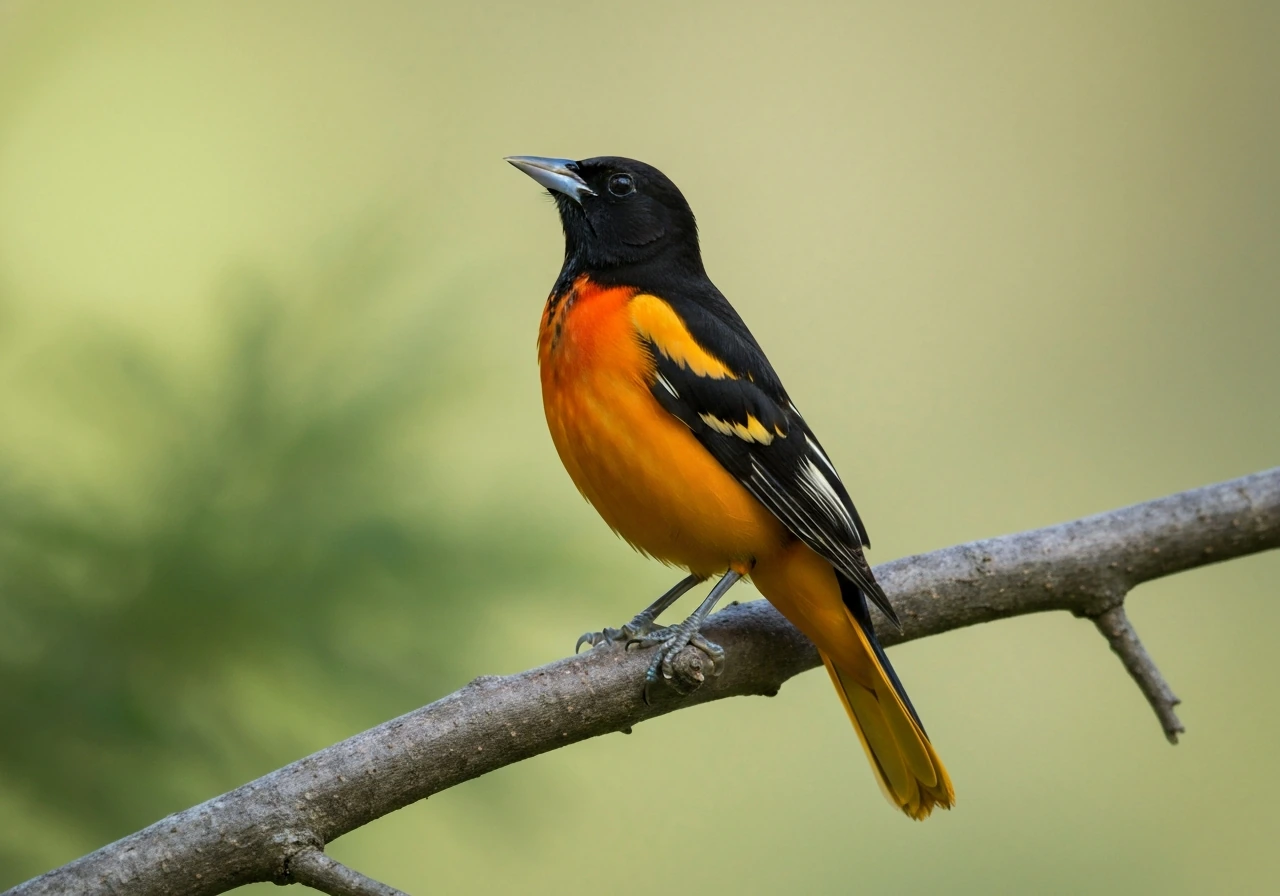
What a Baltimore Oriole encounter most likely means right now
The short answer: seeing a Baltimore Oriole is almost always considered an encouraging, uplifting sign. It tends to arrive as a reminder to reconnect with what brings you genuine delight, to speak or create more freely, or to trust that brighter days are genuinely on the way. The bird's bold orange coloring alone links it to solar energy, vitality, and optimism across a wide range of spiritual traditions. If you've been grinding through a heavy stretch, feeling creatively blocked, or keeping quiet when you actually have something important to say, this bird is commonly understood as a nudge to change direction.
That said, the encounter isn't one-size-fits-all. A Baltimore Oriole singing from a branch above you carries a different energy than one repeatedly striking your window. Context shapes meaning here just as much as the species itself, so read on before you settle on a single interpretation.
The core spiritual messages Baltimore Orioles carry
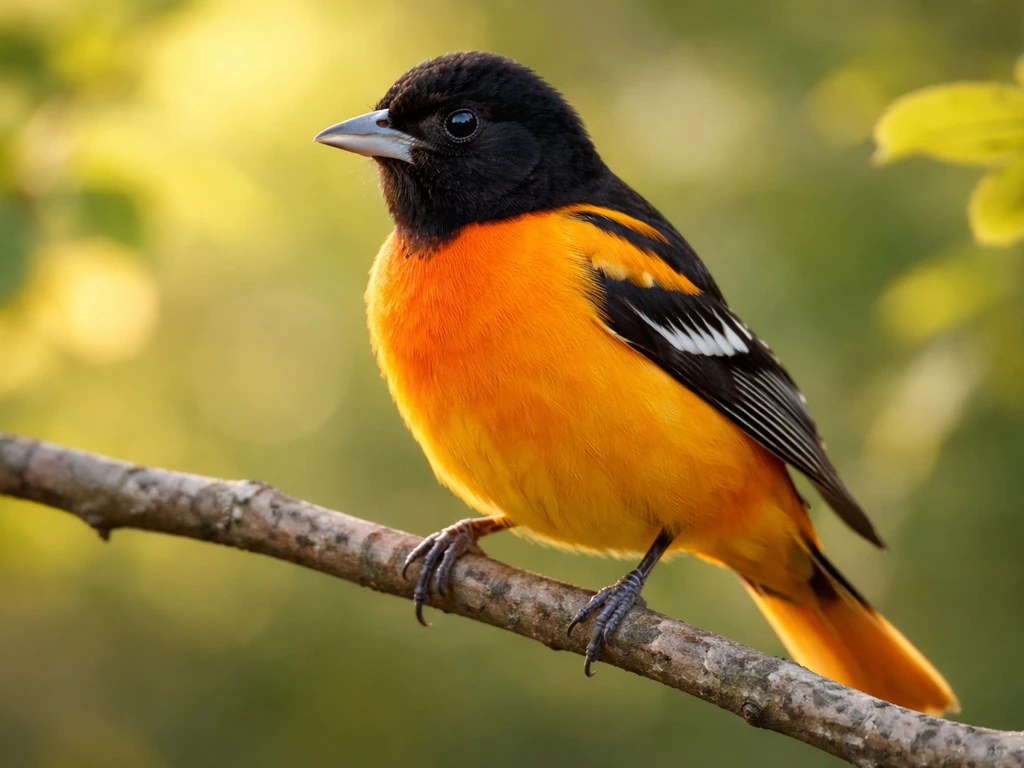
Joy and playfulness
The Baltimore Oriole's signature coloring, that saturated, almost luminous orange, is a consistent symbol of warmth and joy in spiritual symbolism. In many Indigenous North American traditions, brightly colored birds are considered carriers of the sun's energy and are seen as messengers asking you to lighten up, to celebrate small things, and to stop postponing happiness. If you've been waiting for the right moment to feel good about your life, the Oriole suggests that moment is now, not after the next milestone.
Creativity and inspired work
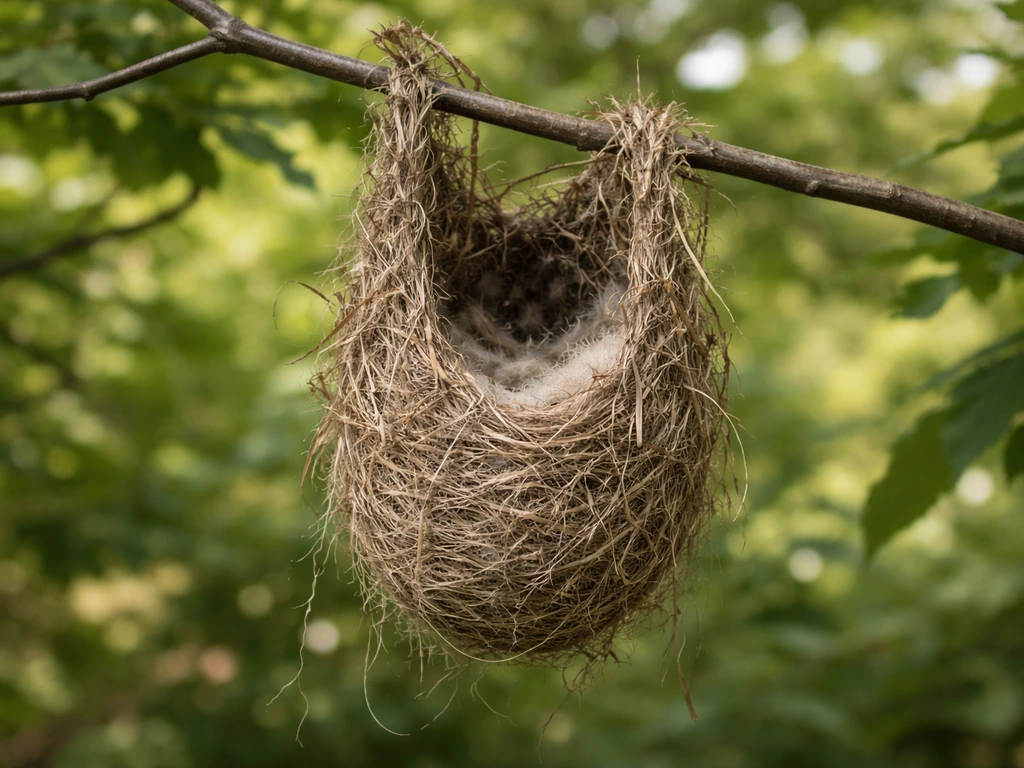
Few birds build anything as artistically remarkable as the Baltimore Oriole's nest. The female weaves a hanging, pouch-like structure using multiple material layers: an outer layer of flexible fibers like grass or yarn, a middle structural layer for stability, and a soft inner lining of down. She returns to a patch of plants over multiple days to gather exactly the right fibers. This patience, precision, and genuine craft is a powerful spiritual metaphor. If you've been second-guessing a creative project or wondering whether a vision you have is worth pursuing, the Oriole showing up is often read as a direct message: yes, build it. Do it with care. Don't rush the weaving.
Communication and authentic expression
The Baltimore Oriole is known for its distinctive, melodious song: a short series of paired whistles, each phrase repeated two to seven times in a sequence lasting only about one to two seconds. It's compact but unmistakable. Spiritually, this style of communication is symbolic in itself: clear, confident, and purposeful rather than rambling or uncertain. Many readers who encounter this bird during a period of silence, avoidance, or unexpressed feelings interpret it as a call to speak up. In Celtic traditions, songbirds were often seen as bridging the human world and the spirit world, their songs literally carrying messages between realms. The Oriole's song invites you to deliver yours.
Hope and seasonal renewal
Baltimore Orioles are migratory birds, arriving in spring and early summer after a long journey. In that sense, their appearance carries an inherent message about return and renewal. Many spiritual traditions interpret migratory birds as symbols of hope precisely because they reliably come back after a period of absence or darkness. If you've been through a loss, a long period of uncertainty, or a season that felt emotionally cold, the Oriole's arrival is often understood as confirmation: things are shifting. Something good is migrating back toward you.
What the bird's behavior is actually telling you
Behavior changes everything in bird spirituality. The same species landing on your shoulder carries a completely different message than that species striking your window repeatedly. Here's how to read the most common Baltimore Oriole encounters.
Hearing or seeing it sing
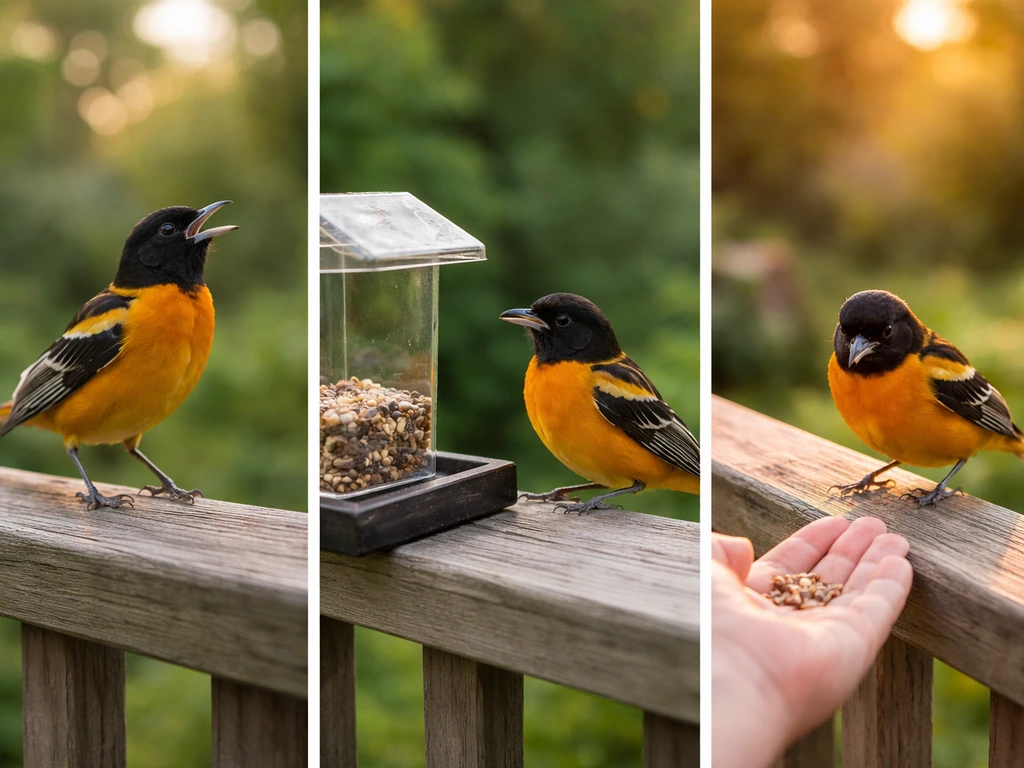
This is the most common encounter and generally the most positive. Hearing the Oriole's song before you see the bird is especially significant in many traditions, because sound reaching you first suggests the message is more internal: something you need to hear, not just observe. Sit with it. The communication theme is dominant here. Ask yourself: what have I been wanting to say or express that I haven't?
It lands on or very near you
A wild bird choosing to land on or very near a human is rare enough that most spiritual traditions treat it as a direct, personal message rather than a general one. With the Baltimore Oriole, a landing typically amplifies the joy and creativity themes, but adds a layer of urgency: this isn't a general reminder, it's specifically for you, right now. Some readers also interpret a bird landing near them as a visitation from a deceased loved one. If that resonates given your circumstances, trust that feeling.
Watching it build a nest
Witnessing nest-building is a beautiful omen spiritually. Because the female Oriole's nest-building is methodical, layered, and requires multiple return visits to gather materials, observing this process is often read as a message about foundation and patience. You may be in a phase of your life that requires careful, intentional building rather than fast results. The Oriole is showing you how: layer by layer, with the right materials, without shortcuts. For more on how orioles broadly are interpreted across spiritual traditions, the deeper themes in oriole bird spiritual meaning can give you useful additional context.
Tapping or repeatedly striking your window
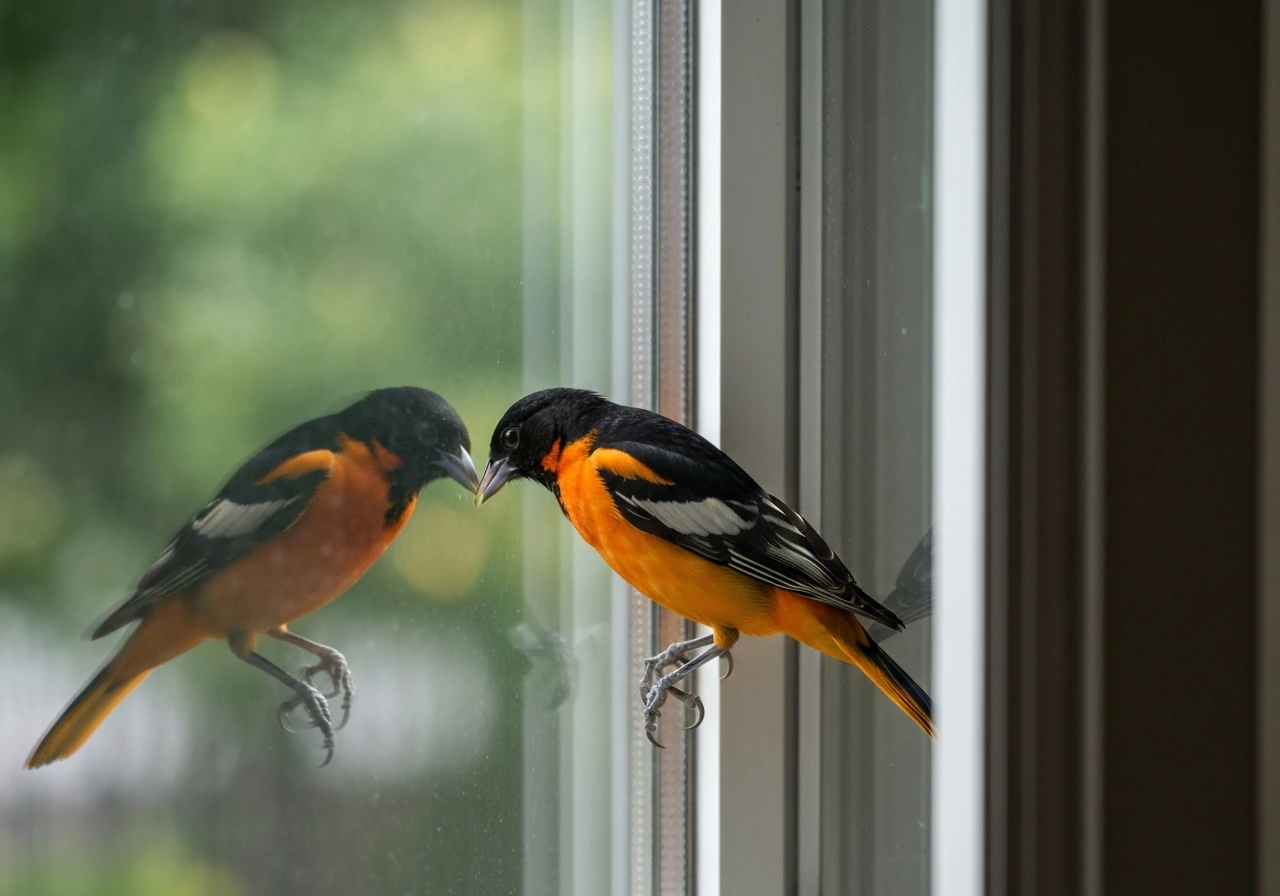
This is where things get more complex, because there's a practical explanation and a spiritual one, and both are worth considering together. When a male Baltimore Oriole pecks or flies at a window, it's typically responding to its own reflection, treating the image as a territorial intruder. It's a bird doing what birds do. But in spiritual practice, even behaviors with natural explanations can carry symbolic weight. Repeated window-tapping is often interpreted as a message to examine what you're fighting in yourself: the reflection you can't stop confronting might be a part of your own nature you keep resisting. The window as a symbol of the barrier between your current self and a fuller version of you is worth sitting with. Practically speaking, if the behavior is ongoing, it's worth addressing for the bird's safety. Window strikes are a serious risk to birds, and taking steps to break up the reflection (using decals or tape patterns on the outside of the glass) protects both the bird and the energetic relationship you're noticing.
Seeing one repeatedly over several days
Repetition in spiritual encounters is almost always interpreted as emphasis. If you're seeing a Baltimore Oriole again and again, the message hasn't landed yet, either because you haven't acted on it or because the timing of what it's signaling hasn't quite arrived. Either way, pay closer attention. Write down every sighting, what you were doing, thinking, or feeling at the moment, and look for the pattern.
When it's a warning vs an encouraging sign
Baltimore Orioles skew strongly positive in spiritual interpretation, but there are circumstances where a more cautious reading is appropriate.
Finding a dead Baltimore Oriole
Encountering a dead bird almost always shifts the interpretation toward endings, transitions, and the need for surrender. A dead Baltimore Oriole doesn't mean something terrible is coming, but it does suggest that something in your life associated with its symbolism (joy, creative expression, a particular way of communicating) may need to end or transform before something new can begin. In many spiritual traditions, a dead bird signals a necessary release rather than a punishment. Sit with what you've been holding onto that might need to go.
Unusually aggressive behavior
If the bird seems to be directing unusual aggression toward you, not just toward its reflection in glass but toward you specifically, that's worth pausing on. In animal spirit traditions, aggression from a typically joyful species can be read as an urgent warning: something in your current path is misaligned, and the universe is trying to interrupt you before you go further. Ask yourself whether you're doing something that feels fundamentally out of integrity with who you are or who you want to be.
| Encounter Type | Likely Spiritual Tone | What to Ask Yourself |
|---|---|---|
| Hearing its song | Encouraging, communication-focused | What do I need to say or express? |
| Seeing it land near you | Direct personal message, joyful | What part of my life needs more delight? |
| Watching it build a nest | Patience, creative foundation | Am I building something with care? |
| Repeated window-tapping | Reflective, possible self-confrontation | What in myself am I resisting? |
| Seeing it repeatedly | Urgent or emphasized message | What message haven't I acted on yet? |
| Finding it dead | Transition, necessary ending | What needs to be released? |
| Unusually aggressive behavior | Cautionary, course-correction | Is something in my path misaligned? |
How to interpret your encounter in context
The same bird carrying the same message in two different contexts can point in completely different directions. Here's how to use the details of your specific encounter to sharpen your interpretation.
Location
Where you saw the Oriole matters. In your backyard suggests the message is about your home life, family, or personal foundation. At your workplace or on your commute suggests it's career or purpose-related. In a natural setting, away from your usual environment, can point to a broader life-path message. If it appeared somewhere emotionally significant to you, like near a place you associate with a lost relationship or a former chapter of your life, weight that location heavily.
Season and time of day
Baltimore Orioles are spring and early summer birds in most of their range, so a sighting during peak migration (roughly April through June) carries the natural renewal themes especially strongly. A sighting outside of typical migration windows might feel even more notable, almost as if the bird went out of its way to find you. Time of day also adds nuance: morning sightings in many traditions are associated with new beginnings and clarity, midday with action and vitality, and evening with reflection and closure.
What's happening in your life right now
This is the most important layer. Spiritual messages don't exist in a vacuum. If you've just started a creative project, the nest-building symbolism speaks directly to that. If you've been stuck in grief, the arrival theme is what matters most. If you've been in conflict with someone and haven't been able to express how you feel, the communication symbolism is front and center. The Oriole doesn't show up with a generic fortune cookie. It responds to what you're actually living through. The color alone, that vivid orange, connects the Baltimore Oriole to the broader world of orange bird spiritual meaning, where themes of enthusiasm, confidence, and emotional warmth run consistently across traditions.
Practical next steps: rituals, journaling, and intention-setting
Once you have a sense of what the encounter might be pointing toward, these steps help you work with the message rather than just thinking about it.
Journal it while it's fresh

Write down the encounter as specifically as possible: where you were, what time it was, what the bird was doing, and what you were thinking or feeling right before it appeared. Then write freely for five to ten minutes using this prompt: 'If this bird came to me with a message, and I already knew what it was, the message would be...' Don't filter. Often what comes out in the first few sentences is the real answer.
Reflection questions to sit with
- Where in my life have I been holding back joy, and what would it look like to stop holding back?
- Is there something I've been creating, planning, or building that I've been too afraid to commit to fully?
- Who do I need to speak more honestly with, and what do I need to say?
- What season of life am I in right now, and what is trying to migrate back to me?
- If this bird is a messenger from someone I've lost, what would they most want me to hear?
A simple oriole intention ritual
You don't need elaborate materials for this. Find something orange, a candle, a piece of fabric, a fruit, anything that carries the color. Sit quietly with it for a few minutes and set one clear intention aligned with what the Oriole encounter brought up for you. If the message was about creative work, name the project and state your commitment out loud. If it was about communication, speak the words you've been holding back, even if you speak them only to yourself. The act of naming your intention in the physical world, using a tangible symbol of the bird's energy, helps anchor the message into action rather than leaving it as a vague feeling.
Keep watching
Spiritual encounters rarely stand alone. Notice what else is showing up around you. Other birds in particular can add layering to the message. A bird like the indigo bunting appearing near the same time, for example, would deepen themes of devotion and purpose. A owl sighting in the same period might add a layer of wisdom and the need for discernment. The birds rarely travel alone in the symbolic sense.
How to check whether your interpretation is right
There's no single authority on what a bird means spiritually, and anyone who tells you otherwise is oversimplifying. What you can do is run your interpretation through two checks that together give you a much stronger reading.
The intuitive check
After you've settled on an interpretation, notice your body's response to it. Does it feel true? Does it create a sense of recognition, like something clicking into place? Or does it feel forced, like you're reaching for a meaning that doesn't quite fit? Your body usually knows. If you feel a slight expansion in your chest when you land on an interpretation, that's often a reliable signal that you're onto something. If it feels flat or hollow, keep exploring. You haven't found the right layer yet.
The cultural and folklore cross-check
Once you have an intuitive read, see whether cultural traditions support it. Native American traditions, Celtic bird lore, Eastern philosophies, and even Christian symbolism often share overlapping themes for the same species. If multiple traditions point in the same direction your intuition already pointed, that's a strong signal you're reading accurately. For the Baltimore Oriole specifically, the consistent themes across traditions are joy, creativity, and communication, which means if your interpretation lands somewhere in that territory, you're almost certainly in the right neighborhood. It's also worth knowing how the color yellow changes things: if you're seeing a lighter or differently colored oriole and aren't sure of the species, reading about yellow oriole bird spiritual meaning alongside this article can help you distinguish the messages. And if the birds you're noticing are more muted in color, the themes in brown bird spiritual meaning offer a grounding contrast.
A simple verification process
- Write out your interpretation in one clear sentence: 'I believe this Oriole encounter is telling me...'
- Check your body's response: does it feel true or forced?
- Look up two or three cultural traditions' views on the species or its dominant symbolism (orange birds, songbirds, migratory birds).
- Note where your intuition and the traditions agree. Lean into that overlap.
- If they don't agree, explore what cultural lore points to that your intuition might have missed.
- Let the interpretation evolve over a few days. The meaning sometimes clarifies as the message plays out in real life.
The Baltimore Oriole is one of the more generous messengers nature sends. It's vivid, musical, and architecturally gifted, three qualities that together point to a life lived with full expression and care. Whatever it came to tell you, the message is almost certainly worth listening to. Some birds require deep specialist knowledge to interpret, like the uppan bird or the ibaka bird, which carry very specific cultural and regional meanings. But the Baltimore Oriole speaks in a language most spiritually curious people can understand on first encounter: be joyful, create something real, say what needs to be said, and trust the season you're in.
FAQ
If I see a Baltimore Oriole, does it always predict something specific?
Yes, but use your senses and context to narrow it down. If the bird was in an intensely emotional moment for you (a difficult conversation, a grief anniversary, starting a project), focus on the theme that best matches what you were actively feeling or avoiding. If it was a casual sighting during an otherwise normal day, it is more likely to be a general nudge toward joy, creativity, or clear communication rather than a specific prediction.
What if I just briefly saw a Baltimore Oriole, with no interaction?
Not necessarily. The spiritual meaning often comes through more clearly when the behavior is specific, such as singing near you, repeatedly landing close, or nest-building. If you only spotted a quick fly-by with no interaction, treat it as an invitation to check in (what have I been postponing?) rather than trying to force a detailed storyline.
I keep seeing Baltimore Orioles. Does repetition mean the message is urgent?
Repeated sightings typically mean the message is still asking for a response, or your timing has not caught up yet. A practical way to work with this is to review your notes after 3 to 7 days and choose one small action aligned with the dominant theme you keep noticing (for example, sending the message you have been avoiding, or starting the next step of the creative work).
What should I do spiritually and practically if a Baltimore Oriole keeps striking my window?
If the bird hits the glass, you should treat it as a real safety issue first. Move quickly to reduce risk by breaking up the reflection (decal or pattern on the outside, tape/paper patterns temporarily) and keep an eye out for distress. Spiritually, you can still reflect on what the “barrier” theme brings up, but do not ignore the birds’ physical danger.
How do I interpret a dead Baltimore Oriole without panicking?
A dead Baltimore Oriole is often interpreted as an ending or release connected to the bird’s themes (joy, creative expression, communication). To avoid turning it into fear, pair reflection with reality checking: ask what habit, relationship pattern, or self-silencing behavior is ready to transform, and choose one concrete letting-go step rather than expecting an inevitable catastrophe.
If it keeps pecking near my door or windows, is it a personal spiritual message or just territorial behavior?
If a male seems to target your window specifically, it is frequently territorial, reacting to its reflection as another bird. For spiritual practice, you can read it as “conflict with yourself” only if it resonates with what you have been resisting. The clean decision rule is, if you notice symbolic meaning but the bird is clearly in danger, prioritize the bird protection steps first.
Does the time of day a Baltimore Oriole appears change the spiritual meaning?
Yes, timing can matter, but only as a modifier, not the entire meaning. Morning sightings often correlate with clarity or new starts, midday with action and energy, evening with closure and review. If your life context strongly contradicts that, let the life context win, and treat time-of-day as a tuning knob.
What is a practical next step when the meaning feels positive but vague?
Most of the most common themes are about what to do internally and externally: joy, creating, and speaking. If you want a “next step,” pick one behavior you can complete within 24 hours. Examples: write the message draft you have been avoiding, name your creative idea out loud, or set a small celebration for something you usually rush past.
How can I tell which spiritual tradition interpretation is the “right” one?
Cultural symbolism can overlap, but it is easy to over-literalize. A helpful approach is to look for the shared core themes across traditions (for this species, joy, creativity, and communication) and then let your lived situation determine the specific application. Avoid choosing a tradition only because it matches your wishes.
What if the bird looked different than I expected, like a lighter orange or more muted tones?
Bird colors can shift the species or the symbolism you are mapping onto it. If the bird you saw looked lighter, differently patterned, or you cannot confidently identify it, stop and verify what it most likely was. Then interpret using the appropriate color and species guidance, because mixing “oriole” and “yellow oriole” themes can lead to mismatched conclusions.
If my intuition feels strong but it also feels heavy, should I trust it?
Your body response is a useful filter, but it should not replace discernment. If the interpretation feels true, take a step that matches it. If it feels emotionally intense but unhelpful (tightness, dread), re-check your assumptions and consider a gentler reading that supports safety, balance, and realistic action.
Next Article
Hamerkop Bird Spiritual Meaning: Messages, Encounters, Guidance
Hamerkop bird spiritual meaning by encounter, covering intuition, boundaries, protection, love guidance, and a daily rit