
When a hamerkop crosses your path, the most common spiritual themes are protection, intuition, and the energy of building something meaningful in your life. In African folklore, particularly across Xhosa, Zulu, and other southern African traditions, the hamerkop is one of the most spiritually charged birds you can encounter, sometimes seen as an ill omen, sometimes as a powerful messenger urging you to pay close attention to what is happening at home, in your relationships, and inside yourself. What it means for you specifically depends heavily on the type of encounter, the context of your life right now, and how you feel in that moment.
Hamerkop Bird Spiritual Meaning: Messages, Encounters, Guidance

Eliza Thornwick
19 May 2026

What the hamerkop most commonly symbolizes

The hamerkop (Scopus umbretta) is not your average wading bird. Its striking hammer-shaped head, its enormous nest, and its apparent comfort around humans have made it spiritually significant across centuries of African tradition. SANBI notes that some indigenous South African cultures view it as an ill omen, and it features prominently in Xhosa folklore. The Kalahari Bushmen connected it to lightning, believing that anyone who tried to rob a hamerkop's nest would be struck. That is a powerful symbol on its own: this is a bird whose home is considered protected, even sacred.
Across modern spiritual writing, the hamerkop tends to cluster around a handful of core themes. These are not random, they grow directly out of the bird's real behavior and the deep cultural history surrounding it.
- Protection and boundary energy: especially connected to the home, family, and anything you are building in your life
- Intuition and attunement: the bird's quiet, watchful presence near water is often read as a sign to look deeper beneath the surface
- Persistence and intentional building: the hamerkop's nest can take 10 to 14 weeks to complete, uses around 8,000 sticks, and can measure up to 1.8 metres across and 1.2 metres high — spiritual writers regularly tie this to the message of steady, deliberate effort
- Messenger energy: the hamerkop is said to carry communications between the physical and spiritual worlds, especially around matters of home and family
- Warning or heightened alertness: in some traditions, particularly Zimbabwean and Xhosa, a hamerkop calling near your home is a signal to pause, assess, and not ignore what you have been avoiding
What the encounter type actually changes about the meaning
How you encounter a hamerkop matters just as much as the fact that you saw one. The same bird can carry very different energy depending on what it was doing and where. Here is how to read the specific scenario you experienced.
Flying overhead, especially while calling
This is the encounter that traditional African folklore takes most seriously. Birdlore and Zimbabwean traditions note that a hamerkop flying over a homestead while calling is considered a particularly strong omen, historically interpreted as a warning about a close relative or major shift at home. Spiritually, flying overhead often signals a message being delivered from above your current line of sight, something you have not yet seen clearly. If the bird was calling, that urgency is amplified. Take this as a prompt to check in with family members you have been out of touch with, or to examine something in your home life you have been pushing aside.
Landing near you or appearing unusually close
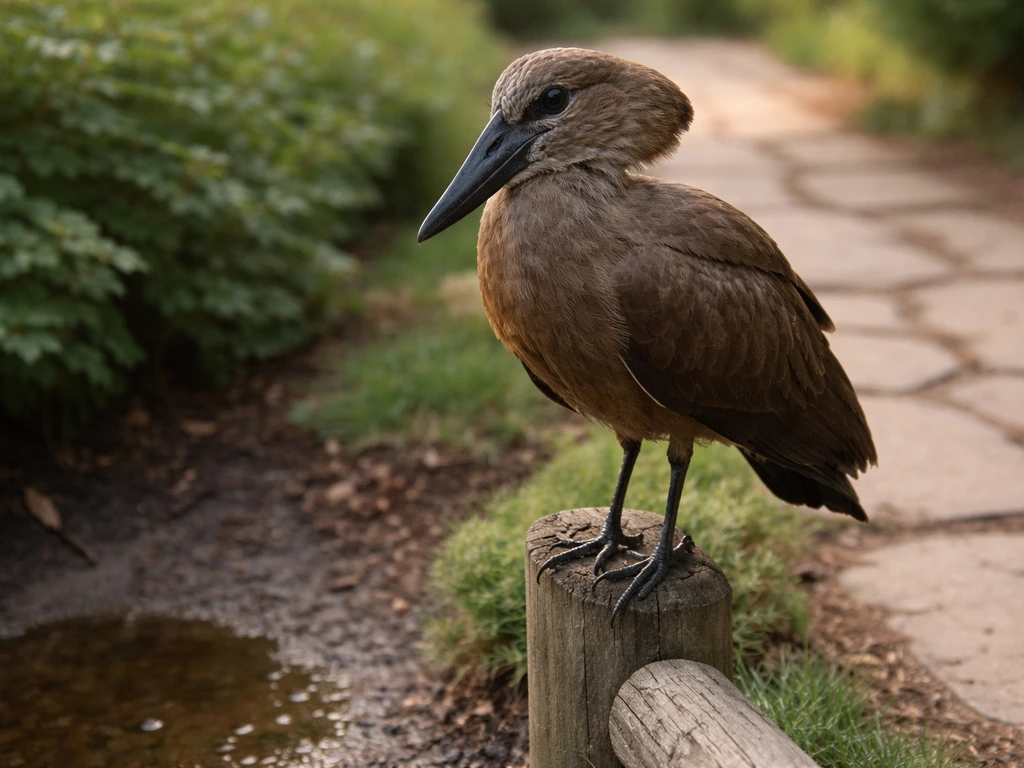
The hamerkop is noted for its apparent comfort in the presence of humans, which is part of why it has attracted supernatural associations for so long. If one lands close to you or seems unbothered by your presence, spiritual interpreters tend to read this as a direct, personal message rather than a general one. It is asking for your attention specifically. This type of encounter is often linked to intuition themes: the message is less about a warning and more about an invitation to trust what you already know deep down.
Building a nest nearby
Finding a hamerkop nest under construction near your home or land is one of the most powerful encounters from a spiritual standpoint. That nest is extraordinary by any standard. It is strong enough to support the weight of a fully grown man, built with a single small entrance hole for protection, and takes months of focused effort to complete. Spiritually, a hamerkop building nearby is almost universally read as a positive sign connected to home, security, and creative effort. It can reflect a period in your own life where you are laying foundations, whether that is a relationship, a project, a home, or a new phase of personal growth. It is an invitation to build with the same patience and intention the hamerkop brings to its own work.
Seeing one near water, quietly watching
The hamerkop spends much of its time standing at the water's edge, still and attentive, waiting. This image, when it comes into your life, tends to carry the energy of patience and deep listening. Spiritually, water is often connected to emotions and the subconscious. A quiet hamerkop near water may be reminding you to slow down, get still, and let what you need to see rise to the surface on its own. If you want to explore the grey and white bird spiritual meaning more specifically, look for details about the bird’s coloring and how it appeared in your situation.
Repeated sightings over days or weeks
A single encounter can be coincidence. When a hamerkop keeps appearing in your life, in the same location or in different places, that repetition is generally taken as confirmation that the message is meant for you and is not yet resolved. Repeated sightings usually point to something you need to examine more seriously, not something to acknowledge once and move on from.
The hamerkop as a spirit messenger: love, protection, and intuition

If you are going through something specific in your life and the hamerkop appeared during that time, here is how to map the symbolism to your situation.
Relationships and love
The hamerkop mates for life and is deeply involved in building its home together with its partner. That behavioral reality feeds directly into its symbolic life. If you are navigating a relationship question, this bird tends to carry messages about commitment, the work of building something together, and whether you are laying the right foundation. A hamerkop encounter during a period of relationship uncertainty might be asking: are you building with intention, or are you just reacting? Are you investing in the foundations, or expecting things to hold together without the work?
Personal protection and security
In several African traditions, the hamerkop's nest itself is considered protected ground. The Kalahari Bushmen belief that tampering with the nest invites a lightning strike is a vivid way of expressing that some things deserve to be left alone and respected. If you are dealing with a situation where you feel vulnerable, where your home or sense of security feels threatened, the hamerkop's energy is often interpreted as a reminder that your boundaries are valid and that protecting what you have built is both wise and necessary. Some spiritual traditions also tie the hamerkop to watching for people or energies that do not belong in your space.
Intuition and inner guidance
One of the most consistent modern spiritual readings of the hamerkop is around intuition. The bird is quiet, watchful, and patient before it acts. If it has appeared for you during a time of decision-making or uncertainty, the likely message is to trust your instincts and stop second-guessing what you already sense to be true. You do not need more information. You need stillness.
What African folklore and cultural tradition actually say
It is worth being honest about where hamerkop symbolism comes from, because it is richer and more specific than a lot of online spiritual writing lets on. This is not a bird with vague, feel-good associations. It carries weight.
In Xhosa tradition and across other southern African cultures, the hamerkop (sometimes called thekwane or uthekwane) is described as a bird of ill omen, particularly when it appears near a homestead and calls. The Dictionary of South African Ethnography links its presence near a kraal with concerns about witchcraft or supernatural interference. The Natalia journal documents the widespread belief that the bird's hooting near a home is a warning that something is wrong in the household's spiritual landscape.
The lightning bird connection is equally significant. In Zulu and Kalahari Bushmen tradition, the hamerkop is associated with lightning (impundulu), and its nest is considered so charged with supernatural energy that disturbing it is believed to bring disaster. This is not superstition for the sake of superstition. These beliefs developed because communities observed the hamerkop carefully for generations and attached meaning to its most striking behaviors: its enormous nest, its stillness, its presence near water, and its eerie calls at dusk.
SANBI notes that the bird's size and the sheer scale of its nest likely contributed to the awe and respect it commands. The nest can be up to 1.8 metres across, requires thousands of sticks, and is structurally sound enough to hold adult human weight. It is easy to see why communities living close to the land found this bird worthy of deep attention.
If you are comparing the hamerkop to other wading birds you might have read about, like the heron or egret, the traditions are quite different. Heron symbolism tends to cluster around patience, grace, and divine messenger themes from Greek and Celtic traditions. Some people also look to grey heron symbolism for guidance, linking it with spiritual messages, patience, and calm awareness grey heron spiritual meaning. Egret symbolism leans toward purity and divine wisdom in many modern spiritual systems. Egret bird spiritual meaning is often described in terms of purity, spiritual clarity, and inner guidance Egret symbolism. The hamerkop's symbolism is more grounded in community protection, home energy, and the boundary between the known and unknown. It is a more complex, and arguably more urgent, messenger.
How to figure out what it means for you personally
Spiritual symbolism is not a one-size-fits-all system. The same bird can carry a different message for different people in different moments. The most reliable way to interpret a hamerkop encounter is to run it through four filters: what was happening in your life at the time, what you felt emotionally when you saw it, where the encounter happened, and whether the timing connects to anything significant.
| Filter | Questions to ask yourself |
|---|---|
| Life context | Were you in the middle of a decision, a conflict, a transition, or a period of building something new? |
| Emotional response | Did seeing the hamerkop make you feel uneasy, calm, curious, or suddenly alert? Your gut reaction is data. |
| Location | Was it near your home, your workplace, a place tied to a relationship, or somewhere neutral? |
| Timing | Did it appear right before or after something significant? On a meaningful date? During a period of repeated difficulty or growth? |
If the encounter felt unsettling, that is worth paying attention to. The African traditions that describe the hamerkop as an ill omen are not trying to frighten you. They are pointing to something real: sometimes a message is a warning, and honoring that warning is how you protect yourself and the people you care about. If the encounter felt meaningful but positive, lean into the building and protection themes. If you felt a strong pull toward stillness, intuition is likely the message.
What to do after your hamerkop encounter
You do not need an elaborate ritual to honor or respond to a spiritual encounter. What you need is intentional reflection and a few grounded steps that help you translate the message into something useful.
Start with your journal
Write down everything about the encounter while it is fresh. Where were you, what time was it, what was the bird doing, and what was your immediate emotional reaction? Then answer these prompts: What am I currently building in my life, and is it built on solid ground? Is there something at home or in a close relationship that I have been ignoring? What does my gut say about a decision I have been postponing? These three questions cover the core hamerkop themes and will usually surface the message quickly.
Try a short grounding meditation
Sit somewhere quiet, ideally near water or outside if you can. Breathe slowly and bring the image of the hamerkop into your mind. Notice what feelings come up. Ask inwardly: what do I need to see that I have been looking past? Sit with whatever arrives without trying to force an answer. The hamerkop's energy is about patience and attentiveness. Your meditation should match that.
Set a simple intention

If the encounter felt like a call to protect something or someone, set an intention to review the boundaries in your life this week. If it felt like a call to build, identify one concrete step you can take toward whatever you have been putting off. If it felt like a warning, take it seriously enough to have the conversation you have been avoiding or to make the practical check-in (call a family member, review a situation at home, revisit a decision you rushed through).
A simple symbolic ritual
If you want to honor the encounter in a more ceremonial way, keep it simple and personal. Find a small stone or stick and hold it while you state aloud what you are building or protecting. Place it somewhere intentional in your home. This is not about magic, it is about making your intention physical and visible so you actually follow through. The hamerkop builds its nest stick by stick. That is the spirit of the practice.
Watch for what comes next
After a meaningful encounter, pay attention to patterns over the next week or two. Do you see the hamerkop again? Do related themes show up in conversations, dreams, or sudden realizations? Confirmations tend to cluster. If nothing resonates and life moves on without incident, the encounter may have been a nudge rather than an urgent message, and that is completely valid too.
When to seek practical help
If your hamerkop encounter felt genuinely ominous and you are worried about a family member or a situation at home, do not rely on spiritual interpretation alone. Call the person you are worried about. Address the situation directly. Spiritual symbols are most useful when they push you toward action, not when they become a reason to wait and see. The hamerkop tradition is about attentiveness and protection. Honor that by being the person who actually checks in, shows up, and addresses what needs addressing.
FAQ
Does the hamerkop bird spiritual meaning change if I only saw it briefly or from far away?
If the hamerkop appeared at a distance, you can still read it, but the emphasis usually shifts. Distant sightings are more often a general “check your attention” nudge, while close landings, nest proximity, or flying low near a homestead tend to feel more personal and specific.
What if I saw a hamerkop during a highly emotional time and the meaning feels scary?
Yes. If you were actively stressed, grieving, or dealing with conflict, your emotions can intensify the symbolism, making a neutral encounter feel like a warning. Use your feelings as a compass, then verify what concrete issue is actually present at home or in your relationships right now.
How can I tell whether the hamerkop message is guidance I should act on, or just a passing impression?
A safe approach is to write your interpretation as a working hypothesis, then run a practical test. For example, if the message points to protection, do one real boundary action (a difficult conversation, reviewing privacy, limiting access). If the “message” only stays abstract, it may be incomplete.
What specific details should I remember to interpret a hamerkop encounter accurately?
Focus on behavior details you noticed, not only the symbolism you expected. Calling overhead tends to be read as urgent, stillness near water as reflective patience, and nest building as foundation work. If you can’t remember behavior, start with where you were and what you were doing when you saw it.
If a hamerkop keeps showing up, what should I do differently instead of just noticing it?
Repeated appearances can be a sign to follow through, but not every repetition means danger. One practical rule is: if the same theme is showing up across days, pick one step you can complete within 24 to 48 hours to address it.
What should I do if I come across a hamerkop nest on my property or during a walk?
If you find a nest nearby, do not treat it as an excuse to interfere. Spiritually, the protected-ground theme is a reminder to respect your limits. Practically, keep distance for safety and do not attempt to move, touch, or disturb anything around the site.
Can local bird abundance make the spiritual meaning less reliable?
If you live in a place where hamerkops are common, frequency can be seasonal rather than spiritual. Consider timing carefully, if it lines up with a major life decision or a recurring relational issue, then it’s more likely to be a meaningful coincidence for you.
How should I respond if I’m concerned because some traditions describe the hamerkop as an ill omen?
Not necessarily. The “ill omen” tradition is usually interpreted as a call for attention, conversation, and protection, not as guaranteed tragedy. If you feel genuinely worried about someone, treat the encounter as a prompt to check in directly, not as a reason to wait.
If I saw a hamerkop while deciding between two options, how do I apply the intuition message practically?
Yes. If the encounter happened during a decision point, ask one clear question, what is my intuition already telling me to do or stop? Then reduce second-guessing by choosing a small next action, a draft message, a planning step, or a boundary to test.
Does the hamerkop meaning differ if it appears near my house versus near the water or while I’m with other people?
If the hamerkop appears in or near your home, the symbolism often centers on security, privacy, and who has access to your space. If it appears near a relationship context (visiting someone, family gathering), it tends to point more toward commitment and building together, pay attention to how it overlaps with your daily routes.
What if I feel unsettled by the encounter, but nothing obvious seems wrong in my life?
If you felt unsettled but you don’t currently have any real conflict to address, reinterpret it as a prompt to slow down and gather facts. Do one grounded action like reviewing schedules, checking on a plan, or having the “hard talk” only when you can do it calmly and safely.
What counts as a respectful way to honor the hamerkop encounter without making it complicated or risky?
A good “ceremonial” method without risk is a short intention statement paired with a concrete commitment. For example, place a small object where you’ll see it and decide on the next step you’ll complete, within a week, related to building or protecting.
Citations
SANBI notes that “Some indigenous cultures in South Africa see the Hamerkop as an ill omen” and that it “features prominently in Xhosa and other folklore.”
https://www.sanbi.org/animal-of-the-week/hamerkop/
Wikipedia states the hamerkop is “known in some cultures as the lightning bird,” and that the Kalahari Bushmen believe that someone struck by lightning resulted from trying to rob a hamerkop’s nest.
https://en.wikipedia.org/wiki/Hamerkop
Lincoln Park Zoo describes the hamerkop’s nesting behavior and provides basic natural history context (zoo-based educational framing), which helps explain why people may associate the bird with “home/nesting” symbolism.
https://www.lpzoo.org/animals/hamerkop/
San Francisco Zoo & Gardens reports a folklore-adjacent idea: locals “often watch a hamerkop enter the nest and another species exit some time later,” which zoo materials frame as a potential source of mythmaking around the bird’s nest.
https://www.sfzoo.org/hamerkop/
Britannica describes the hamerkop’s large nest, noting it builds an enormous stick nest “sometimes 1.8 metres (6 feet) across and 1.2 metres (4 feet) high.”
https://www.britannica.com/animal/hammerhead
San Francisco Zoo & Gardens explicitly ties the hamerkop’s nest presence/visibility to local stories, reinforcing why “nest/home” encounters become spiritually salient.
https://www.sfzoo.org/hamerkop/
Kariega Game Reserve emphasizes the hamerkop as a very notable nest builder in South Africa, supporting the “building/home energy” association people may feel during nest-proximity encounters.
https://www.kariega.co.za/blog/birding-eastern-cape-hamerkop-nest
BirdLife South Africa’s hamerkop account states the nest is large and typically sited in a tree fork, using sticks with a central chamber—ecological details that can be used to ground “home/nesting” interpretations.
https://www.birdlife.org.za/red-list/hamerkop/
Southafrica.co.za states the roof/construction of the hamerkop nest is strong enough to support a “fully grown man,” and notes predator/usurper birds (e.g., Verreaux’s eagle-owls) may occupy the nest—context for why people may experience repeated visits/encounters around nests.
https://southafrica.co.za/hamerkop-nests.html
World Birds claims the bird’s “appearance” and its “apparent comfort in the presence of humans” contribute to its significance in supernatural symbolism (useful for explaining why modern spiritual writers link hamerkop to protection/omens/messaging).
https://www.worldbirds.com/hamerkop-symbolism/
The Natalia journal PDF discusses the uthekwane/Hamerkop in relation to “a bird of ill-omen,” including context about the hooting/behavior being interpreted around homesteads (useful for mapping “calling” to omen meanings).
https://www.natalia.org.za/Files/41/Natalia%2041%20Article%20Koopman%20pp%2040-60.pdf
A Natalia journal PDF includes discussion positioning the “hamerkop” (Scopus umbretta) in relation to Xhosa cultural interpretations and “birds of omen,” which can support culturally specific “calling/near homestead” symbolism claims.
https://www.natalia.org.za/Files/44/Article%20Koopman%20pp%2048%20to%2069.pdf
The PDF states: “the one bird that our people all believe is a bird of very ill omen” in reference to the hamerkop/thekwane framing (source suitable for “ill omen” themes tied to the hamerkop rather than generic wading birds).
https://www.culturalguiding.com/Help/PDF/Folklore_Birds.pdf
DSAE’s entry associates “the Tekwane (known in Afrikaans as Hamerkop)” with “a bird of ill-omen” and claims its presence “near the kraal is taken to mean that someone is exercising witchcraft influences.”
https://www.dsae.co.za/entry/hamerkop/e02904
Birdlore claims an encounter pattern: “A Hamerkop in flight over a homestead is said to signify a particularly bad omen, especially when calling,” and it adds that it may “herald” death of a close relative.
https://www.birdsinfolklore.blog/2023/05/06/the-hamerkop-in-zimbabwean-folklore/
Wikipedia’s “Lightning bird” article links the hamerkop with southern African folklore by describing “the lightning bird or impundulu or thekwane” as part of Zulu folklore and notes it can be interpreted as an omen requiring actions regarding eggs.
https://www.wikipedia.org/wiki/Lightning_bird
Nature’s historical article references belief in maladies tied to supernatural influences and mentions a “strange bird called impundulu” as an origin of lightning, providing historical context for storm-omen frameworks that some hamerkop symbolism writers connect to.
https://www.nature.com/articles/074028a0
Nature discusses lightning’s effects on birds, providing a scientific backdrop for why “lightning/impundulu/hamerkop” omen associations might emerge in communities observing storm behavior.
https://www.nature.com/articles/049601c0
1911 Britannica describes the hamerkop’s nest architecture (enormous nest; flat-topped roof; small entrance hole; placement on tree/rocky ledge), which supports why people may interpret “nest/home” proximity as meaningful.
https://en.wikisource.org/wiki/1911_Encyclop%C3%A6dia_Britannica/Hammer-kop
The SF Zoo docents fact sheet describes mating displays such as “false mounting,” along with behavioral notes—helpful for explaining why unusual non-breeding seasonal behavior could be misread as “messages” in spiritual interpretation.
https://www.sfzoodocents.org/notebook/FactSheets/BIRDS/CICONIFORMES/Hamerkop.pdf
Wikipedia reports nest-building timelines/scale: nests are huge (sometimes >1.5 m across), made with mud platform/walls/roof; a researcher estimated they require around 8,000 sticks; and nests can take 10–14 weeks to build.
https://www.wikipedia.org/wiki/Hamerkop
SANBI notes the huge nest is likely why the hamerkop is treated with “awe and respect,” offering an interpretive bridge from ecology (big nest) to culturally perceived “home/protection” symbolism.
https://www.sanbi.org/animal-of-the-week/hamerkop/
Wikipedia places herons within broader symbolic-mysticism discussions (general foundation for “heron/egret” spiritual systems), but it also helps distinguish heron symbolism from species-specific hamerkop folklore.
https://www.wikipedia.org/wiki/Heron
World Birds claims classical/ancient-style connections (e.g., the Greek myths refer to the heron as a “messenger of the gods”), providing a comparative framework for differentiating “messenger” meanings across bird types.
https://www.worldbirds.org/heron-symbolism/
Earth of Birds ties white egret/bird sightings to “divine wisdom” themes (commonly used in modern spiritual writing), useful for comparison when readers might confuse hamerkop with other long-legged white birds.
https://www.earthofbirds.com/great-white-egret-spiritual-meaning/
The “spirit animal book” PDF lists heron/egret categories as “aggressive, self-determined…” and also includes other bird-meaning mappings; useful as evidence that many contemporary writers use broad, bird-family-level symbolism rather than hamerkop-specific tradition.
https://earthegy.com/assets/images/pdfs/spiritanimalbook.pdf
IERE’s article frames white heron sightings with “intuition and inner guidance” and “messengers from the divine,” demonstrating how common “intuition/messenger” themes are in egret/heron systems (and therefore why users must verify species).
https://www.iere.org/what-does-seeing-a-white-heron-mean/
Zoo-based species pages provide the baseline to avoid misidentifying: hamerkops are distinctive wading birds with characteristic head/crest and domed nest behavior—important to reduce confusion with other waders in spiritual sighting reports.
https://www.lpzoo.org/animals/hamerkop/
Maryland Zoo notes a nest-access design detail (“only one small entrance hole” to a nest), giving a practical detail that can be used in the article to ground “nest/home focus” without assuming mystical causation.
https://www.marylandzoo.org/animal/hamerkop/
San Francisco Zoo describes the hamerkop as associated with folklore and nest-entry stories; this supports an article approach that acknowledges folklore origin without treating it as literal truth.
https://www.sfzoo.org/hamerkop/
Wikipedia summarizes that the hamerkop is monotypic in Scopidae and is known for the huge enclosed nest with a domed roof and single entrance/exit tunnel—behavior that plausibly drives repeated “near home” encounters and attention.
https://en.wikipedia.org/wiki/Hamerkop
Next Article
Grey and White Bird Spiritual Meaning and What to Do Next
Interpret grey and white birds spiritually and get clear next steps, reflections, prayers, and context tips for guidance