
Starlings carry a rich spiritual meaning centered on community, communication, transformation, and adaptability. If you've had a starling encounter recently and you're wondering what it means, the short answer is this: starlings are widely understood in bird-spirituality traditions as a nudge to pay attention to your voice, your connections, and the changes unfolding in your life right now. Everything after that depends on how the encounter happened, how many times it's happened, and what's going on in your life at this moment.
Starling Bird Spiritual Meaning: What It Means and What to Do

Eliza Thornwick
6 Apr 2026

What starlings are spiritually "about"
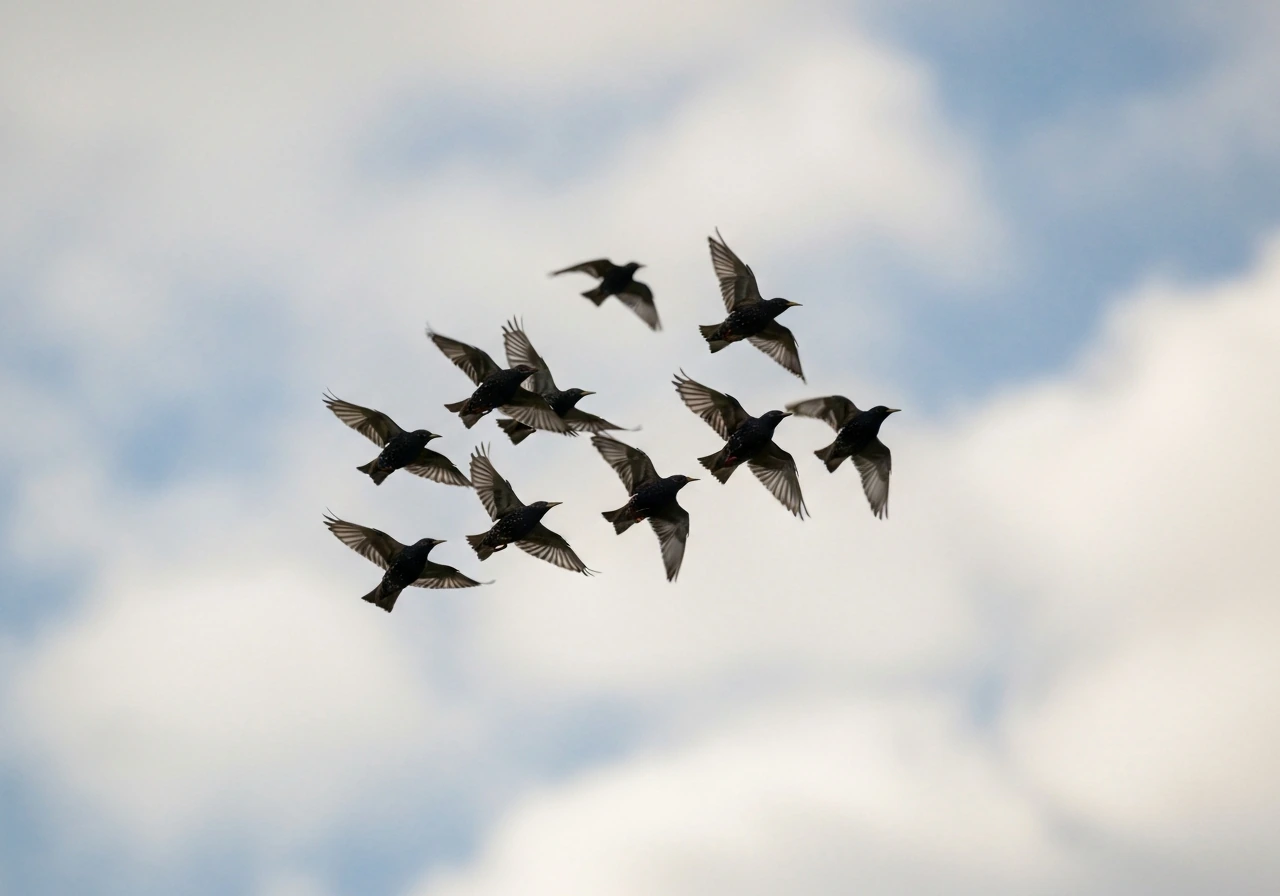
In the European-American spirit animal tradition, starlings are almost universally linked to a handful of core themes: community, the power of collective movement, using your voice, and riding the wave of change. The reason these themes stick is actually rooted in the bird's real behavior. Starlings are extraordinarily social. They form murmurations, those massive, swirling, synchronized flocks that move as one without any obvious leader calling the shots. A Nature news report based on research explains flocking and murmuration as imitation, where each bird adjusts its flight direction and speed to nearby birds, about a dozen of them How starlings check their own speed. When you watch a murmuration, it genuinely looks like thousands of birds sharing a single mind. Spiritually, that image gets translated into unity, coordinated communication, and moving toward a common direction, together.
Beyond the flock behavior, starlings are phenomenal vocal mimics. They can reproduce the songs of other birds, environmental sounds, and even human speech. That's why so many spiritual frameworks emphasize the "voice" theme specifically: starlings are literally masters of communication. If one shows up for you, the traditional interpretation is that something about how you're speaking, listening, or expressing yourself is being highlighted. It's not a warning, it's more of a pointed question: Are you saying what you actually mean? Are you listening to what's being said around you?
Starlings are also famously adaptive. They thrive in cities, suburbs, farmland, and forests. They nest in building cavities, vents, and just about any opening they can find. That resilience has made them a symbol of adaptability and resourcefulness in many modern spiritual frameworks. Think of it less as "this bird can handle anything" and more as a personal prompt: where in your life do you need to be more flexible right now?
What your specific encounter probably means
Not every starling sighting carries the same weight. One of the most useful things you can do is match your encounter type to the interpretive framework that fits it. Here's how to think about the most common scenarios.
Seeing a starling once vs. repeatedly
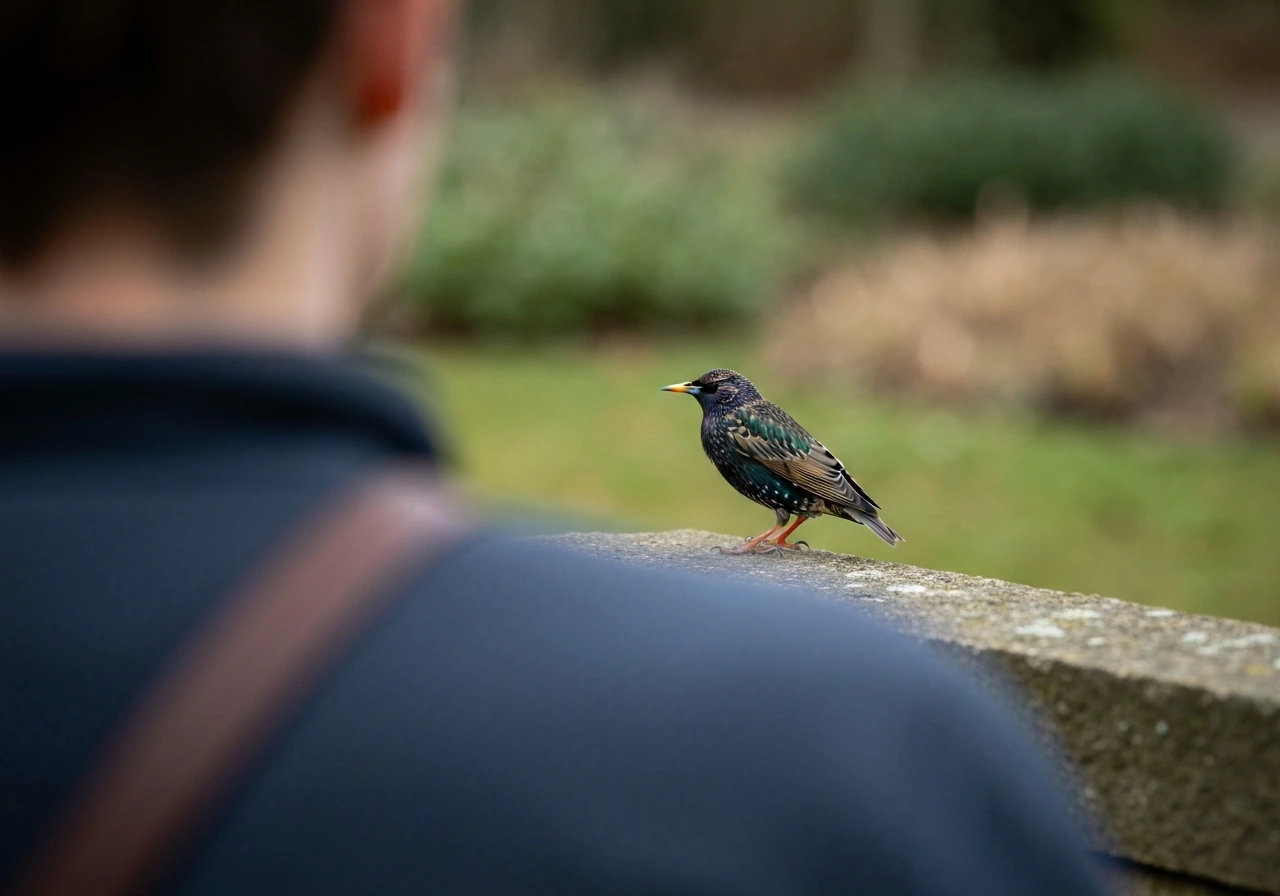
A single, unremarkable starling sighting is generally treated as a gentle nudge, a prompt to notice something rather than a full-on message. Starlings are common birds, and part of honest spiritual interpretation is acknowledging that context. But if you're seeing starlings repeatedly, in ways that feel pointed or timely, that's when most traditions say to pay real attention. Repeated sightings are typically framed as the universe leaning on the horn a little harder: the theme is continuing, and you might be ignoring it. If you've been brushing off something in your creative life, your relationships, or a decision you need to make, a string of starling appearances is a fair signal to stop brushing.
A starling landing near you or on you
When a wild bird makes intentional close contact, it tends to register emotionally as significant, and spiritually, it's treated that way too. A starling landing near you or, rarer still, on you is often interpreted as a personal, direct encounter rather than a general environmental sign. The community and communication themes get amplified here. Some practitioners read it as a message that you need to reach out, reconnect, or make yourself heard in a situation where you've been quiet. Others see it as reassurance that you're not as alone as you might feel. Pay attention to what you were thinking about in the moments before it landed.
A starling at the window
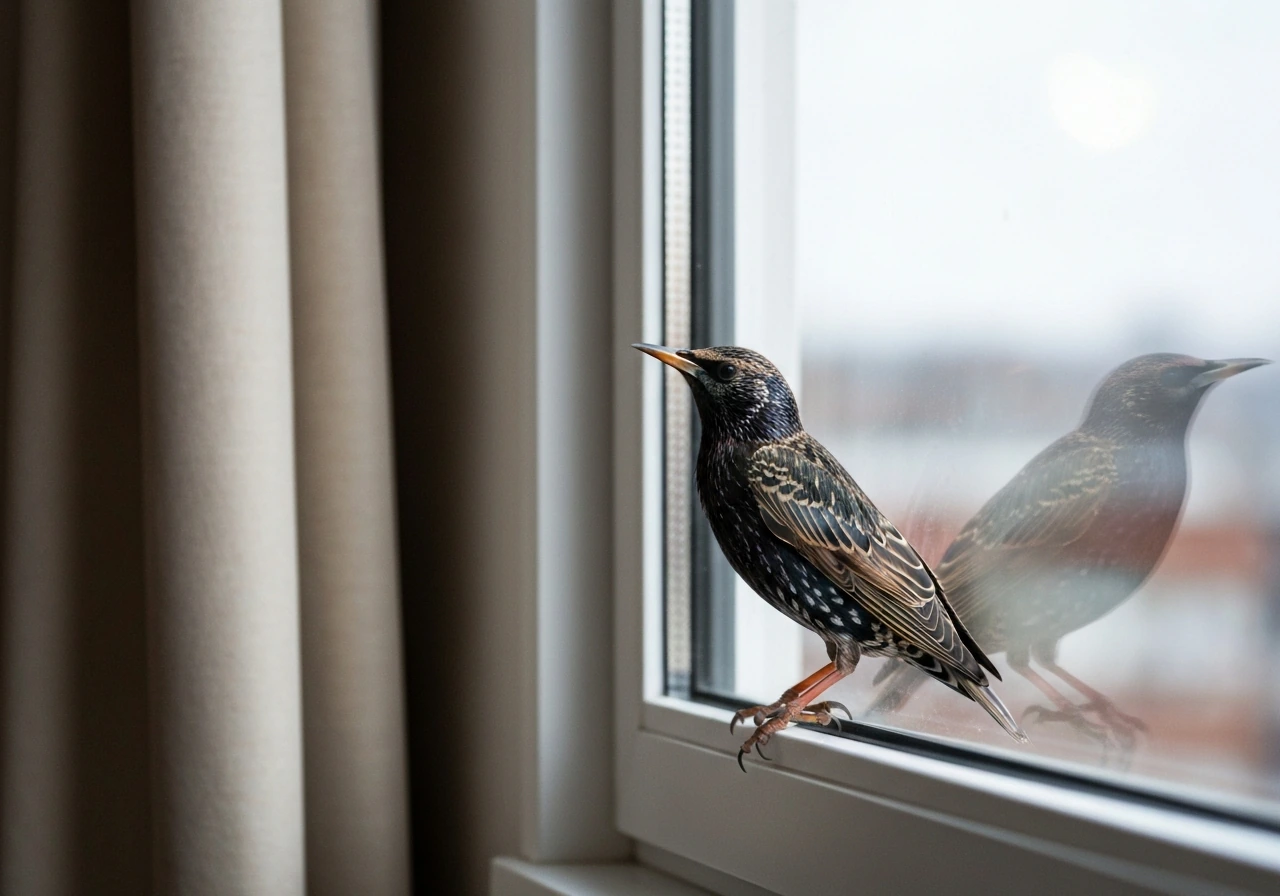
Window behavior gets special attention in almost every bird-symbolism tradition. A starling tapping at or repeatedly visiting a window is often interpreted as a boundary being crossed, or something trying to get through to you that you haven't been receiving. The spiritual reading is usually about communication: a message is waiting, and you may be missing it. It's worth knowing that from a natural history standpoint, starlings hit or visit windows because they see their own reflection and perceive it as a rival bird. That doesn't cancel the spiritual angle if that lens resonates with you, but it does add an interesting layer: are you fighting your own reflection? Are you blocking yourself from seeing something clearly?
Older folklore took window birds very seriously. Traditions across multiple cultures associated a bird at the window with incoming change, and in some cases, with news of death or transition. If you lean toward traditional or folkloric frameworks, it's worth knowing that history. That said, most modern spiritual guidance leans away from fear-based readings and toward the interpretation that window encounters signal important communication or a life threshold, not doom. If you're curious how this fits into broader bird superstitions around good luck, there's a lot of nuance worth exploring.
The four core starling themes, and what to actually do with them
Spiritual symbolism is only useful if it points you somewhere. Here are the four themes most consistently linked to starlings, each framed as something you can act on.
- Community: Starlings rarely travel alone, and their power is collective. If a starling has shown up for you, ask yourself honestly: have you been isolating? Pulling away from people who matter? The prompt here is practical: reach out to someone today. Send the message. Accept the invitation. Community is built in small acts, not grand gestures.
- Communication: This one is the starling's loudest message. Where are you holding back? Is there a conversation you've been avoiding, a creative project you haven't shared, a need you haven't voiced? The starling isn't asking you to be loud, it's asking you to be honest.
- Transformation: Starlings show up most often as symbols of change already in motion. You may not need to do anything to start the transformation. You may just need to stop resisting the one that's already happening.
- Adaptability: If you've been stuck in a fixed approach to a problem that isn't working, this is your signal to pivot. Starlings thrive by being resourceful and flexible. Where can you be more like that right now?
How to figure out what your starling encounter means for you
There's no universal decoder ring for spiritual encounters. The meaning of your starling sighting is shaped by the context you bring to it. Here's a simple decision framework you can work through right now.
- Check the timing. When exactly did the encounter happen? Were you in the middle of a difficult thought, a conversation, a decision, or a moment of stillness? Timing is often the most reliable clue. A starling appearing right as you were thinking about a relationship, a career move, or a communication breakdown is probably speaking to that.
- Check your emotions. What did you feel when you saw it? Curiosity? Warmth? Unease? Your gut reaction is data. Spiritual traditions across the board treat emotional resonance as the most trustworthy interpreter of signs.
- Check your life situation. What's the dominant theme in your life right now? If you've been struggling with isolation, the community message lands differently than if you've been meaning to have a hard conversation with someone. Map the starling's themes onto what's actually happening.
- Ask: is this a message or a signifier? There's a useful distinction between a one-time omen (something is happening right now) and a signifier of a recurring life theme (this keeps coming up because it's part of your ongoing work). Repeated sightings lean signifier. A single striking encounter leans message.
- Trust your intuition last, not first. Let the logical framework do its work first. Then sit quietly and ask what feels true. That inner knowing, after reflection, is usually more reliable than the first excited interpretation.
What to actually do after a starling encounter
The most grounding thing you can do after a significant encounter is write it down before you lose the details. Keep a dedicated journal for unusual encounters, repeating symbols, and moments that feel charged. Note the date, time of day, what you were doing beforehand, where the bird appeared, how it behaved, and what you felt. Patterns emerge over weeks that aren't visible in the moment, and having a record means you're not relying on faulty memory when you look back.
Some journaling prompts worth sitting with after a starling sighting:
- What was I thinking or feeling in the minutes before the encounter?
- Which of the four starling themes (community, communication, transformation, adaptability) feels most alive in my life right now?
- Is there a conversation I've been avoiding? What would happen if I had it?
- Am I resisting a change that's already underway?
- Who in my life have I been meaning to reconnect with?
Beyond journaling, take one small concrete action in the direction the encounter seems to be pointing. Don't wait for perfect clarity. If the communication theme hit you, send one overdue message. If the community theme resonated, make one plan. Spiritual encounters are most useful when they move you toward something, not when they become a puzzle you analyze indefinitely.
If your encounter left you feeling unsettled rather than curious, take a moment to ground yourself before interpreting further. The 5-4-3-2-1 technique, naming five things you can see, four you can touch, three you can hear, two you can smell, and one you can taste, is a reliable way to pull attention back to the present and out of an anxious spiral. Fear-based interpretations rarely lead anywhere useful, and most spiritual traditions actively caution against them.
Starling meanings across traditions, and when to follow your gut
It's worth being honest that starling symbolism is not a single, standardized system. The themes described above, community, communication, transformation, adaptability, come primarily from the modern Western spirit-animal tradition. Other frameworks read starlings differently.
| Tradition / Framework | Primary Starling Meaning | How to Use It |
|---|---|---|
| Modern spirit-animal / omen tradition | Community, voice, adaptability, transformation | Map themes to your current life situation |
| Folkloric / old European | Change coming, news approaching, threshold moment | Acknowledge the change, resist fear-based conclusions |
| Window / boundary symbolism | Communication blocked or incoming, something trying to reach you | Ask what message you've been missing or avoiding |
| Murmuration symbolism | Unity, collective direction, synchronized movement | Consider your role in a group or community dynamic |
| Black starling variant (modern spiritual) | Shadow work, intuition, inner wisdom, collective strength | Use as a prompt for introspection rather than external action |
If you're drawn to the black starling specifically, the symbolism tends to layer intuition and shadow work on top of the core starling themes. You can read more about that in this piece on black starling bird spiritual meaning, which covers how that color-energy overlay shifts the interpretation toward inner wisdom and collective strength.
For comparison, birds like the kestrel carry very different spiritual energy, focused more on focus, patience, and precision, which shows how much symbolism varies even between birds that share similar habitats. And delivery birds like the stork carry themes of new beginnings and arrivals, a contrast that illustrates how the bird's natural behavior always shapes its spiritual meaning. For a specifically hopeful framing, the white stork is a useful parallel: its bright coloring and association with new life shows how visual qualities layer onto a bird's core symbolism, the same way a black starling shifts the base starling meaning.
The honest guidance here is this: use established symbolic frameworks as a starting point, not a final answer. If a traditional interpretation doesn't resonate with what you felt in the moment, trust your gut. Personal intuition, when it comes after reflection rather than before it, is a legitimate interpretive tool. The most meaningful interpretation of your starling encounter is the one that moves you to reflect, act, or connect in a way that genuinely serves your life right now.
FAQ
What if I saw a starling but I do not feel any “spiritual” pull at all?
That can still be useful. Treat it as an environmental prompt only, then choose a practical check-in (for example, ask yourself whether you have been speaking honestly this week, or whether you have been isolating). If nothing in the encounter connects to your life, you can simply log it and move on, without forcing meaning.
How do I tell whether a starling sighting is a one-off nudge or something meant to repeat?
Look for pattern signals, not intensity. Repetition across different days, similar behavior (like calling or window visits), or the same theme showing up in your choices afterward are stronger indicators than one emotional moment. Your journal should make these patterns visible within about 2 to 4 weeks.
Does the spiritual meaning change if the starling is alone instead of part of a murmuration?
Yes, often. Alone sightings tend to be interpreted more as individual communication, self-expression, or personal adaptability, while murmuration energy leans more toward unity, group support, and synchronized direction. If you notice a solo starling lingering near your home, that usually points to what you are trying to “align” internally.
What should I do if a starling repeatedly taps at my window, but it stresses me out?
First, reduce the stress by grounding (5-4-3-2-1) and then handle the environment. Practical step, cover or reposition reflective surfaces near the window temporarily, and keep lights adjusted at night so the bird is less likely to mistake its reflection. Spiritually, you can still interpret it as a communication threshold, but avoid turning it into doom.
Is it a bad sign if the starling encounter felt like a warning?
Not necessarily. “Warning” language often reflects fear rather than guidance. A safer approach is to translate the feeling into an actionable question, such as, what conversation am I avoiding, or what boundary needs attention? If you feel fear that spikes your anxiety, pause interpretation and choose one grounding action before deciding what to do next.
How should I interpret starling vocal mimicry or sounds that seem “directed” at me?
Treat mimicry as heightened communication rather than literal prediction. Note whether the sound happened while you were listening to someone, thinking about what to say, or making a decision about self-expression. Then choose one concrete communication action, like drafting a message you have delayed or requesting clarity in a conversation.
What if I am trying to practice starling symbolism, but it conflicts with my belief system?
It is acceptable to keep symbolism as a self-reflection tool rather than a literal message. If the tradition interpretation does not fit your felt sense, prioritize what the encounter changes in your behavior, not the label. You can also switch frameworks or reduce meaning to a single theme you trust (for example, adaptability only) and ignore the rest.
Does the starling’s color matter for spiritual meaning in my case?
It can. Many people treat black starling symbolism as adding an intuition or shadow-work layer on top of the core themes. If you are not sure about color variation, focus on behavior first (murmuration, proximity, window visits), then decide whether the color aspect is worth adding based on what you actually noticed.
What practical action works best if I keep getting starling sightings during a relationship struggle?
Pick one relationship behavior that matches the “communication and community” themes. Examples include making a specific outreach attempt, asking one direct question instead of hinting, or choosing a support person you trust. Keep it small and time-bound (do it within 48 hours), so the encounter leads to action rather than rumination.
When should I seek help rather than rely on spiritual interpretation?
If the encounter triggers persistent distress, intrusive thoughts, or fear that affects sleep or functioning, treat it as a sign to step back from interpretation and seek support from a trusted professional. Spiritual frameworks should reduce confusion and help you act, not intensify panic.
Next Article
Hamerkop Bird Spiritual Meaning: Messages, Encounters, Guidance
Hamerkop bird spiritual meaning by encounter, covering intuition, boundaries, protection, love guidance, and a daily rit