
A kestrel encounter most often points toward one central message: it's time to sharpen your focus, trust what you already see clearly, and stop second-guessing yourself. Whether the bird hovered overhead, perched close and stared you down, or swooped past unexpectedly, the kestrel's core spiritual energy is about precision, vision, and the courage to act once you've spotted what you need. It doesn't guarantee luck or signal doom. It asks a more useful question: where in your life are you looking without really seeing?
Kestrel Bird Spiritual Meaning: How to Interpret an Encounter

Eliza Thornwick
18 May 2026
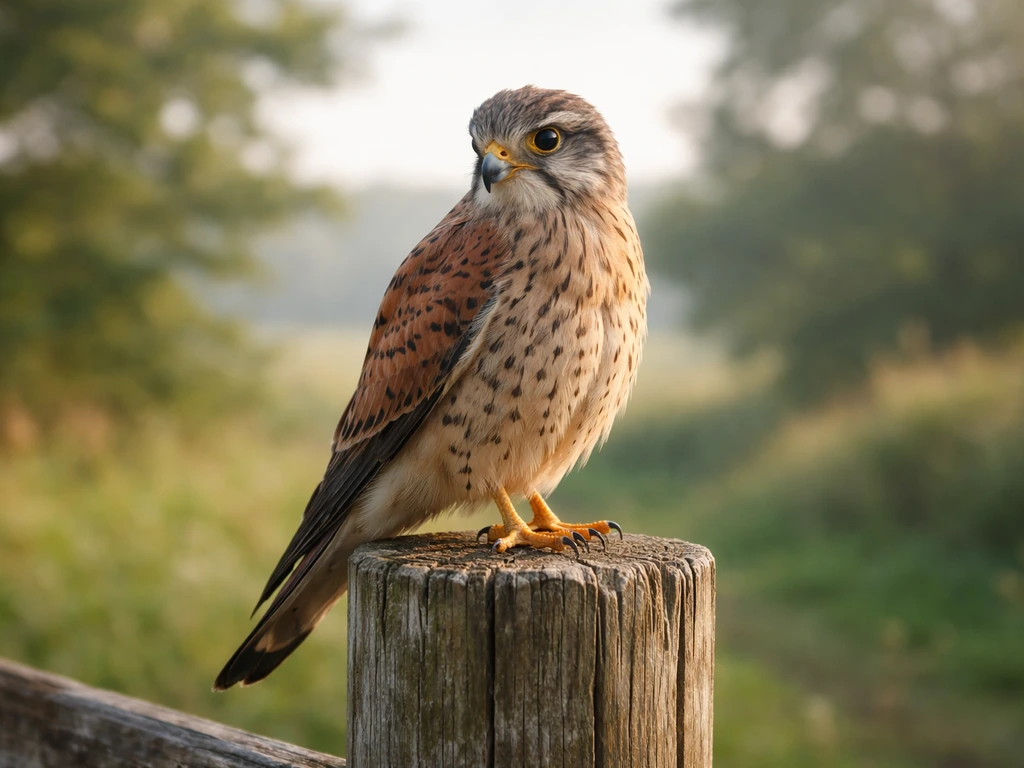
What a kestrel actually is and why people notice them
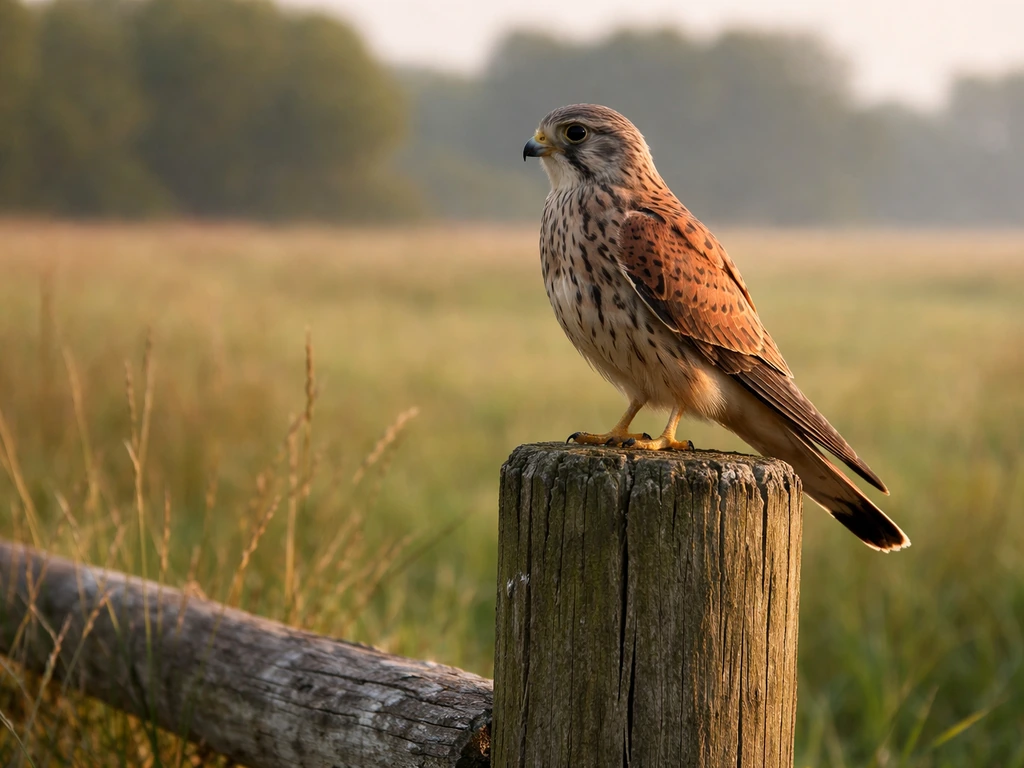
Kestrels are small birds of prey found across much of the world. In North America that's the American kestrel, the continent's smallest falcon, about the size of a robin but built like a little hawk. In the UK and Europe, the Common Kestrel is the one you'll see hovering over motorway verges and open fields. Both species share the same jaw-dropping behavior that makes them spiritually striking to observers: they hover. Not just a quick flutter, but a genuinely suspended, locked-in scan of the ground below, wings spread, tail fanned, head absolutely still while the body adjusts constantly to the wind. The Missouri Department of Conservation describes them as hunting "like miniature helicopters," which is exactly what they look like.
People most commonly notice kestrels in a handful of situations: perched on a roadside wire or fence post, hovering low over a field or parking lot, flying close over your head or car, landing somewhere unexpectedly near you, or appearing repeatedly over a period of days. Because the hovering looks so deliberate and the bird's gaze seems so focused, it's natural to feel like it's watching you specifically. That feeling is worth paying attention to, even if the bird is simply hunting grasshoppers below your feet.
Core spiritual meanings and symbols of the kestrel
Across multiple spiritual traditions and symbolic frameworks, a handful of themes come up again and again when people write about kestrel energy. These aren't rules, they're lenses. Take what resonates and leave what doesn't.
- Sharp vision and perception: The kestrel can literally see ultraviolet light, tracking the urine trails of small animals invisible to human eyes. Symbolically, this maps onto the ability to perceive what others miss, to cut through surface appearances and get to the real situation.
- Focus and precision: The kestrel's hover-hunting technique means holding position with total concentration while the world moves around it. Spiritually, this is about sustained attention, staying in your lane, and not being knocked off course by noise.
- Courage and fearlessness: Kestrels are small but fiercely independent. They don't hesitate once they've spotted prey. This energy is often read as a push toward decisive action after a period of hesitation.
- Timing and patience: A kestrel will hold its hover patiently until the moment is right, then strike with precision. The spiritual parallel is about knowing when to wait and when to move, not rushing or dragging your feet.
- Independence: Kestrels are solitary hunters, confident in their own instincts. An encounter can invite you to trust your own read of a situation rather than relying on others' opinions.
- Protection and guidance: Several spiritual sources frame the kestrel as a protective presence, especially when it appears before a new venture or journey.
- Adaptability: Kestrels hunt from perches when they're available and hover when there's no suitable spot. This flexibility, making the best of whatever conditions exist, is sometimes read as a reminder to stay resourceful.
The thread connecting most of these themes is seeing clearly and then acting decisively. If you've been avoiding a decision, circling around a truth, or waiting for a perfect moment that keeps not arriving, a kestrel encounter tends to feel pointed in retrospect. SpiritAnimals.org similarly frames kestrel symbolism around “wisdom, vision, vigilance, and protection,” describing the encounter as a prompt to see clearly and respond with fearless focus encounter tends to feel pointed in retrospect..
What different kestrel behaviors can mean spiritually
The behavior matters as much as the species. A kestrel perched calmly watching you carries a different energy from one that hovers directly overhead or swoops close and veers off. Here's a practical breakdown of common encounter types and how they're often interpreted.
Hovering above or near you
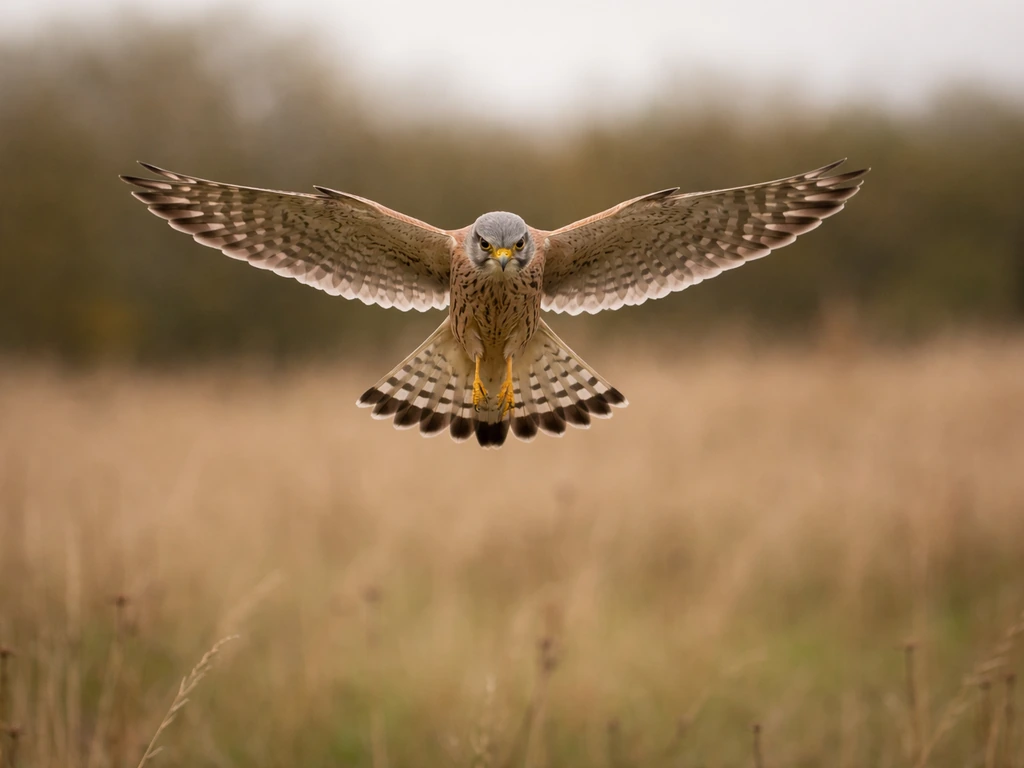
This is the kestrel's signature move, and it's the one people find most spiritually charged. When a kestrel holds position in the air, scanning, it can feel like surveillance in the best possible sense. Spiritually, hovering is often read as a call to pause before acting. The bird is showing you how to scan your situation from above before committing. If you've been rushing toward something or operating on autopilot, a hovering kestrel can be the universe's way of saying: stop, look at the full picture, then move.
Landing close to you or on you
A kestrel landing unexpectedly near you, on a fence right beside you, on your car, or in a rare instance, on your arm or shoulder, is treated by many spiritually attuned people as a strong and direct message. Landing implies arrival, completion of a journey toward you. This is often interpreted as a clear signal that the spiritual message is personal and immediate, not general. Pay attention to exactly what you were thinking or feeling at that moment. That mental or emotional state is likely the subject of the message.
Flying close or directly across your path
This is classical augury territory. Ancient cultures read a bird crossing your path as an omen, with the direction and behavior carrying meaning. A kestrel flying directly toward you and then veering off is often read as a wake-up call, something coming your way that you need to see clearly. If it flies left to right in front of you, traditional interpretations in some Western folklore see this as a positive crossing. Most importantly, note whether it felt urgent or serene, because that emotional impression is your first interpretive clue.
Hunting nearby (not paying you attention)
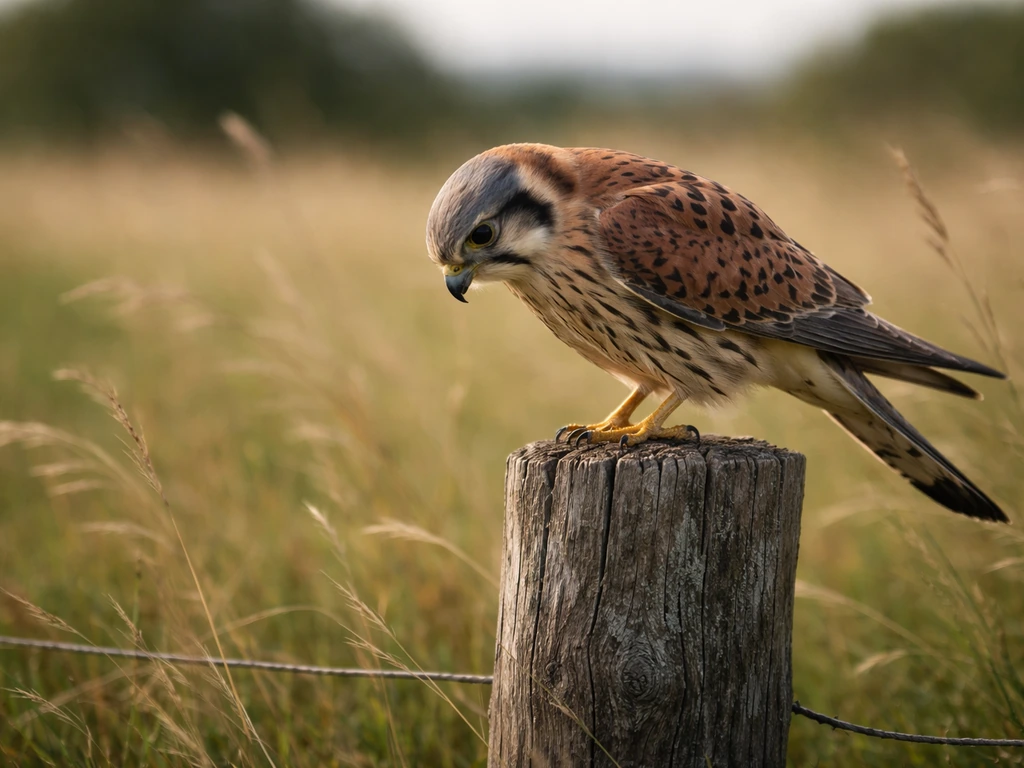
Sometimes the kestrel isn't watching you at all. It's just doing its thing nearby while you happen to be present. This can still carry meaning: you're being shown the energy of focus, patience, and precision in action, without being the target of it. Think of it as a demonstration rather than a message. The invitation is to watch how the bird works and ask yourself where you could apply that same quality of attention in your own life.
Repeated sightings over days or weeks
This is generally treated as the most significant pattern. One sighting can be coincidence. Two might catch your attention. Three or more in a short window, especially if the encounters feel distinct or emotionally charged, tends to be read as a sustained message that hasn't been received yet. Many practitioners suggest that repeated animal sightings are asking you to sit with the symbolism more deeply, because the initial meaning hasn't landed or hasn't been acted on.
Using kestrel energy in your daily life and inner work
Recognizing a symbolic encounter is only half the equation. The useful part is what you do with it. Here's a grounded, practical approach to working with kestrel energy once you've had an encounter.
- Pause before you analyze. Take a breath, settle your body, and name the emotion you felt in the moment of the encounter. Was it calm? Startled? Moved? That emotional charge is your most honest data point, and it comes before any interpretation.
- Ask the kestrel's core question: Where am I not seeing clearly right now? Apply this to relationships, work, creative projects, a decision you've been delaying. The kestrel doesn't bring vague wisdom, it brings focused attention. So focus.
- Set a precision intention. Not a wish list, one specific area of your life that needs sharper vision. Write it down in one sentence. The kestrel energy is about honing, not expanding.
- Practice the hover. Choose one situation in your life and commit to watching it without acting for a defined period: 24 hours, three days, a week. Take notes. Then decide. This is kestrel medicine in practice.
- Check for avoidance. Kestrels act once they see their target. If the encounter made you think of something you've been avoiding, that's not a coincidence. The message is probably there.
- Return to the encounter in a week. Write down what happened in your life in the days following the sighting. This retrospective view, looking back at what unfolded after the encounter, often clarifies the meaning more than any immediate interpretation.
Cultural and folklore perspectives on kestrels
Different traditions have developed their own relationships with the kestrel, and it's worth knowing these not to lock in a meaning but to give yourself more interpretive tools.
Celtic tradition
In Celtic belief, seeing a kestrel before setting out on a journey was considered a sign of protection for the road ahead. The kestrel was a watcher, a sentinel. This makes sense given the bird's hunting behavior: it literally surveys terrain before committing. If you're about to start something new, a kestrel appearance in Celtic-influenced spiritual thinking is generally considered a positive, protective sign.
Native American traditions
Several Native American traditions associate kestrel energy with sharp-wittedness, patience, stoicism, and hunting prowess. The kestrel's ability to wait, observe, and then act with precision maps onto qualities that many Indigenous frameworks admire as warrior virtues: not aggression, but the discipline to stay calm and clear-headed under pressure. It's worth noting that bird symbolism varies significantly across different tribal nations, so these associations are generalizations rather than universal teachings.
European folklore and augury
In ancient Europe, ornithomancy, reading omens from birds' behavior, was a serious practice. Augurs in Rome and Greece observed birds' flight paths, calls, and appearances to interpret portents before major events. The kestrel, known in parts of England as the "windhover," was associated with its almost supernatural ability to hang motionless in the air. This hovering was read as a liminal behavior, holding between two states, which gave it a reputation for insight into what's hidden or about to be revealed. Gerard Manley Hopkins wrote a famous poem about the kestrel titled "The Windhover" in 1877, associating it with mastery and the divine.
Spirit animal and totem frameworks
In modern spirit animal frameworks, the kestrel totem is consistently described as bringing qualities of focus, intuition, adaptability, and swift progress toward goals. As a spirit animal, the kestrel is often associated with guidance during periods of confusion, specifically the kind of confusion where you have all the information you need but haven't been willing to trust your own perception of it. If the kestrel is showing up as a recurring symbol in your life, dreams, or encounters, many practitioners would interpret it as an invitation to step into your own authority and stop waiting for external permission.
Is this a warning, a push, or a blessing?
One of the most common questions people have after a striking bird encounter is: was that good or bad? In many bird superstitions about good luck, specific species or sightings are treated as gentle signs that encourage optimism. The honest answer is that the kestrel's symbolism leans strongly positive, but context always matters. Here's a simple way to check your own intuition rather than outsourcing the answer to a book or website.
| How it felt | What it might suggest | How to work with it |
|---|---|---|
| Uplifting, expansive, calm | A blessing or confirmation — you're on the right track | Trust the direction you're heading. Set an intention around it and keep moving. |
| Startling but then peaceful | A push — you needed the wake-up call | Ask what you've been avoiding seeing. Then look directly at it. |
| Uneasy, tense, unsettled | A caution — slow down and scan before acting | Don't panic. Pause, observe your situation carefully, and wait for clarity before committing. |
| Neutral but attention-grabbing | An invitation to pay attention — the meaning will clarify shortly | Note the encounter, write down what you were thinking, and watch what unfolds over the next two to four weeks. |
A useful body-based approach from divination practice: rather than thinking your way to an interpretation, notice where you feel the encounter in your body. A yes-feeling tends to arrive as a warmth or expansion in the chest. A warning-feeling tends to arrive as a tightening in the stomach or a subtle resistance in the breath. That physical signal, before your logical mind jumps in to explain it, is often your clearest guide. One caution worth holding: as some mindfulness-oriented spiritual frameworks point out, a sign becomes charged mainly because it grabs our attention and we begin building a story around it. That's not a reason to dismiss it, but it is a reason to stay curious rather than certain. Let the meaning reveal itself through what unfolds in your life rather than forcing a conclusion in the moment.
It's also worth noting that kestrel encounters are generally not classified in the same heavy "warning" category as some other bird encounters. Unlike a bird tapping on your window repeatedly or a bird entering your home, a kestrel observed in the wild is typically read as a natural, invited encounter. The energy is more of a message from a peer than a disruption.
How to reflect on your kestrel encounter and what to do next
If you want to actually use this encounter rather than just file it away as interesting, here are some concrete next steps that work whether you're deeply spiritual, casually curious, or just open to the possibility that the natural world occasionally speaks.
Journaling prompts to use today

- What was I thinking about or feeling in the minutes before I noticed the kestrel?
- What area of my life feels unclear or blurry right now? Where am I not looking directly at something?
- Is there a decision I've been hovering around instead of making? What would it look like to commit to it?
- Where in my life am I waiting for a perfect moment when good-enough conditions already exist?
- What would it mean to trust my own vision of this situation, without needing someone else to confirm it?
Simple ritual-friendly ideas
You don't need to do anything elaborate. If ritual feels natural to you, try this: light a single candle, write down the one thing in your life that needs the sharpest clarity right now, and sit with it for a few minutes. You're not asking for an answer. You're just committing to look directly at the question without flinching. That's kestrel energy: not magic, just focused attention applied with courage. You might also spend a few minutes watching a kestrel video online or looking at photographs. Let the image of the bird hovering, still and purposeful, anchor the quality of attention you want to bring to the area of life you identified. Some people find it useful to carry a small image or drawing of a kestrel as a reminder during a period when they're actively working on clarity or a difficult decision.
Watch what happens next
One of the most practical pieces of advice in omen interpretation is this: write down the encounter, note what was on your mind, and then watch what unfolds over the next two to four weeks. Don't force a meaning now if it isn't obvious. The correlations often become clear in retrospect, and that retrospective clarity is actually more convincing than any interpretation you could make in the moment. If the kestrel was pointing at something real in your life, you'll likely know within a month. If nothing seems connected, that's useful information too, and the encounter can simply be appreciated for what it was: a beautiful, focused little bird doing exactly what it was built to do.
If you enjoy exploring bird symbolism more broadly, encounters with other birds like storks, starlings, and birds that behave unusually around humans carry their own distinct symbolic frameworks worth exploring. If you also feel drawn to a white stork bird spiritual meaning, noticing how you respond to that symbolism can add another layer to your reflection on the natural world’s messages storks. Some people also connect the black starling bird spiritual meaning to lessons about transformation, intuition, and aligning with your deeper instincts starlings. Some people also explore the stork bird spiritual meaning to compare themes of love, new beginnings, and protection with what kestrels point toward storks. If you're drawn to starlings too, the starling bird spiritual meaning can offer another layer of insight into how to interpret your own signs. Each species has its own texture and emphasis, and comparing them can help you sharpen your intuition for what resonates specifically with your own encounters.
FAQ
If I felt scared or unsettled by a kestrel, does that mean the spiritual meaning is negative?
Yes, but treat the feeling as data, not a verdict. If you felt fear, rush, or urgency, zoom in on what in your day needed clarity, not on whether the encounter is “bad.” A safer test is whether you can take one small decisive action afterward (a call, decision, or boundary), because that is where kestrel symbolism tends to land.
What if a kestrel seems like it’s just hunting, can it still have spiritual meaning?
Not necessarily. A kestrel may be hunting, especially near mowed grass, fields, parking lots, and road verges. A helpful distinction is timing and focus: if the bird repeatedly re-orients toward you or stays in place scanning while you are emotionally stuck, it’s more likely to function as a mirror for your inner state.
How do I interpret an encounter more precisely instead of giving it a generic meaning?
Use the most specific detail you noticed, not the broad fact of “a kestrel.” Write down whether it hovered, landed, crossed your path, or approached your car, then record what you were avoiding or second-guessing at that moment. The behavior type is often the “how,” and your emotional state is the “what.”
Does one kestrel sighting mean less than repeated sightings?
If you only saw one bird once, it may be a prompt rather than a mandate. Many people treat single sightings as a question to reflect on, while multiple sightings in a short window are read as a persistent invitation to act. A practical rule is: act on the smallest step that would reduce your uncertainty within 48 hours.
What should I do if a kestrel lands near me, on a fence, or even on my arm?
If it landed on you, keep it simple and check the safety details first. From a spiritual lens it can indicate a direct personal message, but physically, avoid startling the bird and give it space to move away. After it leaves, note what you were thinking or feeling most intensely, because that tends to be the most “on-target” interpretive clue.
Do traditional omen rules like direction of flight actually matter for a kestrel encounter?
Don’t rely solely on folklore direction rules. When people try to force left-to-right or other crossing interpretations, they often miss the most useful signal, which is your own felt resonance. If you want to use direction as a tool, pair it with body-based intuition (warmth versus tightening) and the situation you are in.
What if I keep trying to “solve” the message instead of taking action?
Yes, and it’s a common mistake. The article’s approach can become a loop if you keep waiting for “the perfect moment” to figure out the sign. Instead, treat the encounter as permission to decide now with incomplete information, then review results later to see what was true.
How can I apply kestrel spiritual meaning to relationships, work, or a major life decision?
If you feel the encounter is pointing toward a relationship or career shift, anchor it to a concrete next step you control (a conversation, application, negotiation, or boundary). If it points toward emotional clarity, anchor it to a release action (journaling, therapy appointment, apology, or ending a rumination cycle). The kestrel theme favors precision, so choose one specific target.
What should I do if I can’t find any connection between the kestrel encounter and my life?
If nothing in your life seems connected, that can still be meaningful. Treat it as a reminder to practice noticing, because the symbol is also about sharpened perception. A good “no connection” protocol is to give it 2 to 4 weeks of observation, then file it as a lesson in attention rather than a hidden prophecy.
Next Article
Bird Superstitions for Good Luck: Signs, Meanings, and What to Do
Interpret bird superstitions for good luck, with species-specific signs, what to do, and safety tips.