
If a yellow warbler crossed your path today, here is the short answer: this bird is widely understood as a messenger of joy, renewal, and authentic self-expression. It carries an energy that says something bright is possible right now, and your job is to figure out whether that message is a confirmation, an encouragement, or a gentle nudge toward something you have been putting off. The rest of this guide will help you do exactly that.
Yellow Warbler Bird Spiritual Meaning: What It Means and What to Do

Eliza Thornwick
20 Apr 2026
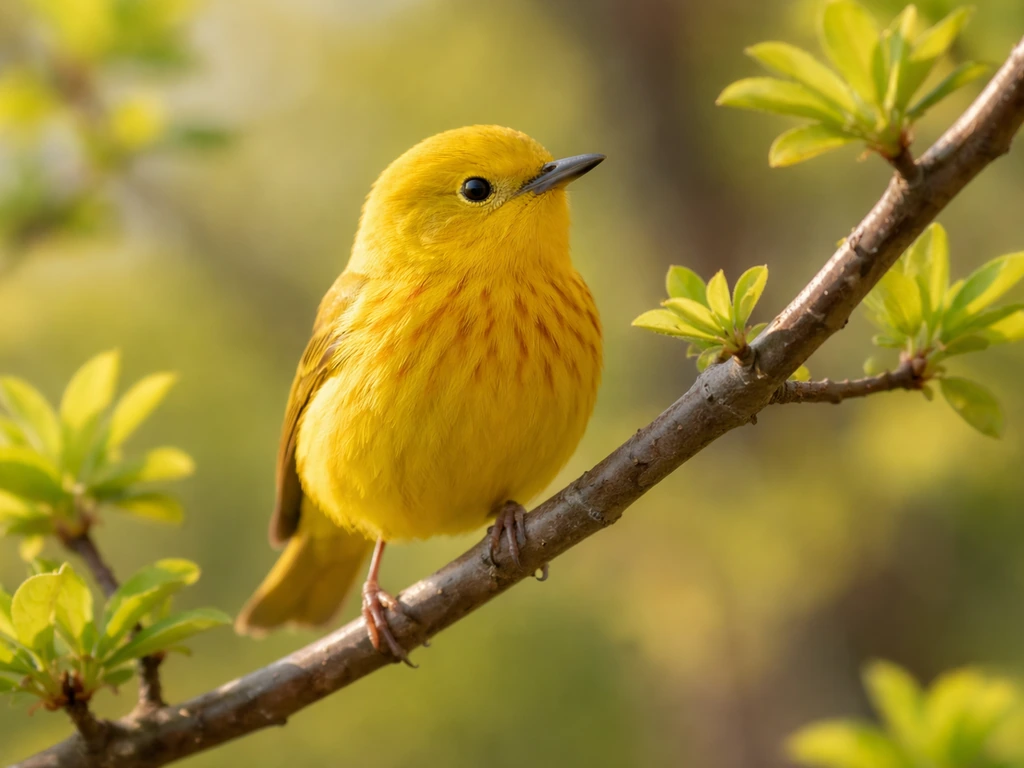
Yellow warbler energy at a glance
The yellow warbler is a small bird with an outsized spiritual reputation. Its intense, almost glowing yellow color connects it symbolically to solar energy, clarity, optimism, and the life force that pushes through after a long winter. This is not a shy or ambiguous bird; the male sings persistently near the tops of trees and shrubs, defending his territory through voice more than force. That behavior alone tells you something about the energy it represents: speak up, claim your space, and do it with brightness rather than aggression.
Across multiple spiritual and cultural traditions, yellow birds in general are associated with communication, happiness, and new beginnings. The yellow warbler, specifically, deepens those themes through its connection to spring migration and renewal. Cornell Lab data shows that by May, yellow warblers have traveled from wintering grounds in Central and South America to set up breeding territories across much of northern North America, arriving in streamside thickets and willow-lined wetlands right at the height of spring's energy. That seasonal rhythm makes the yellow warbler a natural symbol of timely arrival, right-place-right-moment energy, and the courage to begin.
In Navajo tradition, the yellow warbler is called Dahtoo' yinooghałi and appears in place-based narratives that tie specific birds to the land and to story. Some spiritual writers reference Native American connections between warblers and healing energy, though it is worth approaching those interpretations with personal discernment, since Indigenous traditions are varied and regionally specific. What most frameworks do agree on is that this bird signals something worth paying attention to, especially around themes of voice, light, and forward movement.
What your specific encounter actually means
Context is everything. A yellow warbler singing outside your window in May near a willow tree is behaving entirely normally, and that matters when you are trying to read a message. But a yellow warbler appearing on your back porch in an unusual place, at an unusual time, or in an unusually persistent way, that is worth sitting with. The first question to ask yourself is not what does this mean but rather what was I thinking or feeling when this happened? Spiritual encounters often arrive as punctuation marks on our own inner conversations.
Here is a practical framework for interpreting your exact encounter based on the circumstances around it.
| Encounter Type | Likely Spiritual Theme | Question to Ask Yourself |
|---|---|---|
| Saw it briefly while outdoors | General reminder of joy and possibility | Was I worried or stuck in my head before I saw it? |
| It lingered near you or seemed to watch you | Personal message, invitation to tune in | What area of my life needs more lightness right now? |
| Appeared during a difficult moment or decision | Encouragement or confirmation | Does this feel like a yes to something I have been considering? |
| Saw it repeatedly over days or weeks | Persistent guidance or an unaddressed theme | What am I consistently avoiding or delaying? |
| Appeared near your home unexpectedly | Message about home, family, or creative life | Is there something unspoken or unresolved close to home? |
| Appeared during grief or loss | Comfort, the presence of something loving nearby | Who or what might be trying to reassure me? |
It also helps to notice the bird's behavior, not just its presence. A yellow warbler singing loudly and clearly is a very different signal from one that appears quietly and still. Song-forward encounters tend to amplify the communication and expression themes; quiet, watchful appearances lean more toward reflection and inner guidance.
What specific behaviors are telling you
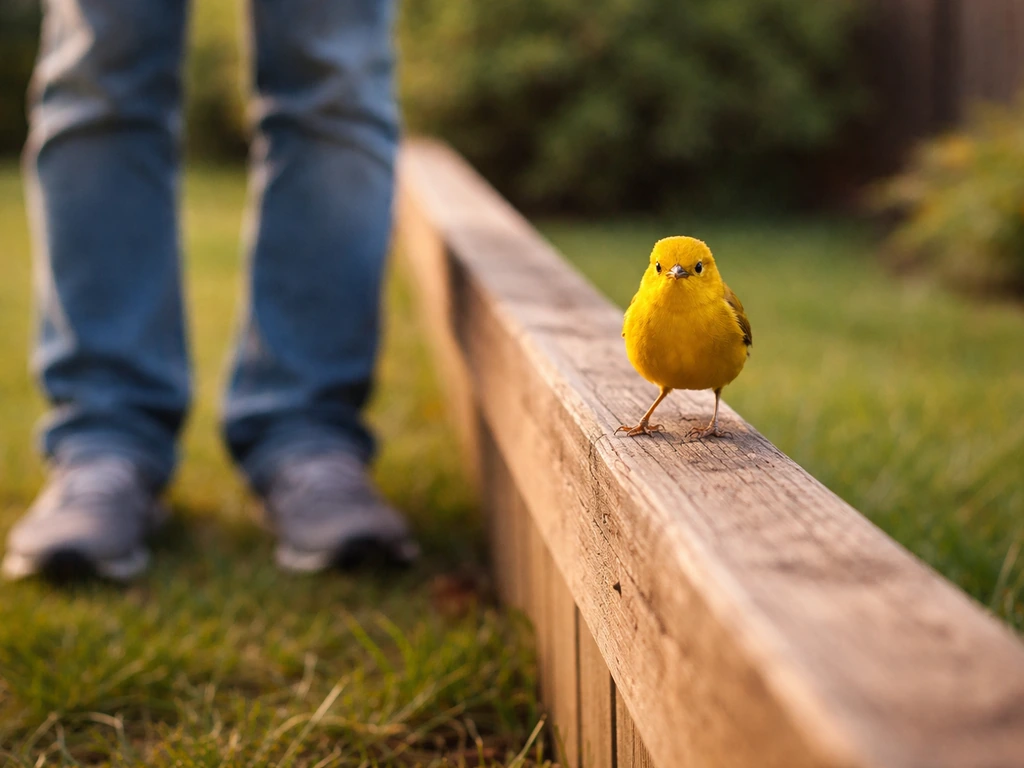
If it comes unusually close to you or seems to follow you
Yellow warblers are generally not bold around people, so if one lands near you, hops in your direction, or follows along a fence line while you walk, pay attention. In spiritual terms, this kind of direct approach is often interpreted as an urgent or personal message, something being communicated specifically to you rather than just through the environment. Many people report feeling a sudden clarity or calm in these moments, which is worth noting in a journal afterward. The themes here are usually around your voice, your joy, or something you are being called to begin or return to.
If it keeps tapping on your window
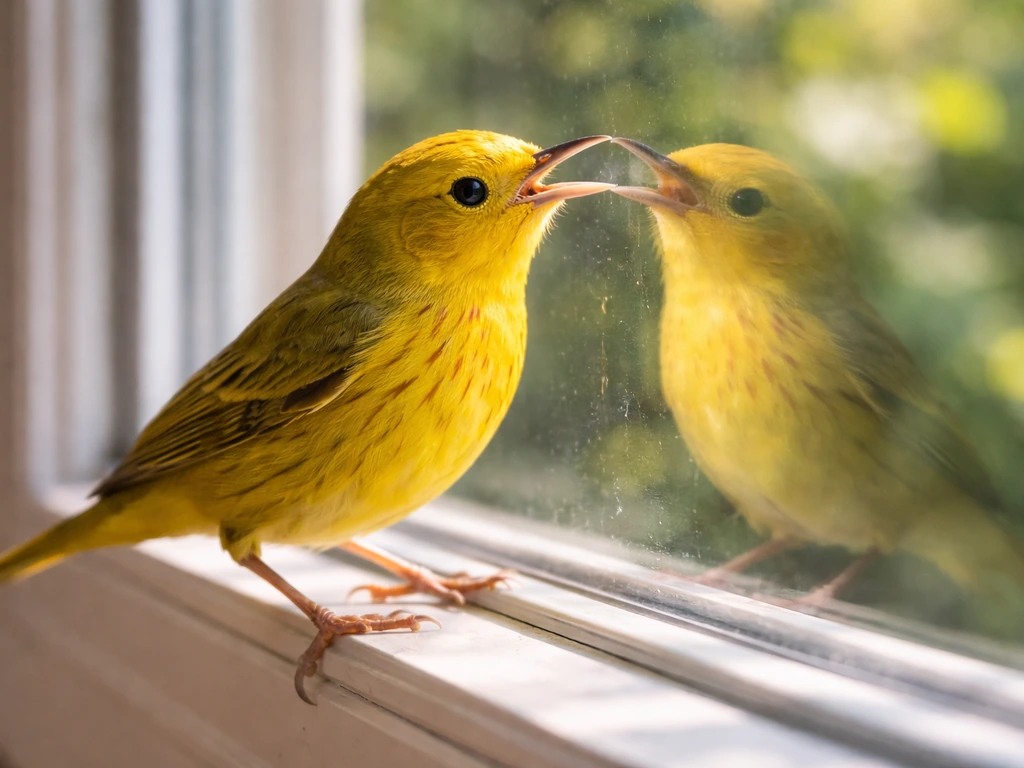
Window-tapping deserves a practical note first: during spring and fall migration (April through June and August through November), birds are at higher risk of window collisions because they confuse glass reflections for open space or are drawn toward indoor lights. A yellow warbler tapping at your window may simply be responding to its own reflection in the glass, especially if it is a territorial male defending against a perceived intruder. Experts at Clemson and Utah State University Extension recommend placing external window decals, closing blinds at night, and making glass more visible to reduce collision risk.
Spiritually, a bird tapping at a window has long been interpreted as a message trying to get your attention from the outside in. Some people also look at widow bird spiritual meaning, using signs and symbolism to guide how they respond inwardly a message trying to get your attention. Some traditions read it as news arriving, a threshold moment, or a prompt to look at what is being reflected back to you. If it is happening repeatedly and you have ruled out simple territorial behavior (or addressed the window reflection issue and the bird keeps coming back), the spiritual invitation is to ask: what am I not seeing clearly in my own life right now?
If it keeps appearing over and over
Repeated sightings amplify whatever message the first encounter carried. Think of it less as the universe shouting at you and more as a gentle tap on the shoulder that gets firmer if you keep ignoring it. It is worth noting, though, that if you are in yellow warbler habitat near streams or shrubby edges during May, repeated sightings may simply mean a male is defending nearby territory and you are walking through it. The spiritual and the natural can coexist without contradiction; both can be true at once. The question is whether the encounters feel personally resonant or just ecologically ordinary.
Timing, life themes, and personality connections
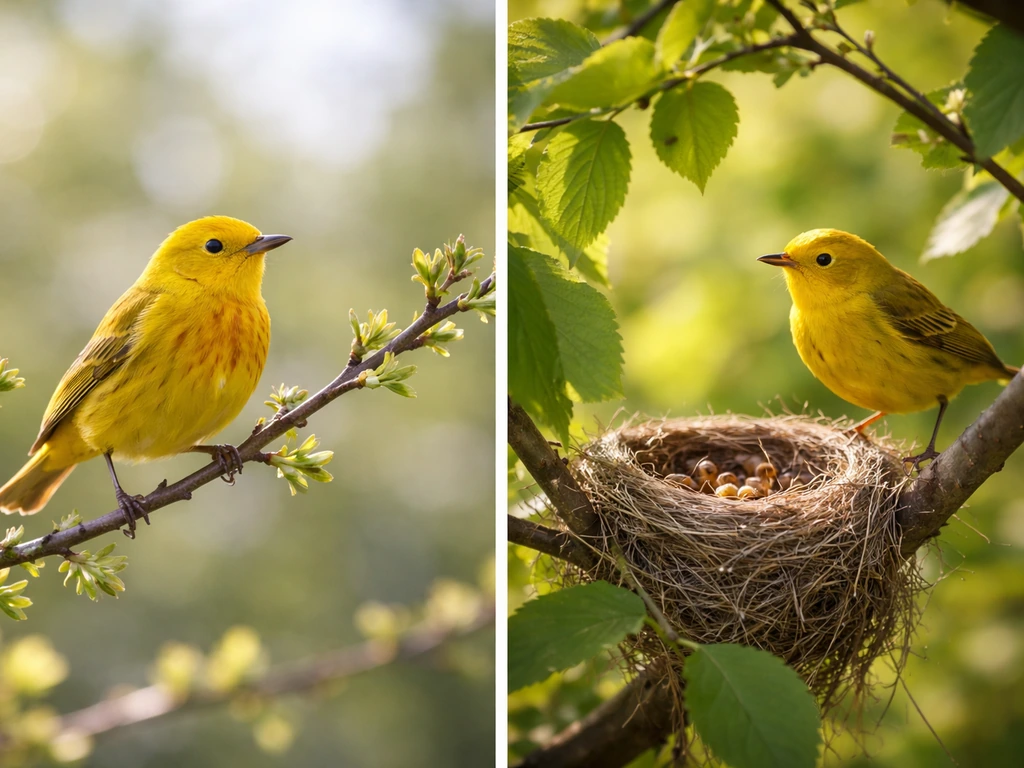
The yellow warbler's spiritual meaning shifts subtly depending on when it appears. Spring sightings, which align with the bird's actual migration and breeding season, carry the strongest new-beginning energy. If you see one in April or May, the message is almost always about starting something, claiming your voice, or stepping into a new chapter with confidence. The male yellow warbler arrives, claims his territory through song within days, and begins building a life there. That is a powerful behavioral parallel for anyone standing at a crossroads.
Summer sightings, when the bird is nesting and raising young, tend to carry messages around nurturing, creativity, and protecting what matters. The yellow warbler is a notably devoted parent; males bring food to females incubating eggs and to young chicks during the roughly 11-12 day incubation period and the 8-10 day nestling period that follows. If you are encountering this bird during the nesting season, the message may be about commitment, care, and showing up consistently for something you have already started.
Late summer and fall encounters, tied to the bird's southward migration, carry a different tone: completion, releasing what is done, and trusting the journey ahead. This is also when the themes of resilience surface. The yellow warbler's response to cowbird nest parasitism is remarkable: rather than abandoning a compromised nest, the bird often builds a new layer directly over the problem and starts again. Smithsonian researchers have documented this behavior, and it is a striking symbol of resourceful perseverance, not erasing hardship, but building something new right on top of it.
In terms of personality themes, people who feel strongly drawn to yellow warbler energy or experience it as a spirit guide often share traits like creative expressiveness, a drive toward authenticity, sensitivity to joy and beauty, and a tendency to feel drained when they are not speaking their truth. If any of that resonates, the yellow warbler may be less of a one-time message and more of a consistent thread in your spiritual life.
When the message feels heavy: warnings, fear, and loss
Not every encounter with a yellow warbler is a bright, cheerful sign, and it is worth being honest about that. If the bird appears injured, dead, or distressed, the emotional weight you feel in that moment is real and worth acknowledging spiritually, even as you respond practically.
Finding a dead yellow warbler is difficult, especially if you were already in a tender emotional space. Across many traditions, a dead bird near the home is seen as a sign of transition, the ending of one phase to make way for another. It does not mean something terrible is coming; it more often signals that something is completing, a relationship, a chapter, a version of yourself. The grief you feel at the sight of it may itself be the message, pointing you toward something you have not fully mourned or released.
If you find a dead bird, please handle the practical side first. The CDC advises avoiding direct contact with dead wild birds due to avian influenza concerns, and recommends using gloves and a mask if you must handle or dispose of the bird. Do not bring it inside. Illinois Department of Public Health guidance echoes this, recommending protective equipment including eye protection when dealing with dead wild birds in the current H5N1 climate. Dispose of it properly, wash your hands thoroughly, and then give yourself space to sit with whatever comes up emotionally.
An injured yellow warbler by your window requires a different, more immediate response. Do not try to handle, feed, or rehabilitate it yourself. Tufts Wildlife Clinic advises that if you must secure a stunned bird, you can gently cover it with a light towel in a box, keeping the area dark and quiet, and then contact a licensed wildlife rehabilitator immediately. The U.S. Fish and Wildlife Service notes that taking in a wild bird without proper authorization is illegal, and well-meaning handling often causes more harm than good. Find your nearest rehab center, make the call, and let the professionals take it from there.
Spiritually, an injured bird by a window can represent a message that tried to reach you but got blocked, something like a communication, a feeling, or an intuition that you have been deflecting or ignoring. The invitation is to ask what you have been unwilling to look at, and then look at it.
What to actually do with the message: journaling, rituals, and real-world steps

Reading about spiritual meaning is one thing. Translating it into your actual life is where it gets useful. Here are practical steps you can take today, right after your encounter.
Journal it while it is fresh
Sit down and write for ten minutes without editing. Start with: where was I, what was I doing, and what was I thinking before the encounter? Then describe the bird, what it did, how long it stayed, and how you felt in your body while watching it. Finally, write one sentence that starts with: if this moment was a message, it would say. Do not overthink that sentence. Your first instinct is usually the honest one.
Questions to sit with in meditation or prayer
- Where in my life am I holding back my voice, my brightness, or my full self-expression?
- Is there a relationship where communication has gone quiet that needs tending?
- What am I being called to begin, protect, or release right now?
- Is there joy available to me that I am not letting myself feel?
- What would it look like to claim my space the way a yellow warbler claims its territory, through song rather than silence?
Real-world actions aligned with yellow warbler symbolism
- Reach out to someone you have been meaning to contact: yellow warbler energy is strongly tied to opening communication and repairing connections.
- Begin something you have been delaying: even a small first step aligns with the bird's arrive-and-claim energy.
- Spend time near water or in nature, especially near streams or wooded edges, where this bird actually lives; sometimes the spiritual message is reinforced simply by being in its habitat.
- Write a letter you do not send: if there is something unsaid in a key relationship, get it onto paper first.
- Do something that brings you uncomplicated joy today: this bird is a solar symbol, and sometimes the most spiritually aligned action is simply to let yourself feel good.
How to confirm your interpretation and what to do if it keeps happening
There is no universal decoder ring for bird symbolism, and anyone who tells you otherwise is oversimplifying. What you can do is test your interpretation against your life. If the message you received felt like an encouragement to speak up, and you speak up in the following week and it goes well, that is meaningful feedback. If it felt like a timing cue to start a new project and you act on it and things begin to flow, that is confirmation in the most practical sense. Your lived experience is the best validation tool you have.
If the encounters keep repeating, the most grounded thing to do is keep tracking them. Note the date, time, what you were doing, your emotional state, and the bird's behavior each time. After three or four entries, look for the pattern. Is it always appearing when you are anxious? When you are making a decision? When you are near a particular person? The pattern will tell you more than any single sighting.
It is also worth grounding yourself in a healthy skepticism about frequency. One spirituality and nature education resource points out that the number of times you see a bird does not automatically scale up the spiritual urgency of the message. Sometimes you are just in the bird's habitat. Sometimes you are now noticing something that was always there. What matters is whether the encounter feels resonant and whether acting on the message you receive brings you clarity, connection, or growth.
If you are drawn to exploring related bird symbolism, the broader warbler family carries overlapping themes of song, voice, and seasonal guidance. White birds tend to carry messages around purity, peace, and spiritual presence, while birds like the whippoorwill lean toward night, mystery, and transitions between states. Each species adds its own texture, but the yellow warbler's particular gift is its brightness and its insistence on being heard, a quality worth borrowing, whatever is happening in your life right now.
The bottom line: trust your first instinct about what the encounter meant for you, write it down, and do one small thing in the direction it pointed. That is how a spiritual moment becomes useful, not by analyzing it until it loses its power, but by letting it move you forward even a little.
FAQ
What if I do not feel positive when I see a yellow warbler, does that ruin the message?
If you do not feel joy when you notice the bird, do not force a “happy” reading. In that case, shift the focus from the color symbolism to your felt experience (tone of the song, your body sensations, the thoughts that rose). An “off” emotional response can still be meaningful, especially if it matches something you have been avoiding rather than something you need to celebrate.
How can I tell whether the yellow warbler is a personal sign or just normal bird behavior?
A good way to differentiate “spiritual nudge” from ordinary behavior is to compare the bird’s pattern to its context. In May near streamside thickets, persistent singing often indicates a defending male. A potentially more personal encounter is when the bird’s behavior stays unusually targeted (repeatedly circling your immediate space, landing very near you, or returning across days in different locations) after you have ruled out window reflections.
Can the spiritual meaning be about timing, not just overall themes?
Yes. If the bird repeatedly appears while you are in the middle of a communication task, decision, or creative work, treat that as “timing amplification.” Then choose a single small action tied to voice, such as drafting the message you have been delaying, speaking up in one meeting, or setting a boundary. If you act and nothing shifts at all after several weeks, downgrade the urgency and revisit the context notes.
If the sign is about voice, what does that look like in real life without causing drama?
When a yellow warbler shows up after you have been silencing yourself, the “speak up” theme often lands as gentle courage rather than confrontation. Try actions that increase authentic expression without escalating conflict, for example, using “I” statements, asking one clarifying question, or sharing your true preference privately before you share it publicly.
Should I interpret a yellow warbler tapping a window spiritually, or first assume it is reflection or migration behavior?
If it is a window incident, address the practical cause first: use external decals, reduce nighttime indoor light near the glass, and close blinds at night during migration season. Then re-check whether the bird keeps returning for more than a day or two after the changes. Only after that should you treat it as a clearer “attention from the outside in” prompt.
What should I do in the moment if the bird approaches me while I am walking or doing something daily?
If the bird lands near you while you are walking, the most useful question is “What am I carrying right now that needs expression?” Then pick a one-step response you can do immediately, like journaling one sentence, making a quick phone call, or taking a creative micro-action (song, sketch, draft). If you cannot act for safety or practicality, note the impulse anyway and schedule the action for within 48 hours.
Does the meaning change if I see one during nesting season, when it is busy raising young?
When a yellow warbler appears in summer, it can map to nurturing themes, but that does not have to mean taking on more responsibilities. The aligned action is usually “consistent care for what already matters,” such as checking in with a person, supporting a project you have started, or simplifying routines so you can sustain your energy.
How should I respond spiritually and practically if I find a dead yellow warbler near home?
When you find a dead bird, your safest next step is practical and protective, do not bring it inside, avoid direct contact, and use proper protection if handling or disposal is required. Spiritually, treat the event as a prompt to notice what is finishing or what grief you have not let move, then do a small closure action (write a goodbye letter, release an item, or schedule a conversation) when you feel ready.
What if the yellow warbler looks injured near my window, can I help it myself?
An injured bird is not a “sign you should decode by handling it.” The priority is contacting a licensed wildlife rehabilitator. If you need to secure a stunned bird temporarily, keep the environment dark and quiet in a box with minimal handling, and avoid feeding or giving water. Spiritually, you can still reflect on the “blocked communication” theme after the safety steps are done.
If I keep seeing the yellow warbler, how do I avoid turning it into overthinking or anxiety?
Repeated sightings can be ecologically ordinary. To reduce over-meaning, track your encounters for a short window, then test for usefulness: did acting on the interpretation lead to clearer decisions, better conversations, or measurable progress? If not, update your reading toward general presence (renewal, noticing, openness) rather than a specific urgent message.
I do not like journaling, is there a quick way to interpret the encounter responsibly?
If you do not want to journal, you can use a “3-2-1” check. 3 facts (where you were, what it did, when), 2 feelings (what you noticed in your body, what thought arrived), 1 action (one small step related to the theme of voice, joy, or beginning). Doing this once is enough, repeat only if it feels clarifying.
Next Article
White Bird Spiritual Meaning: What It May Mean and Do Next
Discover white bird spiritual meaning, including flying vs appearing, plus steps to reflect, journal, and seek confirmat