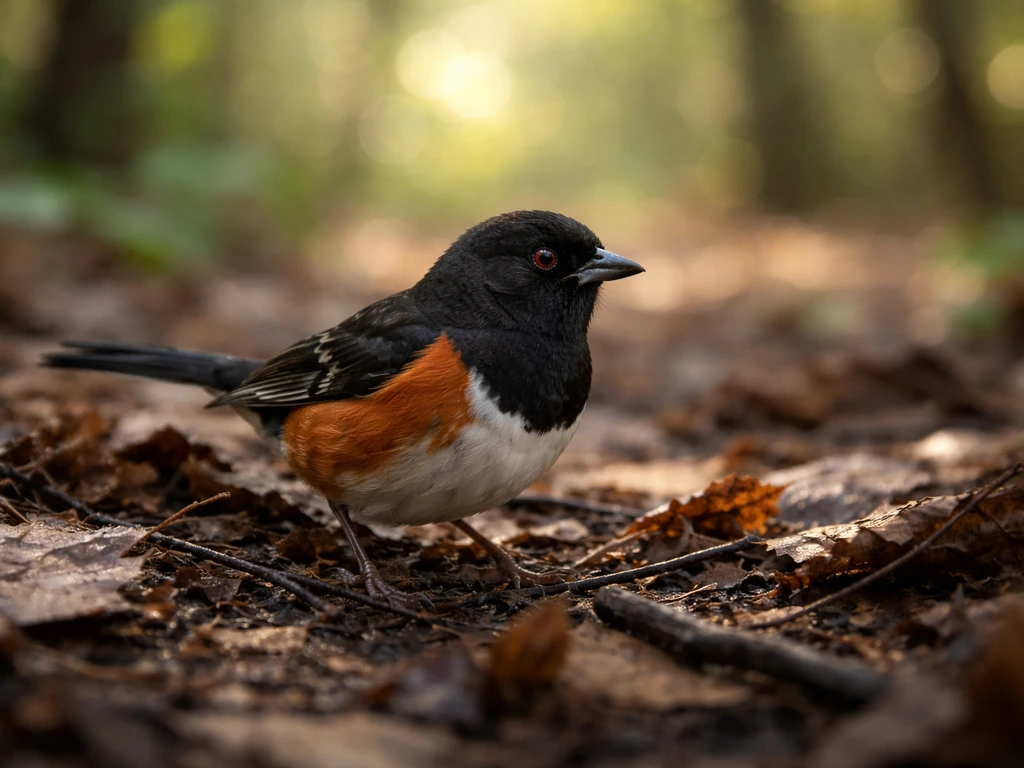
When a tui appears in your life, the most likely spiritual message is about your voice, your communication, and your connection to something larger than yourself. If you are researching tauhou bird spiritual meaning, use the same reflective approach: notice what you feel invited to say or listen to spiritual message.
Tui Bird Spiritual Meaning: Messages, Omens, and What to Do

Eliza Thornwick
13 May 2026

Whether it landed near you, sang outside your window, or kept showing up in your garden, the tui is widely understood as a messenger bird: one that carries meaning between worlds, between people, and between the part of you that speaks and the part of you that has been staying quiet. That said, spiritual meaning is always personal. The tui gives you a prompt, not a verdict. What you do with that prompt is the whole point.
What exactly is a tui (and why it matters for interpretation)

The tūī (Prosthemadera novaeseelandiae) is a native New Zealand bird and the largest honeyeater in the country. From a distance it can look entirely black, but in good light it reveals striking iridescent blue, green, and bronze feathers, plus a pair of distinctive white throat tufts called poi. It makes a mechanical whirring sound in flight from its wing feathers alone, and its song is complex enough that people sometimes confuse it with the bellbird. One of its most remarkable qualities: tūī can mimic human speech. Māori trained them to do exactly that, which gives you a sense of just how deep this bird's association with voice and language runs.
Tūī live all over New Zealand, including towns and cities, so running into one is far more common than encountering a rare or elusive bird. They are feisty, territorial, and will aggressively defend a flowering tree from every other bird around. If one showed up near your home, garden, or feeder, it was almost certainly there because the environment attracted it, not because it was lost. Knowing this matters for spiritual interpretation: a tui visiting your space is a deliberate, confident presence, not an accident.
If you are outside New Zealand and wondering whether this applies to you, it still can. Many people encounter tūī at wildlife sanctuaries, on travel, or through imagery and dreams. The symbolism travels with the bird. But for those in Aotearoa New Zealand, the tui is part of the everyday landscape in a way that makes its spiritual resonance particularly personal and culturally specific.
The core spiritual meaning of the tui
At its heart, tui symbolism orbits around voice, communication, divine messaging, and authentic self-expression. This is a bird that literally learned to speak human words. Spiritually, that points to something significant: the tui is asking whether you are saying what needs to be said, and whether you are listening to the messages already coming your way. Titmouse bird spiritual meaning is often interpreted through similar themes of communication, guidance, and what you may be ready to notice and act on Spiritually.
Beyond voice, the tui carries themes of joy and playfulness. Watch one at a flax flower and you will see a bird that seems to delight in its own existence, diving and swooping, singing complex songs that mix whistles, clicks, grunts, and growls into something genuinely musical. Spiritually, this translates to a reminder not to take life so seriously that you forget the pleasure of being alive and expressive. The spiritual meaning of a tui bird in New Zealand often centers on inner guidance that encourages joy, expression, and mindful listening Spiritually, this translates.
The tui is also linked to guidance and spiritual bridging. In many traditions, birds that move between the forest and the human world are seen as carriers of messages from ancestors, the divine, or the subconscious. The tui sits comfortably in both the deep bush and the suburban garden, making it a natural symbol of that in-between space where inner life and outer life meet.
- Voice and authentic expression: say what is true for you
- Communication: a message may be coming, or needs to go
- Joy and presence: delight in where you are right now
- Guidance: trust what you are being pointed toward
- Spiritual bridging: connection between this world and something beyond
- Confidence and boldness: the tui does not hide or shrink
What the tui's behavior tells you spiritually
How a tui appears matters just as much as that it appeared. Different behaviors carry different emphases, and paying close attention to what the bird was actually doing gives your interpretation much more precision.
A tui lands near you or on you
This is rare and striking, and spiritually it tends to be read as direct contact. The tui chose your proximity deliberately. Most interpretations point to a personal message: something that has been on your mind or in your heart is asking for attention right now. It can also signal that guidance is close, perhaps from an ancestor, a spiritual source, or your own deeper knowing. Sit with what was on your mind in the moments before the bird landed.
A tui sings loudly or repeatedly near you
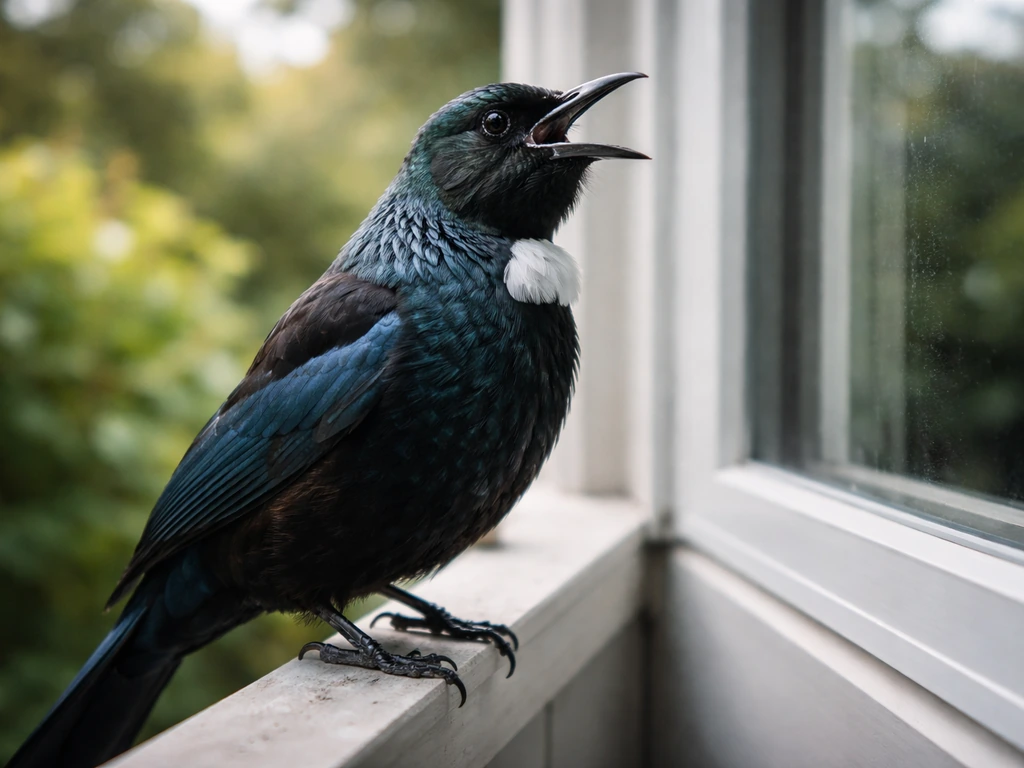
The tui's song is extraordinarily complex. When one sings persistently near you, the spiritual read is almost always about voice and listening. Either you need to speak something out loud that you have been keeping inside, or you are being invited to truly hear what is already being said to you, whether by a person in your life, your own intuition, or something you consider divine. The repetition matters: if it keeps singing, the message has not been received yet.
A tui taps or hits your window
Before going spiritual on this one, it helps to know the practical reality: tūī are territorial birds, and reflective windows look like other birds to them. Research from the USGS confirms that birds often strike windows because they see their own reflection and interpret it as an intruder. This is especially true for a species as aggressive and territorial as the tui. So a tui tapping or hitting your window is very often a tui picking a fight with itself.
That said, spiritually the symbolism is still worth sitting with. A window tap is often interpreted as a message trying to get through, a knock asking you to look more closely at something in your own life. The spiritual prompt here is: what are you not seeing clearly?
A tui keeps visiting your garden or property
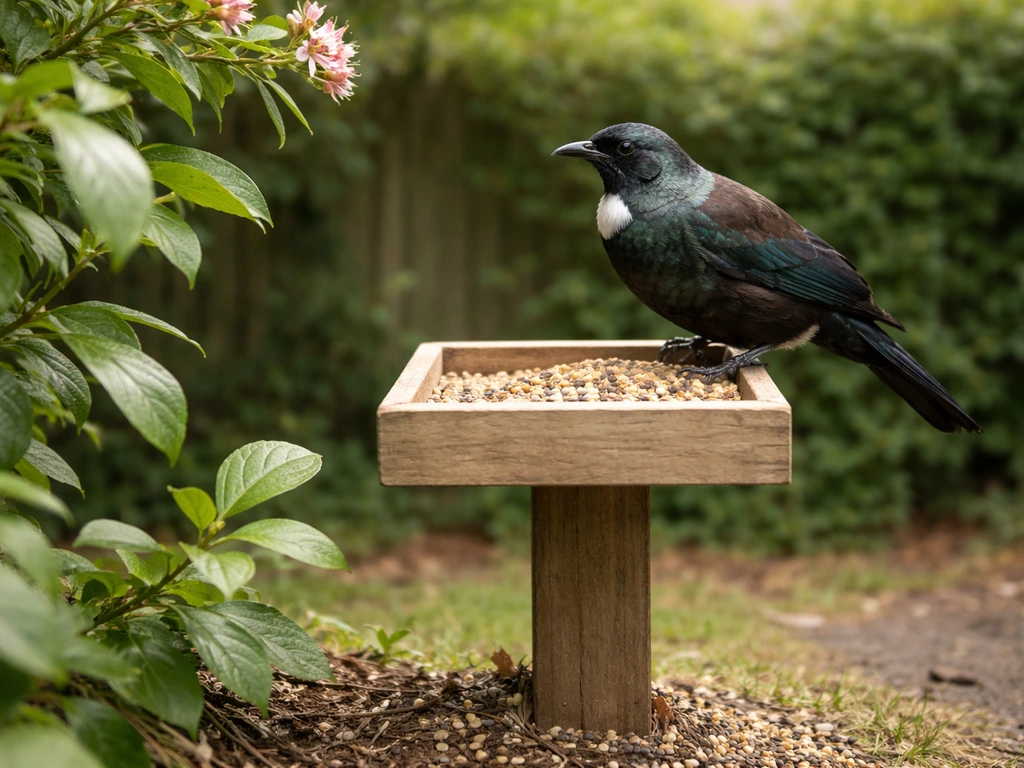
Repeated visits over days or weeks suggest the tui is either drawn to something physical (a flowering tree, a feeder, a water source) or, spiritually, is showing up as a persistent messenger. Ask yourself what theme has also been repeating in your life during this period. Recurring encounters tend to amplify the core message: something needs your attention and is not going away.
A tui appears during a significant moment
If a tui appeared right as you made a decision, received news, finished a difficult conversation, or sat with a question, many people interpret this as confirmation or acknowledgment. The timing feels meaningful because it is meaningful to you. That personal resonance is the whole mechanism of sign interpretation: the encounter lands differently because it lands at a specific moment.
Tui meaning in love, home, work, and life transitions
| Life area | What the tui may be pointing to |
|---|---|
| Love and relationships | Honest communication is needed; say what you feel; listen more carefully to a partner or potential partner; joy is available if you open up |
| Home and family | Your home environment is being blessed or protected; an ancestor or loved one may be visiting; tend to the connections under your roof |
| Work and purpose | You are being encouraged to speak up, share your ideas, or pursue creative expression; boldness is rewarded right now |
| Grief and endings | In Māori tradition, birds often carry the presence of those who have passed; a tui appearing during grief can feel like a visit from someone you have lost |
| Major transitions and new beginnings | The tui signals that you are being guided through the change; trust your inner voice and move with confidence, not hesitation |
In the context of grief especially, the tui carries a particularly tender meaning in Aotearoa. Many New Zealanders report tui appearances shortly after losing a loved one and interpret them as a form of visitation or reassurance. This is not superstition so much as a deeply human practice of finding connection across the gap between living and dying. Whether or not you share that belief, the encounter tends to bring comfort, and comfort during grief is its own kind of gift.
When a tui encounter feels ominous: reversed signs and common myths
Some people feel unsettled by a tui encounter, particularly if the bird struck a window hard, appeared during a difficult moment, or behaved aggressively. It is worth being honest about this rather than just defaulting to positive spin.
Te Ara notes that in Māori tradition, bird calls and arrivals were sometimes interpreted as signals of good or bad luck, and that these interpretations varied by species and circumstance. There is no single, universal Māori teaching that says the tui specifically signals danger or death. Claims like that tend to be oversimplified or misattributed. What Māori traditions do reflect is a sophisticated relationship with birds as communicators, and that communication could carry many kinds of messages, not just pleasant ones.
If an encounter felt negative or unsettling to you, the spiritual invitation is to ask why. Was the bird injured? That can prompt reflection on vulnerability or the need to rest. Did it fly aggressively at the window? That territorial behavior is ecologically normal and does not require a fearful reading. Did it appear during a moment of personal fear or sadness? The encounter may be reflecting what you were already feeling, not causing it.
The most useful reframe is this: a tui encounter that feels uncomfortable is still a message worth listening to. It might be asking you to look at something you have been avoiding, rather than announcing something terrible on its way. Spiritual signs, across virtually every tradition, tend to function as wake-up calls rather than punishments.
Māori, cultural, and mythic context you should actually know

If you are going to interpret a tui encounter spiritually, getting the cultural context right matters, especially if you are in New Zealand or drawing from Māori tradition. Here is what is actually well-sourced and worth knowing.
Tūī were trained by Māori to mimic human speech, which is documented in education and conservation resources and aligns with the bird's remarkable vocal abilities. This practice underscores the deep relationship between tūī and language in Māori culture. The bird was not just a background creature; it was literally taught to speak, making it a living bridge between the human and the natural world.
In Māori spiritual understanding, meaning is typically grounded in specific whakapapa (genealogical and relational lineage), geography, and narrative rather than universal one-size-fits-all omens. This is an important distinction from how bird symbolism often gets presented online. A tui's significance might mean something specific in the context of one iwi (tribe) or one whānau (family) story, but that does not mean there is a single locked-in meaning that applies everywhere. Māori spiritual frameworks are rich, local, and relational, not generic.
What you can draw on with confidence is the bird's broader cultural profile: a creature of voice, song, mimicry, and connection to the living world of te taiao (the natural environment). In te ao Māori (the Māori worldview), the natural world is alive with meaning and relationship, and birds are often understood as kaitiaki (guardians) or as carrying the presence of atua (spiritual beings) or tīpuna (ancestors). Approaching a tui encounter with that relational, respectful lens rather than a fortune-telling one will get you much closer to an authentic interpretation.
It is also worth noting that the tui's close New Zealand companions, including the tauhou (silvereye) and the kiwi, carry their own distinct symbolic traditions. Similarly, birds like the towhee and titmouse in North American traditions share some thematic overlap around voice and messenger symbolism, though they come from entirely different ecological and cultural contexts.
How to interpret your specific tui encounter right now
Rather than looking for a fixed answer, the most useful approach is to ask good questions and sit with the answers. Here is a simple method you can do today, no spiritual background required.
Questions to ask yourself first
- What was I thinking about or feeling in the moment before or during the encounter?
- Has this theme been repeating in my life recently?
- Was the tui's behavior natural and explainable (feeding, territorial, curious), or genuinely unusual?
- Did the encounter feel like it carried a charge or emotional weight for me personally?
- If this was a message, what is the one thing I most need to hear right now?
A simple journaling process
- Write down the encounter in plain detail: where, when, what the bird did, how long it lasted.
- Write one sentence about what was on your mind or in your life at that moment.
- Write what the encounter made you feel, not what you think it should mean.
- Write the first word or phrase that comes to mind when you think: 'If the tui was saying something, it was...'
- Sit with that word or phrase for a day and notice whether it keeps being relevant.
The journaling matters because meaning is not something you find in a dictionary of omens. It is something you recognize when you encounter it. The questions are just tools to help you hear what you already, on some level, know.
How to decide if the message is real
Spiritual discernment is a practice of testing meaning rather than grabbing the first interpretation that feels exciting. Spiritual discernment approaches include evaluating whether influences align with moral or spiritual fruits, such as conscience and reason, rather than harmful patterns. Ask: does this reading produce something useful, clarifying, or kind? Does it align with what I already sense to be true? Is it asking me to grow, or just telling me what I want to hear? If the message holds up over a few days of reflection and keeps pointing in the same direction, that is a good sign it has something genuine to offer. If it fades, that is fine too. Not every tui is a cosmic telegram.
Practical and spiritual steps to take after a tui encounter
Once you have sat with the meaning, here is how to actually move with it.
- Speak something you have been holding back: write it, say it out loud, or tell someone who needs to hear it
- Listen more actively this week: the tui's song theme is as much about receiving as transmitting
- Spend intentional time outside, especially near native plants or birds, to stay in the conversation
- If the encounter felt like an ancestor or loved one visiting, acknowledge them: light a candle, say their name, or simply sit in gratitude
- If the tui appeared during a decision point, trust the direction your gut was already leaning before you second-guessed it
- If you are in New Zealand, consider learning more about local Māori bird traditions from iwi-based sources or cultural educators, especially if tūī feature strongly in your area
- Plant or tend something that attracts tūī (harakeke/flax, kōwhai, or put out a sugar-water feeder) as a way of maintaining relationship with the natural world that showed up for you
You do not need to resolve the meaning completely in order to act on it. Sometimes the most honest response to a tui encounter is simply: I heard something. I am paying attention. That shift in awareness, that turning toward rather than away, is often exactly what the encounter was asking for.
FAQ
What should I do if I keep seeing a tui but nothing obvious is “wrong” in my life?
Treat it as a prompt to check for misalignment, not just to fix problems. Ask what communication habits you have been neglecting (with a partner, coworker, or even yourself), and choose one small action within 24 to 48 hours, like sending a message you are delaying or having a conversation you keep postponing.
How can I tell the difference between a window-strike “sign” and an actual safety issue?
First prioritize safety and the bird’s welfare. If you find injury or blood, contact a local wildlife rescuer or reporting line, and only after that do the spiritual reflection. The spiritual meaning can still be “look more closely,” but the immediate practical step is to ensure the bird is okay.
If the tui appeared during grief, does that mean the person will return or I should expect a miracle?
No, a comfort-focused encounter is not a guarantee of outcomes. Many people receive emotional reassurance and closure cues, even when nothing changes materially. A useful step is to pair the encounter with a concrete grief ritual, like writing a letter, visiting a place, or reaching out for support.
Is it disrespectful or inaccurate to apply Māori meanings to a tui if I am not Māori?
It can be disrespectful to treat Māori teachings as universal fortune-telling. A safer approach is to focus on respectful, relational themes that the article already centers on (voice, relationship, te taiao), and to avoid claiming a specific iwi or whānau meaning unless you have proper knowledge of that context.
What if the tui encounter feels scary, and I do not want to “interpret it positively”?
You can hold both, acknowledge the emotion, and still extract value. Ask, “What boundary or vulnerability is being spotlighted?” Then choose a grounding response (rest, conversation, or a boundary) rather than forcing a hopeful narrative.
Does a tui’s behavior change the meaning I should take from it?
Yes, behavior is your main “data.” For example, persistent singing suggests listening or voice activation, while aggressive territorial behavior near your space suggests protection and boundaries. Match the takeaway to the dominant behavior you observed, not just the fact that a tui appeared.
What if I am outside New Zealand and I see a similar bird or a dream version of a tui?
Dream or imagery encounters can still carry symbolism, but you should be cautious about mapping it to New Zealand-specific cultural context. Use it as a personal cue about communication and inner listening, and verify the message by seeing whether it leads to practical clarity over the following days.
How long should I “test” a tui message before deciding it is real for me?
Give it a short consistency window, about 3 to 7 days, especially if the prompt concerns a decision or conversation. If the same theme keeps surfacing during that time (in thoughts, dreams, or repeated encounters), it is more likely you are discerning something useful rather than chasing a one-off coincidence.
Could a tui encounter be a coincidence, and how do I avoid over-interpreting it?
Yes, it can be ordinary. A good guardrail is practicality: does the interpretation help you communicate better, listen more deeply, or take a safe step? If your reading produces only anxiety or vague excitement with no actionable insight, scale it back and treat it as “I noticed it,” not “it predicts it.”},{
What is a simple journaling prompt to use after a tui encounter?
Write three lines: (1) What was I thinking or avoiding in the hour before? (2) Who or what do I feel called to speak to, listen to, or protect? (3) What is one kind, concrete step I can take in the next day? This keeps the meaning grounded and actionable.
Next Article
Towhee Bird Spiritual Meaning: What It Could Signal You
Interpret towhee bird spiritual meaning: grounding, home, truthful communication, renewal. Get practical next steps afte