If a tui just crossed your path today, here's what most people working with bird symbolism would say: you've received a nudge toward authentic expression, joy, and trusting your own voice. The tui is widely interpreted as a messenger of communication, vitality, and spiritual connection, especially within New Zealand's cultural and spiritual landscape. But the specific behavior you witnessed, what was happening in your life at that moment, and how you felt when it happened all matter enormously. This guide will walk you through all of it.
Spiritual Meaning of Tui Bird in NZ: Signs and What to Do

Eliza Thornwick
4 May 2026
Meet the tui: what makes this bird special

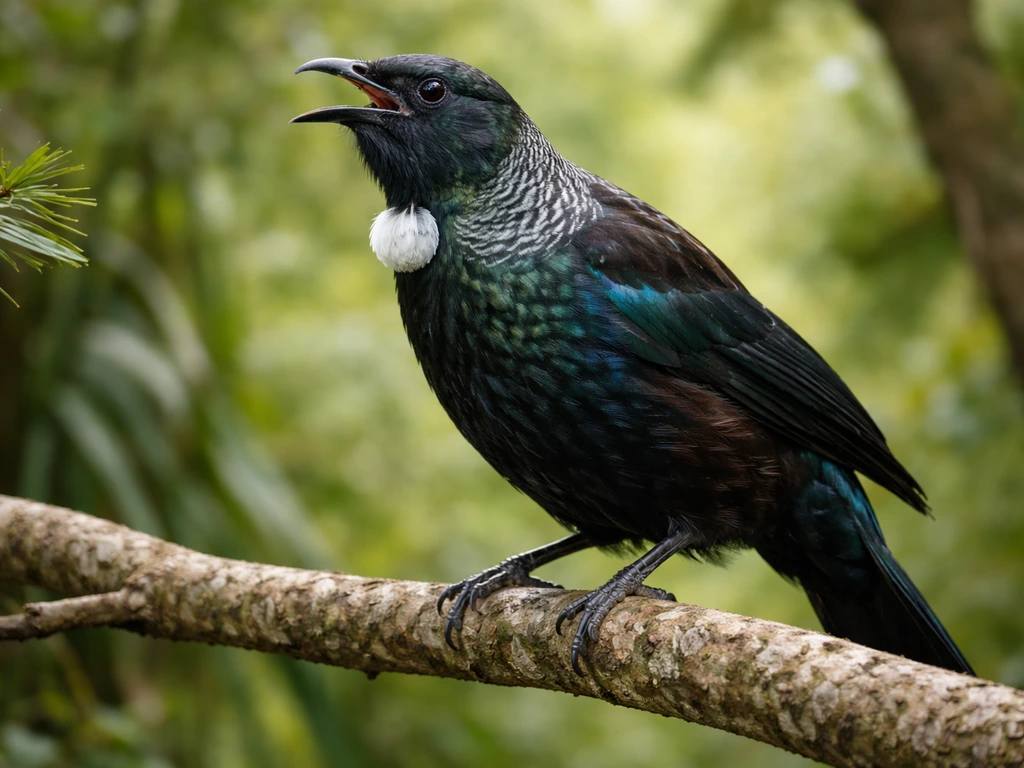
The tui (Prosthemadera novaeseelandiae, or tūī in te reo Māori) is one of New Zealand's most recognizable endemic songbirds. It's a medium-sized, iridescent bird with a distinctive white throat tuft and a curved beak built for drinking nectar from native flowers. You'll find tui year-round wherever there's a reliable nectar source, whether that's a stand of native kowhai and flax or a well-stocked garden feeder. They're fiercely territorial around food and famously acrobatic in flight.
What really sets the tui apart is its voice. Māori know the tui as kōkō as well, and historically young tui were kept as mōkai (cherished pets) and taught to speak, which speaks volumes about how deeply this bird is associated with language and communication. The tui's song is genuinely remarkable: it includes flute-like melodic notes woven together with coughs, grunts, and wheezes that seem almost human. There's even a well-known Māori proverb, 'Me he korokoro tūī,' meaning 'like the throat of a tūī,' used to praise someone's beautiful singing voice. All of this backstory feeds directly into what people spiritually associate with this bird.
Common spiritual meanings of a tui encounter
Across New Zealand spiritual communities and broader bird symbolism traditions, a tui sighting or hearing tends to carry a cluster of consistent themes. None of these are fixed rules, but they're the meanings that come up again and again when people reflect on their experiences with this bird.
- Authentic voice and self-expression: The tui's extraordinary song is its defining characteristic, and spiritually this often translates to a message about speaking your truth, using your voice, or stepping into a creative or communicative role you've been holding back from.
- Joy and vitality: Tui are loud, bold, and unapologetically full of life. An encounter often feels like a reminder to embrace joy, to stop muting yourself, and to be present in your own energy.
- Spiritual connection and messages from ancestors: In many New Zealand spiritual frameworks, birds in general, and tui especially, are seen as carrying messages between the living and their ancestors. A tui appearing at a significant moment may feel like a wink from someone who has passed.
- Adaptability and resourcefulness: Tui follow nectar sources and shift their patterns with the seasons. Spiritually, this suggests flexibility, trusting abundance, and following what genuinely nourishes you rather than staying in something out of habit.
- Protection and boundary-setting: Tui are fierce defenders of their territory. Their energy is sometimes interpreted as a reminder that it's okay, even necessary, to protect your space, your energy, and what matters to you.
- Duality and complexity: The tui's song contains both beautiful and unusual sounds at once. This can symbolize the integration of different parts of yourself, or an invitation to hold complexity without needing to resolve it into something simple.
What tui behavior can tell you
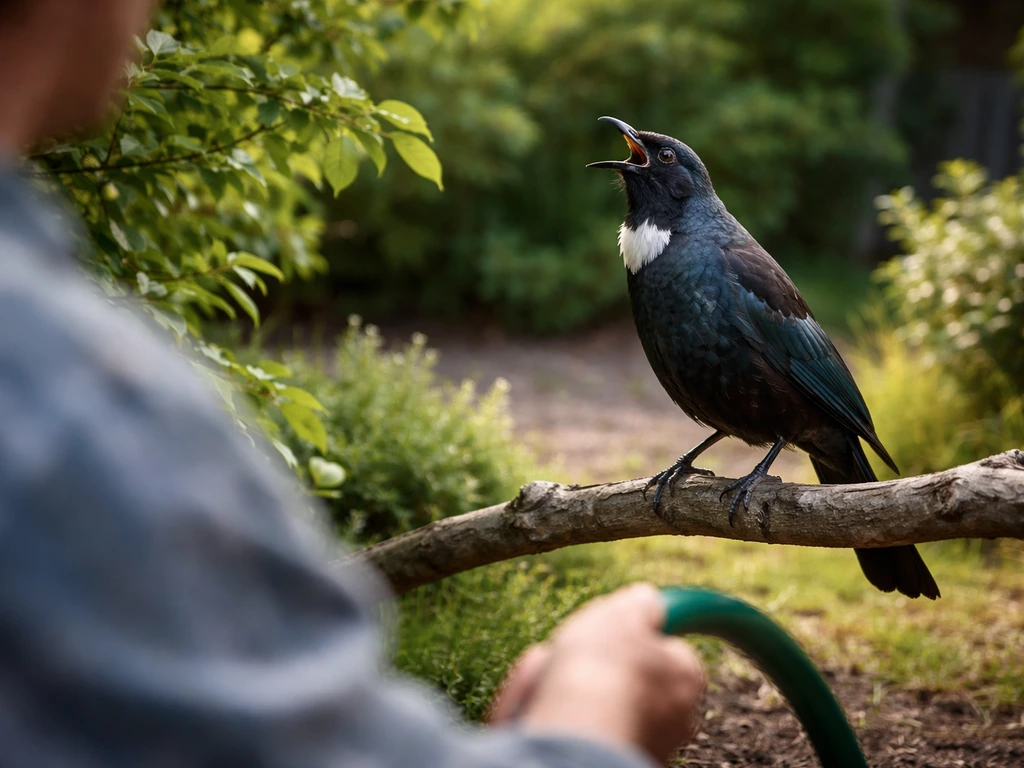
The same bird can deliver very different messages depending on what it was actually doing when you encountered it. Behavior is one of the most useful lenses for interpreting any bird encounter spiritually, and with tui it's especially rich because they have such a wide behavioral range.
Tui singing near you
This is probably the most common tui encounter, and it's often the most powerful. A tui singing close to you, especially if it seems to pause and direct its song in your direction, is widely interpreted as a strong signal around communication. Ask yourself: is there something you need to say that you've been holding back? A conversation you've avoided, a creative project you haven't started, or a role you've been too shy to step into? The tui's song near you is often read as encouragement to open up and let your own voice be heard.
Tui swooping or flying close
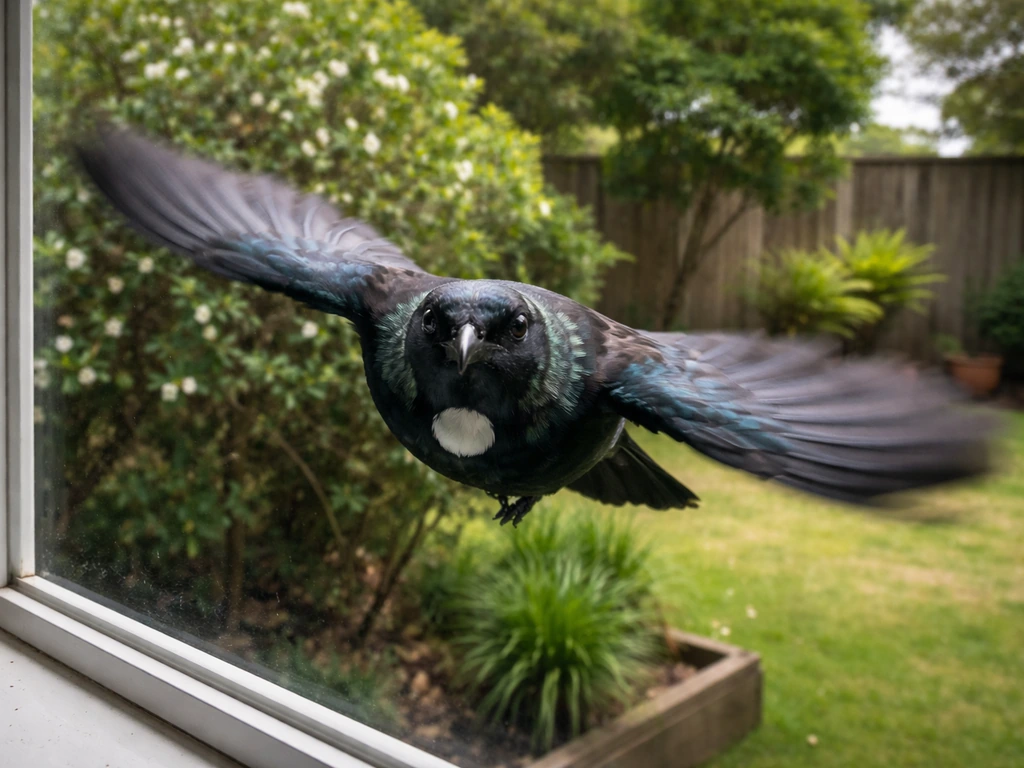
Tui do swoop, especially around their nesting territory. If a tui swooped near you or seemed to deliberately fly close, this is often interpreted as an attention-seeking gesture, a spiritual nudge that says 'wake up, pay attention to something.' It can also carry protective energy, especially if you're in a vulnerable or uncertain period. It might not be comfortable, but the message is often one of urgency: don't ignore what you already know.
Tui landing on or very near you
A tui actually landing on you is rare and considered a significant encounter by most people who work with bird symbolism. This level of closeness is usually interpreted as a very personal, direct message, often connected to ancestors or spirit guides making contact. It may also carry themes of deep trust, a sign that you're exactly where you're supposed to be right now. If this happened to you, sit with it. It's worth journaling about in detail (more on that below).
Tui nesting near your home
A tui choosing to build its rough cup-shaped nest near your house or on your property is generally seen as a very positive omen. Nesting birds spiritually represent new beginnings, domestic blessings, creativity taking root, and a sense of being protected. The male tui occasionally helps the female with nest-building, and this cooperative energy can reflect themes of partnership and shared effort. If tui are nesting near you, many people would say your home carries a welcoming, nurturing energy.
Repeated tui visits
If a tui keeps showing up, especially in unusual contexts or at emotionally significant moments, that repetition is worth noting. Single encounters can be coincidence. A pattern is harder to dismiss, and in bird symbolism, repeated visits from the same species are often interpreted as a persistent message you haven't fully received yet. What is the theme you keep avoiding or circling around? That might be exactly what the tui is nudging you toward.
Tui behaving strangely or acting distressed
Tui do have distinct alarm calls, separate from their melodic song. If a tui you encountered seemed agitated, distressed, or was making unusual sounds rather than singing, some people interpret this as a caution signal, an invitation to slow down, be careful, or pay attention to a situation that may not be what it appears. That said, always consider the practical first: a tui acting distressed is often actually distressed. Check whether it's injured or in danger before reading too deeply into the spiritual angle.
Tui as a spiritual guide: messages for different areas of your life
Where you are in your life at the moment of the encounter shapes what a tui's message might be pointing toward. Here's how the tui's core themes tend to translate into specific life areas.
| Life Area | What the Tui Might Be Saying | Questions to Reflect On |
|---|---|---|
| Love and Relationships | Authenticity and open communication are needed; don't silence yourself to keep the peace | Am I expressing my real feelings? Is there a conversation I keep avoiding? |
| Career and Work | Your voice, creativity, or skills deserve to be more visible; stop underselling yourself | Am I hiding my abilities? Is it time to speak up, apply, or create something new? |
| Family and Home | Nourishment, protection, and joy in your closest bonds; a new chapter in domestic life | How am I showing up for the people I love? What would feel genuinely nourishing right now? |
| Change and Transition | Trust the movement; follow what genuinely feeds you, even if it means shifting direction | What am I holding onto out of fear? What would I pursue if I trusted abundance? |
These aren't predictions, they're prompts. The tui doesn't tell you what to do. It invites you to tune into what you already sense is true but might be avoiding.
How to interpret your specific tui experience
The most useful thing you can do after a meaningful bird encounter is slow down and actually work with it rather than just Google the meaning and move on. Here's a practical process to help you find what's actually relevant for your situation.
Questions to ask yourself first
- What was I thinking about just before the encounter? What problem, person, or question was in my mind?
- What did I feel in my body when I saw or heard the tui? Relief? Alertness? Sadness? Joy? That emotional response is data.
- Was this an unusual encounter for where I live, or do I see tui regularly? Unusual encounters carry more weight than everyday sightings in high-tui areas.
- What time of day was it, and what was I doing? Encounters at threshold times (dawn, dusk, after a difficult conversation, immediately after a decision) often feel more charged.
- Has this happened before recently? Pattern matters more than a single event.
- Is there something in my life right now where I'm not using my voice, not expressing myself, or not following what genuinely nourishes me?
Journaling prompts to go deeper
- Describe the encounter in as much detail as you can: where, when, what the tui was doing, how close it was, what it sounded like.
- Write about what was happening in your life that day or week. What are the big open questions or decisions you're sitting with?
- If the tui were carrying a message specifically for you right now, what would it be? Don't overthink this. Write the first thing that comes up.
- What would it mean if you took that message seriously? What would you need to do, say, or let go of?
- How do you feel about that? Resistance? Relief? Both?
Timing and context clues
Timing is often where the most specific meaning lives. A tui singing outside your window on the morning you're about to make a big decision feels different from a tui you startled in the garden while weeding. Meaningful coincidences, as psychologists who study them put it, are best treated as signposts rather than directives. They point toward something worth noticing, but they don't make decisions for you. Give yourself space for the meaning to settle rather than forcing an immediate interpretation.
Cultural and belief perspectives: Māori views and broader symbolism
It's important to be honest here: there isn't one single universal spiritual meaning for the tui. A tui encounter can still be a powerful way to explore the tui bird spiritual meaning in your own life. Different traditions and communities bring their own understanding, and it would be reductive to collapse them all into one tidy interpretation.
Māori perspectives
For Māori, birds (manu) hold a significant place in the world. They are seen as connecting the physical and spiritual realms, and encounters with certain birds can be understood as messages from ancestors (tūpuna) or spiritual guides. The tui specifically is tied to communication and oratory: the proverb 'Me he korokoro tūī' celebrating beautiful speech is a direct example of how deeply this bird is associated with the power of voice in te ao Māori (the Māori world). Contemporary Māori spiritual practice often involves greeting birds in the ngahere (forest) and using karakia (prayer or incantation) to open and close interactions with the natural world. If you're engaging with tui symbolism and feel drawn to a Māori framework, approaching it with genuine respect and humility matters. This isn't a tradition to sample casually; it's a living worldview.
Mainstream and contemporary spiritual symbolism
Outside of specifically Māori frameworks, the tui has been adopted into a broader New Zealand spiritual consciousness and into wider totem animal traditions. In these contexts, the tui as a totem or spirit animal guide is typically associated with joy, communication, the integration of complexity (light and shadow, music and noise), and following what genuinely feeds your soul. Books on totem animals often suggest working with an animal guide by setting a clear question or intention, then observing what comes up in both waking life and your inner world. This is a more personal, individualized approach that doesn't draw from any one tradition.
A note on different traditions
Some readers will approach this from a broadly spiritual or metaphysical place, others from a Māori cultural lens, and others from a more psychological angle where meaningful coincidences serve as mirrors for our own inner states. All of these can coexist, and none of them require you to dismiss the others. If you're also exploring symbolism of other New Zealand birds, the kiwi carries its own distinct spiritual themes around groundedness and introspection, while the tauhou (silvereye) is often associated with community and adaptability. If you're curious about the tauhou bird spiritual meaning too, it can add another layer to how community, adaptability, and small cues show up in your life. If you're also drawn to the kiwi bird spiritual meaning, it can complement the tui's message with themes of grounded introspection and inner reflection. The tui's energy is notably bolder and more expressive than either.
What to do now: practical steps after a tui encounter

If you're sitting with a tui encounter that felt significant, here's what I'd actually recommend doing, in order.
- Ground yourself first. Before interpreting anything, take a few slow breaths or go outside barefoot for a few minutes. Encounters like this can stir up a lot of emotion and speculation, and you'll think more clearly from a calm baseline.
- Journal it out. Use the prompts above while the details are fresh. Don't edit yourself; just write what you experienced and what it brought up.
- Notice what resonates. Read back what you wrote and pay attention to any sentences that made your chest tighten or your stomach settle. Those are usually the parts that are actually true for you.
- Sit with it for a day or two. Resist the urge to immediately act on a single interpretation. Give the meaning room to develop. What feels true tomorrow morning might be clearer and more nuanced than what you thought in the first hour.
- Express gratitude. Whether that's a quiet internal thank you, a karakia if that's appropriate to your practice, or simply acknowledging the moment, expressing gratitude closes the loop and keeps you open to future encounters.
- Take one aligned action. If the tui's message pointed toward something specific (a conversation you need to have, a project you've been stalling on, a boundary you need to set), commit to one small concrete step toward it. This is how spiritual insight becomes useful rather than just interesting.
- Stay grounded in your own wellbeing. Bird symbolism is a meaningful reflective tool, but it shouldn't drive anxiety or compulsive checking for signs. If you find yourself feeling anxious or unable to make decisions without looking for omens, that's worth talking to someone about. Spiritual tools work best when they support your peace, not undermine it.
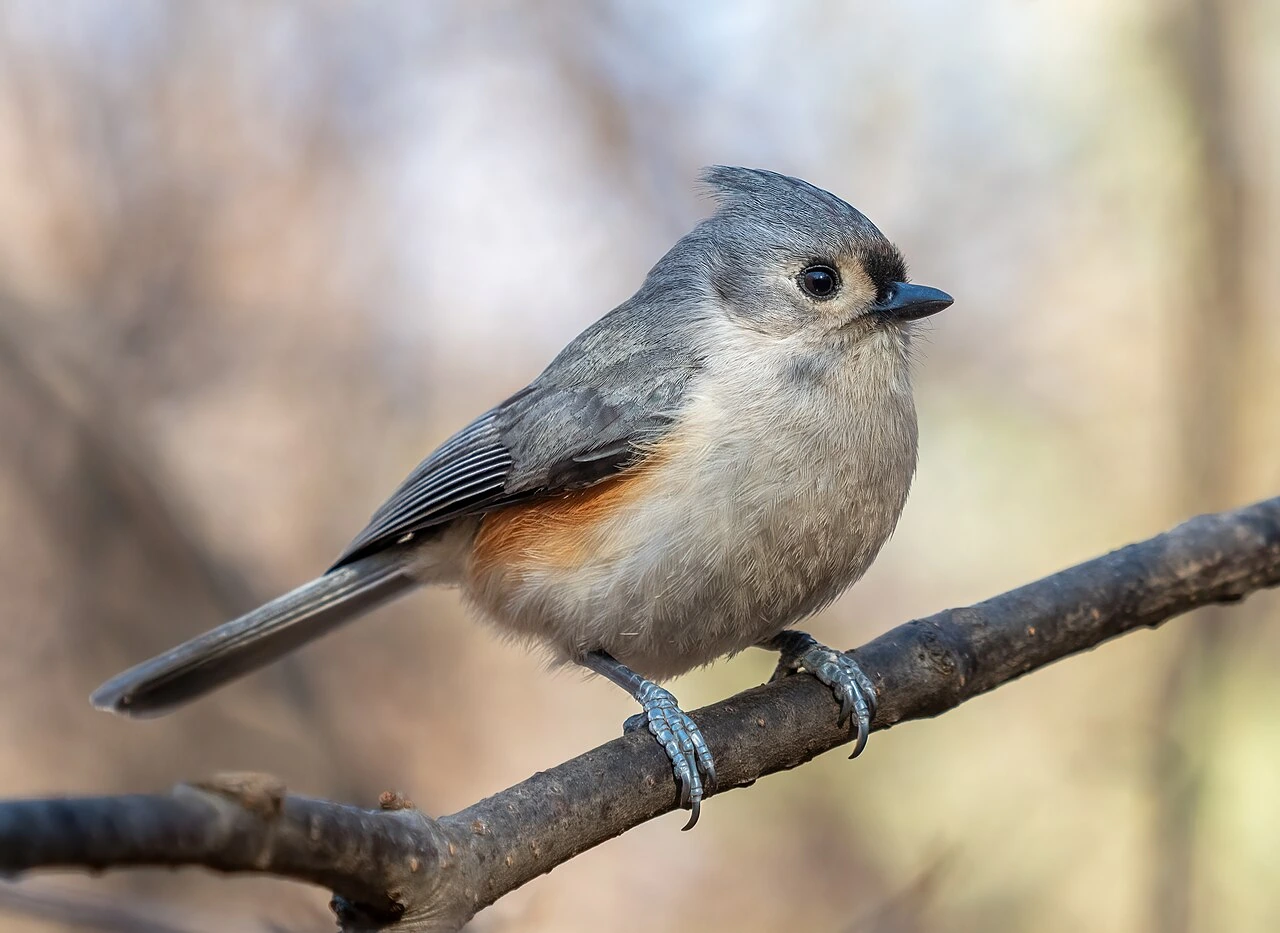
The tui is one of the most spiritually vivid birds in New Zealand. A towhee bird spiritual meaning is often tied to grounding, belonging, and noticing what home and community are asking you to face spiritually vivid. Bold, complex, joyful, and fiercely authentic, it's a pretty remarkable messenger to receive. Trust what you felt in that moment. If you are curious about other bird symbolism too, you may want to explore the titmouse bird spiritual meaning and what it could be saying in your own life. That instinct, that feeling in your chest when the song hit you, is usually the real starting point.
FAQ
How can I tell whether my tui encounter is spiritual guidance or just a meaningful coincidence?
Use your emotional data first. If the encounter nudged you toward a specific action that aligns with your existing intuition (for example, reaching out to someone, starting a creative task), treat it as guidance. If it creates fear, compulsion, or a sense you must act immediately, slow down and frame it as a prompt to reflect, not a command.
What should I do if the tui sounded “off,” like coughing, wheezing, or making alarm calls?
Don’t skip the practical check. Look for signs the bird is injured, trapped, or in danger, then contact local wildlife help if needed. Only after confirming the bird is safe should you interpret the spiritual angle, otherwise you may overlay meaning onto an ordinary crisis.
Does a tui showing up repeatedly mean the message is “urgent,” or could it still be coincidence?
Repetition raises the odds that it is a prompt you are ready to notice, but urgency depends on your context. If the sightings coincide with an avoidance pattern (procrastination, unresolved conversation), treat it as “timed.” If your life situation is stable and nothing is being avoided, it may simply be a gentle reminder.
What is the best way to journal after a tui landing nearby or appearing very close?
Write down four specifics: what the bird did, where it was, what you were thinking about in the 10 minutes before, and how your body felt (tight chest, calm, alert, teary). Then add one sentence answering, “What voice have I been silencing?” This keeps the interpretation grounded and personal.
If I want to use a Māori framework, how can I approach it respectfully without “sampling” beliefs?
Start with humility and consent. Observe from a distance, avoid turning karakia or teachings into a performance, and learn from credible Māori sources or community guidance before using any practices. If you feel unsure, choose simpler respectful actions like quiet attention and gratitude rather than formal rituals.
Is it appropriate to act on the tui message if I’m not sure what it means?
Yes, but choose low-risk actions. Examples include having the conversation you have been delaying, making a small creative start, or setting a communication goal for the week. Avoid major irreversible decisions (changing jobs, ending relationships) until you have clarity and time to reflect.
Can the tui meaning change depending on time of day or location of the encounter?
Very much. A tui singing near your window in the morning often points to your next step for the day, while a sudden alarm call in the garden may relate to immediate boundaries or a situation you need to assess. Location matters too, for example, near your door can symbolize readiness to let someone in (or to speak up).
What if I dislike or feel uncomfortable around birds and the tui still comes near me?
Let discomfort be information. Sometimes the message is not “open up” but “notice what you resist” (noise, vulnerability, visibility). If you feel threatened, prioritize safety and practical steps, and interpret the spiritual meaning as learning to meet your own resistance gently.
Do I need to treat the tui as a totem or spirit guide to get value from the encounter?
No. You can use the tui symbolism in a psychological way, as a mirror for what your inner life is already signaling. Setting an intention to observe patterns (themes you keep returning to) can be enough without adopting a spiritual identity or making it a long-term commitment.
Is it possible that my tui encounter relates to communication, even if nothing “communication-related” is happening?
Yes, because “communication” can be internal. The message may be about how you talk to yourself, how clearly you identify what you want, or whether you are honest about a feeling. Ask, “Where am I being unclear with myself?” and try one small alignment step, like naming your real need in one sentence.
Next Article
Titmouse Bird Spiritual Meaning: Encounters, Guidance, Next Steps
Titmouse bird spiritual meaning, hope, protection and guidance with a checklist, journaling prompts, and next steps for