
Seeing or hearing a coucal is widely read as a sign of protection, home-centered energy, and personal courage. Across South Asian folklore the greater coucal is a good omen, especially when its deep resonant call meets you as you head out in the morning. Modern spiritual interpretation layers on themes of warding off negativity, strengthening boundaries, and trusting your own instincts. That said, the full meaning depends heavily on what you were doing, feeling, and thinking when the bird appeared, so the sections below will help you match the encounter to your actual life.
Coucal Bird Spiritual Meaning: Interpret Your Encounter

Eliza Thornwick
12 May 2026

Meet the coucal: who this bird is and why people feel its pull

The coucal is not one bird but a group of roughly 27 species in the genus Centropus, all belonging to the cuckoo family Cuculidae. You might know the greater coucal (sometimes called the crow pheasant in India) or the pheasant coucal of Australia and New Guinea, among others. What ties them together is a ground-hugging lifestyle, a secretive personality, and a call that seems to come from everywhere and nowhere at once.
If you're trying to confirm you actually heard or saw a coucal, here are the fastest ID clues. The pheasant coucal has a black head, neck, and underbody with reddish-brown wings barred in black and cream, plus an orange-barred black tail in breeding plumage. Its call is a distinctive deep, hollow 'oop-oop-oop-oop,' sometimes accompanied by a metallic tapping. The Senegal coucal has a curved black beak and striking red circles around the pupils, giving it a famously stern expression.
Its song tends to create what observers describe as a 'strange feeling,' partly because you rarely spot the bird before you hear it. Most coucals are reluctant to emerge from dense undergrowth, which is part of why an actual sighting feels like something worth paying attention to.
That secretive quality is spiritually significant on its own. The coucal has a hidden nature, a way of being present without being seen, and that alone tends to make people feel they've been chosen when one reveals itself. Unlike the related cuckoo, the coucal is not a brood parasite. It builds its own domed grass nest on the ground or in low bushes, raises its own young, and (in the pheasant coucal's case) the male does most of the incubating and nest-building. That independence and investment in home and family is woven into almost every spiritual theme the bird carries.
The main spiritual themes a coucal carries
Most spiritual interpretations of the coucal cluster around a handful of consistent ideas. The most prominent are protection and home defense, courage, warding off negative energy, and trusting what is hidden inside you. Some people also connect the cat and bird spiritual meaning of this message to intuition, protection, and inner guidance protection, courage, warding off negative energy, and trusting what is hidden inside you. A secondary cluster draws from the broader cuckoo-family symbolism: new beginnings, transformation, and guidance during life transitions. Think of these not as fixed meanings but as a vocabulary. Your job is to figure out which word the bird was speaking to you.
- Protection and home defense: the coucal is consistently linked to guarding what matters, especially family, personal space, and emotional boundaries
- Courage to act: the bird is associated with moving forward even when you can't see the full picture, much like it moves through dense undergrowth
- Warding off negativity: the greater coucal in particular is connected to clearing harmful energy or people from your environment
- Hidden strength: because the coucal rarely shows itself, its appearance is often read as a reminder that your real power is internal and doesn't need to be performed
- New beginnings and transition: as a member of the cuckoo family, it carries transformation energy, signaling that a chapter is ending or beginning
- Attunement to weather and nature: in some traditions the coucal is a 'rainbird' whose call before a storm marks it as a messenger between the natural and spiritual worlds
What the coucal's behavior is telling you
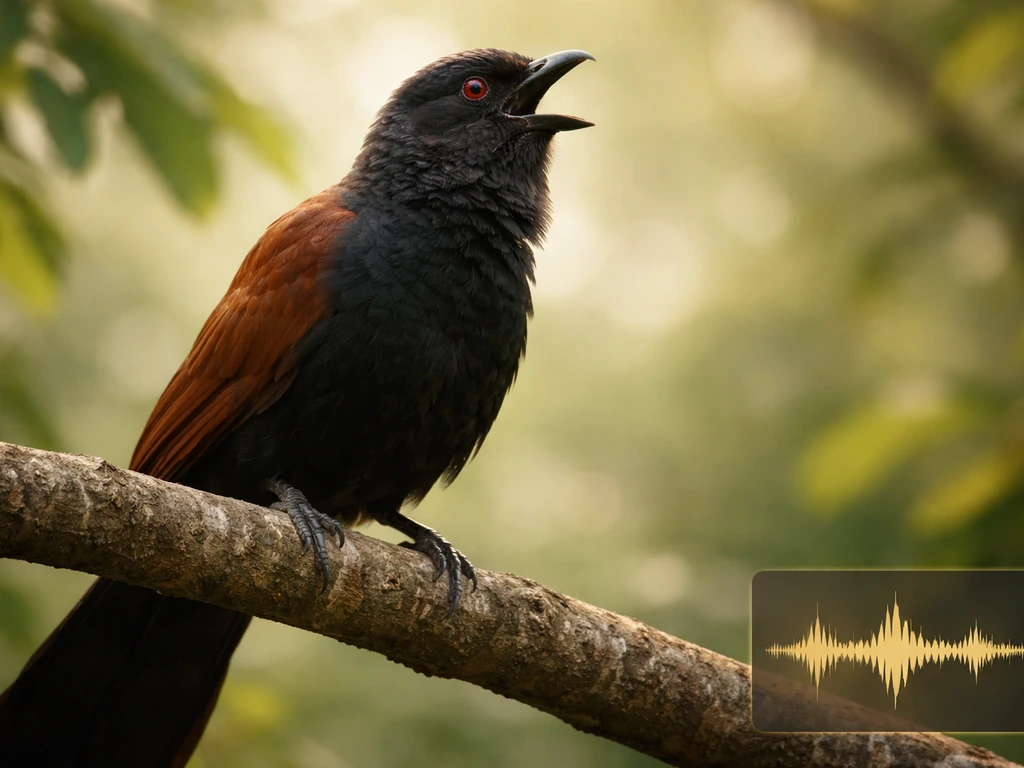
The call
The coucal's call is its biggest spiritual signature. That deep, resonant 'oop-oop-oop' or 'coop-coop-coop' is hard to ignore and even harder to locate, which is exactly why folk traditions treat it as a direct message rather than background noise. In South Asian belief the call is specifically auspicious when you hear it upon leaving your home in the morning, as though the bird is blessing your path for the day.
If you keep wondering about a specific crow bird spiritual meaning, compare your intuition to the same protection and guidance themes found across bird omens. If you've been wrestling with a decision or feeling anxious about what lies ahead, that morning call is widely interpreted as encouragement and green-light energy. A call heard at other times still carries protective meaning, but the context you attach to it matters a great deal.
If you want to compare how other omen interpretations work, explore the koel bird spiritual meaning for another bird-omen perspective.
Landing on or near you
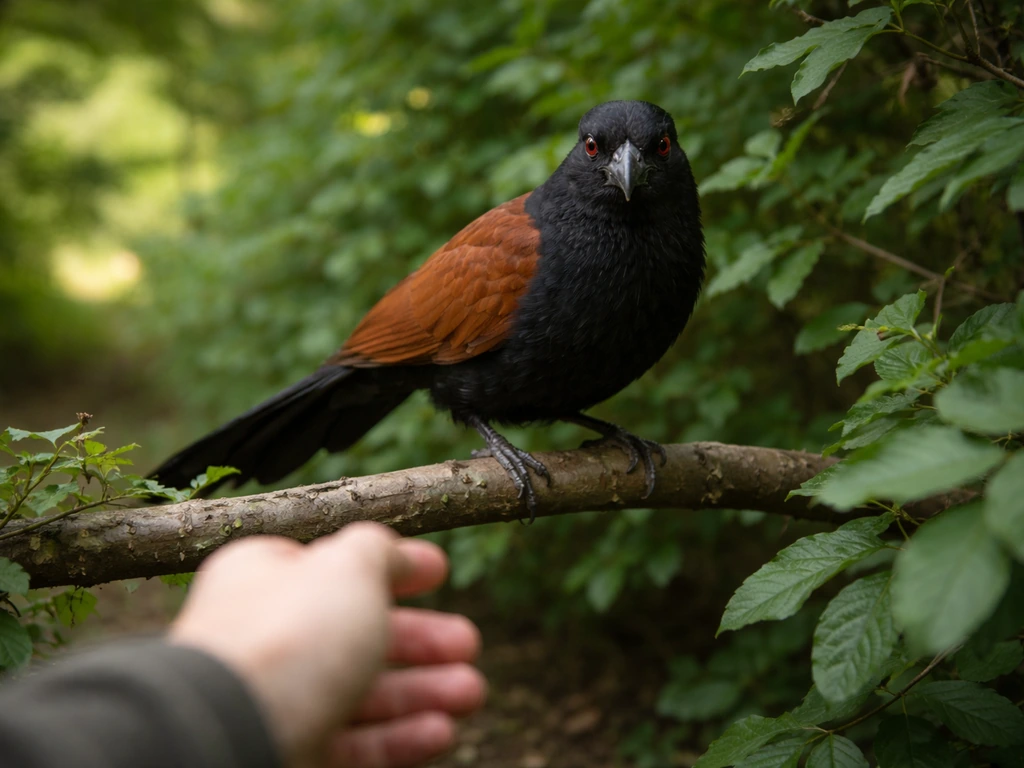
Coucals rarely approach humans willingly. They are skulking birds that prefer dense cover, so if one comes close, lands near you, or makes direct eye contact, that's a genuinely unusual event. Most spiritual frameworks treat such closeness as a strong signal: the message is meant specifically for you, is urgent, or has been trying to reach you for a while. Themes of personal protection and courage intensify here. Ask yourself what you've been avoiding or what boundary you've been reluctant to enforce.
Following or repeated appearances
If the same coucal (or coucals in the same spot) keeps showing up over days or weeks, the traditional interpretation is that the message is not yet received. Repetition in bird omen traditions generally means: slow down, pay closer attention, and look at the life area the bird's core themes point to. For the coucal that's almost always home, family, personal safety, or a transition you're resisting.
Nest-building near your home
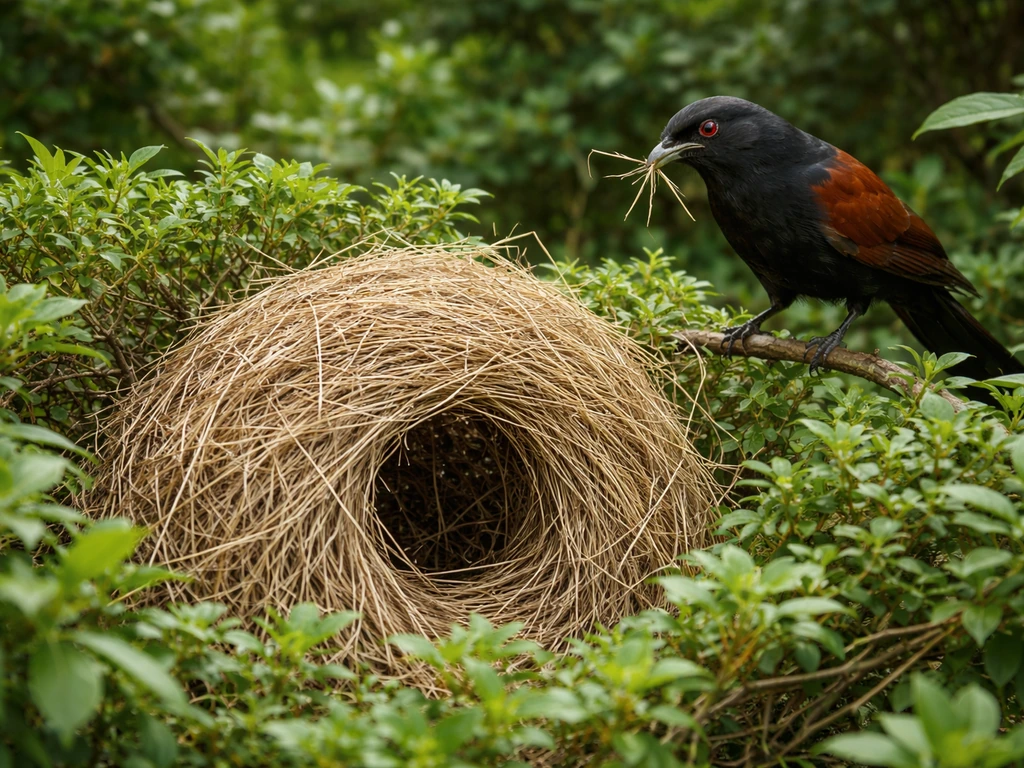
Spotting a coucal building its domed grass nest in your garden or nearby shrubs is considered especially positive. Because the coucal raises its own young and the male is heavily involved in nest-building and incubation, this behavior maps spiritually onto themes of nurturing, investment in your home life, and the reward of consistent effort. It can also signal that a new phase of family stability or domestic harmony is being constructed, sometimes literally in real life, sometimes metaphorically.
What the encounter type says about the message
| Encounter type | Core spiritual theme | Practical question to ask yourself |
|---|---|---|
| Hearing the call at morning departure | Good omen, blessing for the path ahead, courage to proceed | What decision or journey am I stepping into today? |
| Call heard near your home (no sighting) | Protection is nearby; a warning or blessing for the household | Is there something at home or with family that needs my attention or defense? |
| Coucal seen at a window or indoors | A direct, personal message; boundaries between inner and outer world | What am I letting in or keeping out of my life right now? |
| Coucal approaching or following you | Urgent personal message; protection being actively offered | What have I been avoiding that needs courage to face? |
| Nest-building near your home | Stability, domestic harmony, investment in what matters | Am I nurturing the foundations of my home life? |
| Repeated sightings or calls over days | Unacknowledged message; a theme demanding sustained attention | Which area of my life am I ignoring despite clear signals? |
| Call heard at night or dusk | Shadow work, hidden truths, subconscious signals (coucals are known to call nocturnally) | What is operating beneath the surface that I haven't looked at honestly? |
Connecting the coucal's message to your actual life
Bird symbolism is never a one-size reading. The same coucal call means something different to someone in the middle of a family conflict, someone about to start a new job, and someone who has been feeling spiritually flat for months. The most useful thing you can do right after an encounter is pause and notice the emotional weather inside you. The coucal's core themes (protection, courage, hidden strength, transition) are the map. Your inner state is the territory.
Ask yourself three questions immediately after an encounter. First: what was I thinking about or feeling in the minutes before the bird appeared? Second: what area of my life feels unsettled, uncertain, or unprotected right now? Third: is there a decision I've been delaying because I lack courage or clarity? The intersection of those three answers and the coucal's symbolic vocabulary is where your personal meaning lives.
It also helps to notice the physical setting. Coucals favor subtropical and tropical forest edges, mangroves, and dense shrubland. If you encountered one in its natural habitat, the message may be about grounding yourself in your natural environment or honoring the ecosystem you've built around yourself. If you saw or heard it in an unusual place, like a city garden or near your front door, that displacement itself can carry meaning, suggesting the spiritual signal is reaching into your ordinary, everyday world specifically.
What different cultures and traditions make of the coucal
Folk belief around the coucal is genuinely mixed, and it's worth knowing both sides. In South Asian traditions, particularly in Gujarat and across India more broadly, the greater coucal is called the Bharadwaj bird and treated as an auspicious sign. Hearing its call when you leave the house in the morning is considered a [good omen for the day's endeavors](https://www. bnhs.
org/public/hornbillpdf/HornbillJan-Dec%202021_Web. pdf). In other regions, however, the same bird's eerie call links it to evil spirits and supernatural warning. Both interpretations acknowledge the same quality: this bird carries something beyond the ordinary.
The valence (good versus cautionary) shifts by culture and context, which is why your own intuitive response to the encounter matters as much as any fixed tradition. If you’re connecting to the black-naped monarch’s spiritual meaning, look for themes of protection, intuition, and guidance during a transition black-naped monarch bird spiritual meaning. The black cormorant bird spiritual meaning is often read as a sign that intuition and inner truth are ready to guide you.
The coucal is also a 'rainbird' in some cultures, meaning its calls before a storm mark it as a natural prophet, a bridge between the physical and the spiritual, between what is visible and what is coming. This resonates with the cuckoo family's broader spiritual reputation for new beginnings and transformation, themes you'll also find when exploring the spiritual meaning of the cuckoo bird or even the koel, which is another Cuculidae family member steeped in symbolism across Asian traditions.
The formal practice behind bird-omen reading has a name: ornithomancy. Ancient Greeks and Romans practiced augury and ornithomancy as structured ritual, with trained seers interpreting the direction of a bird's flight, its calls, and its behavior as divine communication. Ancient Roman augury even assigned different meanings based on whether a bird appeared on the right (favorable) or left (unfavorable) side of the observer. That tradition wasn't guesswork or superstition in isolation; it was a coherent interpretive system. Modern spiritual interpretation of bird encounters is a direct descendant of that lineage, even when people don't know the historical name for what they're doing.
Where modern interpretation diverges from older traditions is in the role of personal intuition. Ancient augury was formal, directed, and conducted by specialists facing a specific ritual direction. Today, most of us reading bird encounters are doing so spontaneously and personally. That actually gives you more interpretive freedom, but it also means you carry the responsibility of honest self-reflection rather than outsourcing the reading to an external authority.
What to do right now: journal prompts, reflection, and practical next steps

The most grounding thing you can do after a coucal encounter is write it down while it's fresh. Don't worry about whether you're 'doing it right.' Spiritual journaling around bird encounters is simply the practice of recording what happened, what you noticed internally, and what questions the encounter opens. If you want to dig deeper into the junco bird spiritual meaning, review what details stood out to you during the encounter and how they relate to your current emotional state Spiritual journaling around bird encounters.
- Write the encounter exactly as it happened: time of day, location, what the bird did, how long it lasted, and what you were doing beforehand
- Note your immediate emotional response: did you feel surprised, calm, slightly unsettled, or quietly moved? That reaction is data
- List the one or two areas of your life that feel most unsettled right now, then hold them next to the coucal's core themes (protection, courage, home, hidden strength, transition)
- Ask: is there a boundary I need to strengthen, a decision I've been putting off, or a person or situation I've been avoiding confronting?
- Set a simple intention: spend the next few days observing your home environment and emotional boundaries with fresh eyes, as if you're the coucal scanning the undergrowth for what's actually there
- Offer gratitude, in whatever form feels natural to you, for the encounter. This closes the loop energetically and signals that you received the message
- Watch for the bird again over the next week. If it reappears, go deeper into whatever question surfaced in your journal
If the encounter felt distressing rather than uplifting, that's worth taking seriously. An eerie call at night or a coucal behaving in ways that felt threatening can stir genuine unease, especially if you're already going through a difficult time.
In that case, the bird is still more likely a messenger than a threat, but the message may be pointing to something that genuinely needs attention: a relationship that feels unsafe, a living situation that needs to change, or an inner fear you've been suppressing. Sitting with that discomfort in a journal is healthy.
If it tips into anxiety that doesn't ease within a day or two, talking to a trusted friend, spiritual director, or counselor is a genuinely useful step, not a sign that your experience wasn't real or meaningful.
Bird encounters like this one are most useful when they act as a mirror rather than a verdict. The coucal didn't come to tell you what will happen. It came to reflect something back about what is already happening inside you, and what you already know but may not yet have the courage to act on. That's the bird's real gift.
FAQ
How do I interpret a coucal bird spiritual meaning if I felt anxious instead of uplifted?
Yes, and the difference helps you avoid overthinking. If the encounter happens when you are calm or focused, interpret it as encouragement for steady protection and boundary-setting. If it happens during conflict, fatigue, or dread, treat the message as a prompt to slow down and check for what feels unsafe, rather than assuming a specific “good outcome.”
Does the coucal bird spiritual meaning change if I hear it at night or during the day?
Focus on the strongest practical signal: what you were about to do (leave home, start a conversation, make a choice) and what emotion you had in the minutes just before. The “morning leaving-home” timing is a common auspicious pattern, but for non-morning sightings you can still use protection and courage as the theme, then refine it by your situation at that moment.
What should I do if a coucal keeps showing up over days or weeks?
Use repetition as a consistency check, not a prophecy. If the same coucal shows up for several days, choose one small action that supports the core themes (for example, setting a boundary, improving home safety, or finishing the delayed decision). Repeated sightings are most helpful when they translate into one concrete step within 24 to 72 hours.
How can I tell if I really saw or heard a coucal, and does wrong identification change the meaning?
Try to separate symbolism from identification. If you are unsure whether it was a coucal, rely on the distinctive, hollow “oop-oop” or “coop-coop” call and the ground-hugging, secretive behavior. If those cues are missing, treat the encounter as a “message-like moment” but stay cautious about drawing firm spiritual conclusions.
What does it mean spiritually when a coucal lands near me or makes eye contact?
If it makes direct eye contact or approaches unusually close, treat it as personal and time-sensitive. A helpful guideline is to interpret it as asking for stronger self-protection and a clearer boundary, especially around the thing you have been avoiding (a tough talk, a safety concern, or a decision you keep delaying).
Is coucal bird spiritual meaning connected to intuition, or is that only for other birds?
It can, but don’t force a “tribal match.” Many people connect the coucal with intuition and hidden inner guidance because the bird is secretive and hard to locate. If you want to refine it, ask what intuition you have been second-guessing lately, then treat the coucal as a nudge to trust that inner signal with a small, testable action.
What if I encountered the coucal in an unusual place like a city garden or near my front door?
Yes. One subtle way is to look at the environment and ask, “What is my equivalent of this habitat?” A forest-edge or shrubland encounter can point to grounding and honoring your support systems, while an encounter at a front door or city garden can suggest the message is entering your everyday routine, home life, or access points (where you let things in).
How do I know whether a coucal encounter is a “good omen” versus a caution?
Think of it as a warning sign only when it aligns with your lived reality. If the encounter felt threatening, unsafe, or emotionally destabilizing, interpret it as a call to attention (for example, addressing a relationship dynamic that feels unsafe, reviewing home security, or acknowledging a fear you have been suppressing). If anxiety spikes and doesn’t ease after a short window, it’s appropriate to seek support.
What is the fastest way to journal or act on coucal bird spiritual meaning after an encounter?
If you want a simple method, journal three facts and one choice: (1) what you heard or saw, (2) where you were and what you were doing, (3) your strongest emotion before the encounter, then (4) the one courageous choice you can make today that matches protection or home defense. This keeps the reading practical instead of vague.
Next Article
Black Cormorant Bird Spiritual Meaning and What to Do
Explore black cormorant spiritual meaning, interpret encounters, and get grounded daily steps for change, intuition, and