The black cormorant is one of those birds that grabs your attention and doesn't let go. Spiritually, it's most commonly linked to diving beneath the surface (literally and figuratively), trusting your intuition, emotional depth, and transformation. When one shows up in your life, the nudge is usually this: stop skimming. Go deeper. There's something real below the surface of a situation you've been avoiding, and you have what it takes to find it.
Black Cormorant Bird Spiritual Meaning and What to Do

Eliza Thornwick
11 May 2026

The black cormorant and why it hits differently
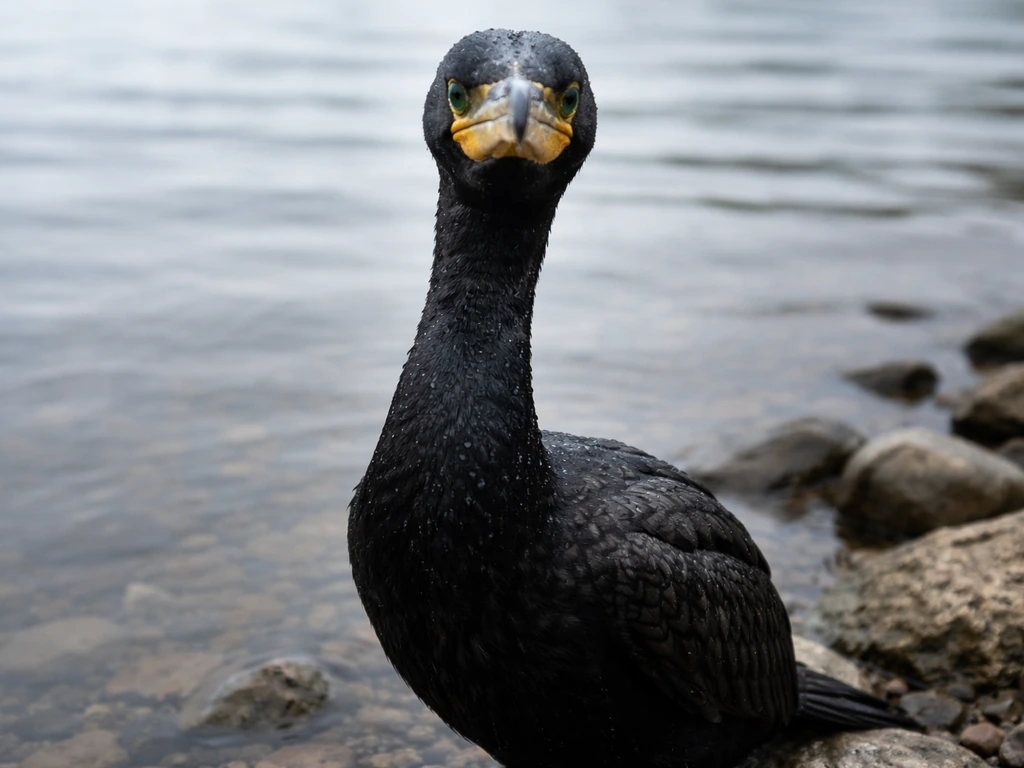
The cormorant is a genuinely unusual bird. Unlike most water birds, its feathers aren't fully waterproof. It dives deep, gets completely soaked, then has to come back to shore and spread its wings wide in the sun just to dry off and fly again. That cycle, drenching itself to get what it needs, then openly surrendering to the sun, is the heart of why so many spiritual traditions treat this bird as a symbol of transformation, vulnerability, and renewal.
Visually, it's striking: all-black, long-necked, with a slightly prehistoric quality. It doesn't look like your average garden bird. When people see one, they remember it. That memorability is part of the spiritual conversation, too. Birds like the crow carry similar dark-feathered energy, and there's natural overlap in what they symbolize. But the cormorant is more specifically tied to water, depth, and what lives below the visible surface of life, which gives it its own distinct flavor.
In Scandinavian folklore, cormorants were believed to carry the spirits of sailors and fishermen lost at sea, visiting their loved ones in the form of this bird. That tradition frames the cormorant as a bridge between worlds, a messenger from those who have passed, appearing as a good omen rather than a fearful one. In some Scandinavian traditions, cormorants are considered a blank" rel="noopener noreferrer">good omen, and spirits of sailors lost at sea may visit loved ones disguised as cormorants. In other traditions, particularly in some translations of ancient Hebrew texts, the cormorant is listed among birds associated with wildness and the uncultivated natural world. The interpretations vary widely by culture, which is actually important context to carry into your own reading of an encounter.
Core spiritual themes the cormorant brings
Across the most consistent interpretations, a few themes keep surfacing. These are worth sitting with before you layer in the specific details of your encounter.
- Diving for hidden truths: The cormorant's whole life strategy is going beneath the surface to find nourishment. Spiritually, this maps to looking past the obvious, asking harder questions, and trusting what you find below the surface of a situation.
- Transformation through full immersion: Because its feathers get waterlogged, the cormorant can't half-commit. It goes all in, gets soaked, and then has to completely reset. This speaks to cycles of letting go, surrender, and renewal rather than safe, partial change.
- Trusting your intuition: Several spiritual traditions connect the cormorant to the ability to navigate murky, unclear situations by feel rather than clear sight. It dives in cloudy water and finds what it needs anyway.
- Emotional depth and shadow work: The all-black coloring, the underwater world, and the liminal space between water and air all point toward the unconscious, hidden emotions, and the parts of yourself you haven't fully examined.
- Resilience and adaptability: The cormorant thrives in environments that would challenge other birds, fresh water, saltwater, cold coasts. It adapts. This can signal a message about your own capacity to navigate difficult terrain.
- Voice and agency: Cormorants are vocal birds with a specific, not-always-pretty call. Their presence can be a nudge to speak up, claim your space, and stop swallowing what needs to be said.
- Connection to ancestral and spirit-world messages: Particularly if you have Scandinavian heritage or a connection to maritime culture, a cormorant sighting carries extra weight as a potential message from those who have passed.
What the encounter looked like: reading the context
How a cormorant showed up matters as much as that it showed up. Here's how to read the most common types of encounters.
You spotted one in the distance
A simple sighting, especially if it stopped you mid-thought, is worth paying attention to. The cormorant tends to appear when you've been running on surface-level thinking: busy, distracted, managing appearances. The sighting is a gentle tap on the shoulder. What are you not looking at? What question have you been afraid to dive into? You don't need to do anything dramatic, but do take five minutes to check in with yourself about something you've been skimming over.
It landed near you or directly on you
A bird choosing to land on or very close to a person is relatively rare behavior, and most people feel it immediately as significant. With a cormorant, this kind of direct contact usually amplifies whatever the core message is: something important wants your full attention right now, not eventually. Some traditions read a bird landing near the chest or heart area as connected to emotional or relationship themes. If this happened to you, take it as an invitation to sit with something that's been sitting in your heart unexamined, possibly a relationship dynamic, a grief you haven't fully processed, or a decision you've been delaying for emotional reasons.
It was tapping your window or making unusual contact
There's no cormorant-specific tradition around window tapping, so lean on the broader symbolism here. Birds tapping at windows are widely interpreted as attempts to deliver a message, often from a loved one who has passed or from your own higher self trying to get through. With a cormorant doing it specifically, I'd layer in the depth and hidden-truth themes: something is trying to break through the glass you've put between yourself and a truth. The persistence of the tapping matters too. A single tap is a nudge. Repeated tapping over days is harder to ignore and worth taking more seriously as a prompt to look at what's sitting just below the surface of your awareness.
You keep seeing cormorants repeatedly

Repeated sightings are how the universe turns up the volume. If you've been noticing cormorants everywhere, in different locations, at unexpected times, or in situations where the bird doesn't quite belong, that's not coincidence as most people use the word. Jung called this synchronicity: a meaningful parallel between your internal state and external events. Repeated cormorant sightings usually mean the invitation to go deeper isn't optional right now. Something wants your attention, and it's not going to stop showing up until you look at it directly.
Reading behavior as a spiritual clue
What the cormorant was doing when you saw it adds another layer to the message. This is where bird symbolism gets genuinely useful, because behavior gives you context that a simple sighting doesn't.
Diving and actively feeding
A cormorant actively diving, going under, surfacing, going under again, is showing you the process in action. This is an encouragement. You're being shown that diving in, even into murky or uncomfortable territory, is how you get what you actually need. If you've been circling a hard conversation, a difficult self-examination, or a decision that requires real commitment, the diving cormorant is saying: go in. You have the instincts to navigate it.
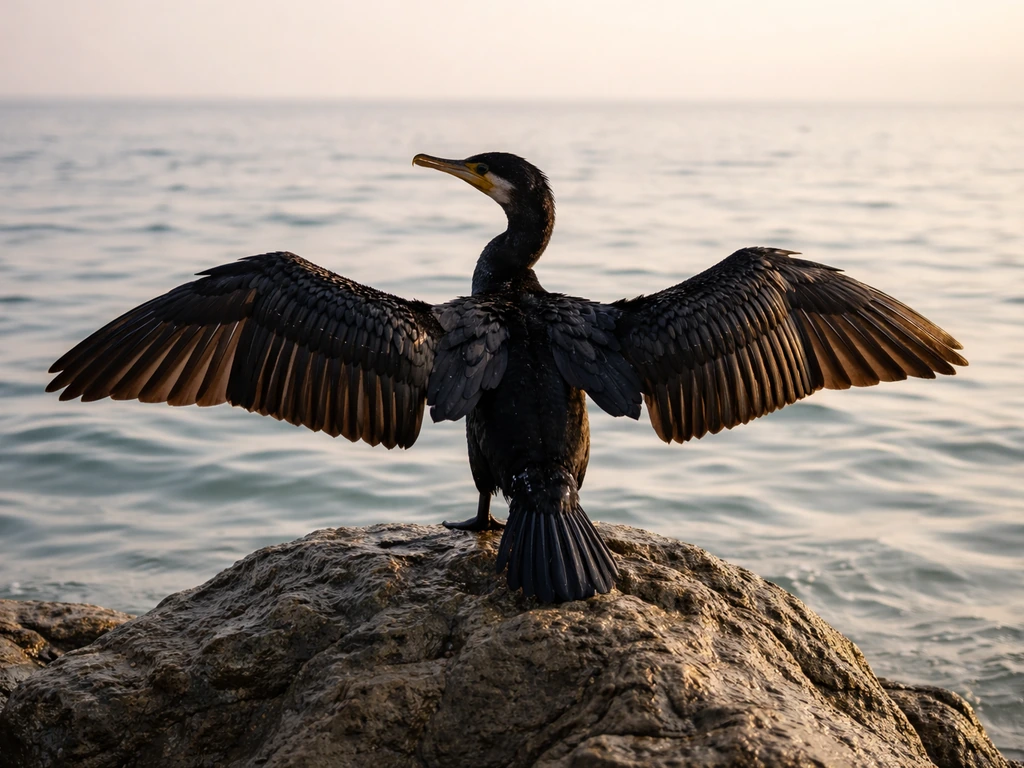
Wings spread, sunning on a rock or post
This is probably the most visually iconic cormorant posture, and it's genuinely meaningful. The bird has just come up from deep water, completely soaked, and now it has to stand completely open, exposed, and vulnerable in the sun to reset. Spiritually, this is the life-death-rebirth cycle made visible. If the cormorant you saw was sunning with wings spread, the message leans toward the renewal phase: you've already done the deep dive (or you're about to finish it). Now you need to stop, be vulnerable, let the light in, and allow a reset before you try to move again. Don't rush this part.
Swimming calmly, roosting, or resting
A cormorant swimming steadily or resting peacefully near water suggests you're in a phase of integration. You've done or are doing the work. The message here is patience and trust: keep moving at your natural pace, stay close to your emotional depths without being swept away, and trust that the right things are coming to the surface in their own time.
Calling out, being vocal, or communicating loudly
The cormorant's call is not beautiful in a songbird way. It's loud, unmistakable, and direct. If you witnessed a cormorant calling, especially if it seemed directed at you or caught you off guard, that's a nudge about your own voice. What have you not said? What are you swallowing to keep the peace? The cormorant doesn't have a pretty call and doesn't seem to care. Sometimes your truth doesn't need to be elegant. It just needs to be spoken.
When the sign feels heavier: dead cormorant, droppings, or disturbing behavior
Not every bird encounter feels light and positive, and it's worth addressing the ones that carry more weight directly.
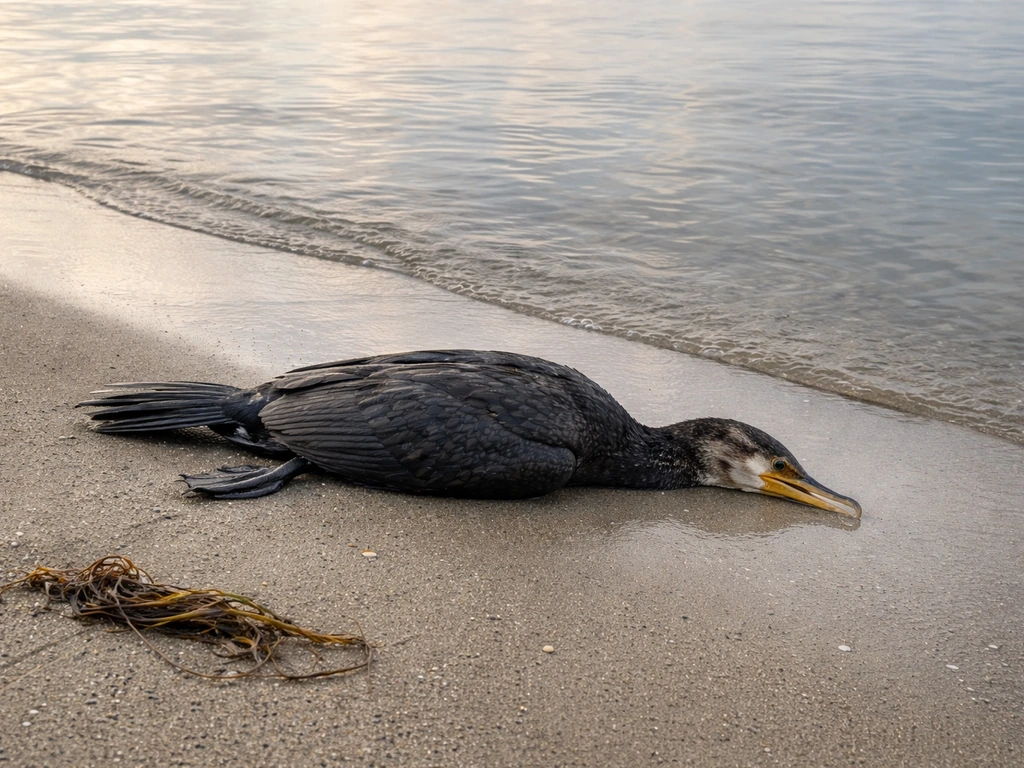
Finding a dead cormorant
First, the practical note: if you're seeing multiple dead birds in an area, contact your local wildlife agency or health department, because clustered bird deaths can signal a disease outbreak and have nothing to do with spiritual messages. That's a responsible first step, not a spiritual one. For a single dead cormorant, the spiritual read is about endings and transition. It can also be viewed as a sign of the quail bird spiritual meaning, which centers on instincts, timing, and quiet inner work. Given the cormorant's themes, a dead one often signals the end of a transformation cycle, specifically the death of a pattern, relationship dynamic, or version of yourself that you've been clinging to. It's not a bad omen in most traditions; it's completion. The question to ask is: what in your life has already ended that you haven't fully acknowledged or grieved?
Unusual or erratic behavior
A cormorant acting in a genuinely disoriented or distressed way, flying into things, unable to hold itself upright, visibly injured, is first and foremost a bird that may need help. The Washington Department of Fish and Wildlife recommends only intervening if the animal is clearly injured or sick; otherwise, leave it alone and observe. Spiritually, a distressed cormorant can mirror back agitation in your own inner landscape: something is off-balance that you're either ignoring or haven't yet named. But don't over-read. Sometimes a sick bird is just a sick bird.
Bird droppings
Across many folk traditions, being hit by bird droppings is actually considered a lucky sign, a sudden disruption that clears the path for something good. With a cormorant, the luck angle fits: being 'hit' unexpectedly by something associated with depth and transformation is often read as a wake-up call wrapped in unexpected grace. Wash it off and notice what you were thinking about right before it happened.
How to interpret this for your specific situation
The cormorant's message is always personal. The themes are consistent, but the application depends entirely on where you are in your life right now. Here are the questions that tend to open the right doors.
Questions to ask yourself
- What was on my mind right before or during the encounter? The cormorant often shows up when you're already subconsciously circling something important.
- What have I been avoiding looking at honestly? In my relationships, my work, my own behavior?
- Is there something I know intuitively but have been refusing to act on? What would acting on it actually cost me?
- Am I in a diving phase (active transformation, uncomfortable change) or a sunning phase (rest, integration, renewal)? Which do I actually need right now?
- Is there something I haven't said that needs to be said? To someone else, or to myself?
- Is there someone who has passed whose presence I've been feeling lately? Could this be connected to them?
Journaling prompts to go deeper

- Describe the encounter in as much sensory detail as you can. What were you doing? What did you feel in your body when you saw the bird?
- If the cormorant was a messenger, what is the one sentence it was trying to deliver to you? Write it down without overthinking it.
- What is the 'deep water' in your life right now? What are you circling but not diving into?
- What would 'spreading your wings in the sun' look like for you today? What would real rest or surrender actually require?
- Write about something you've been skimming over. What would change if you looked at it directly and honestly?
Practical next steps you can take today
You don't need an elaborate ritual to work with this energy. Here are specific, grounded things you can do right now.
Grounding and centering first
Before you interpret anything, ground yourself. Cormorant energy is watery and deep, and it can stir up emotions quickly. Stand or sit with your feet flat on the floor, take five slow breaths, and let whatever is surfacing come up without immediately trying to fix or analyze it. If you're near water (a river, lake, ocean, even a bowl of water on a table), use it as a focal point. Water helps you access the emotional and intuitive intelligence the cormorant represents.
Release what's waterlogged
The cormorant's most important ritual is releasing what's weighing it down so it can fly again. Write down one thing you're carrying that's become too heavy: an old story you tell yourself, a resentment, a role you've outgrown. Then burn the paper, flush it, bury it, or simply place it in a bowl of water and pour it outside. The act of physically releasing it matters as much as the intention.
Boundary-setting and speaking your truth
If the calling or vocal behavior resonated with you, pick one thing you've been needing to say and say it today, even if only to yourself out loud or in a journal. The cormorant doesn't hold back its call. Practice naming the thing clearly, without apologizing for it or softening it into nothing.
Acknowledgment and gratitude ritual
If you felt a presence in the encounter, particularly if you have reason to think it may have been connected to someone who has passed, take a moment to acknowledge them directly. You don't need a formal prayer. Simply say (aloud or inwardly): 'I felt you. Thank you for the visit. I'm paying attention.' Light a candle if that feels right. The Scandinavian tradition didn't make elaborate ceremony out of these visits; it simply honored them.
Meditation or contemplative practice
A short visualization can be powerful here. Close your eyes and imagine yourself diving into clear water the way the cormorant does. You're looking for something in the depths, and you trust your instincts to find it. What do you surface with? What does it look like? This kind of active imagination, rooted in Jungian thinking and similar to what many shamanic and meditation traditions use, can surface insights that straightforward thinking won't.
Common misunderstandings and when to pull back
A few things trip people up with bird symbolism in general, and with the cormorant specifically.
One sighting versus a pattern
If you saw a cormorant once near a river or coastal area where cormorants actually live, be honest with yourself about whether this is genuinely unusual. Cormorants have a wide range and are common near many waterways. A single unremarkable sighting in their natural habitat is worth a moment of reflection, but it doesn't demand a life audit. Repeated sightings in places they don't normally appear, or encounters with unusually direct bird behavior, carry more weight.
Is this a warning or support?
People often get stuck trying to decide if a sign is a warning or an encouragement. With the cormorant, the honest answer is: usually both. The bird is showing you something real, something you need to look at. That's support in the form of a mirror. It's only a 'warning' if you interpret the discomfort of being seen clearly as a threat. The question isn't 'is this bad?' but 'what is this showing me?' That reframe tends to unlock the useful interpretation faster.
When the encounter felt negative or disturbing
If seeing the cormorant genuinely unsettled you, rather than just surprised you, sit with that feeling without immediately explaining it away or amplifying it into disaster. Your emotional response is data. Something in you recognized something. But disturbing feelings around bird encounters are also sometimes anxiety, grief that's close to the surface, or projection. The Thomas Aquinas tradition and modern psychological perspectives both caution against treating every external event as a direct supernatural message. Hold the interpretation lightly. Ask what the feeling points to in your own life before deciding the bird 'caused' it.
Cultural meanings vary, and yours matters most
Scandinavian tradition sees the cormorant as a bringer of comfort from the dead. Some older religious interpretations place it in lists of 'unclean' birds. Modern spiritual sites frame it as a growth and intuition symbol. None of these is more correct than the others, and none of them knows your life. Your own intuitive response to the encounter, the feeling in your body when you saw it, what was on your mind in that moment, is at least as valid as any tradition's interpretation. If you are also curious about the spiritual meaning of a cuckoo bird, notice how its symbolism affects your thoughts and emotions in the moment. If you are looking at other birds for spiritual cues too, you might also explore the junco bird spiritual meaning for how it can reflect change, intuition, and inner renewal. Use the cultural and spiritual frameworks as lenses, not as verdicts.
If you're drawn to exploring similar birds for comparison, the crow shares some of the cormorant's depth and transformation themes from a land-based perspective, while birds like the coucal and koel carry their own water-adjacent or liminal symbolism worth exploring. Each bird brings its own specific flavor to overlapping themes, and noticing which one stopped you in your tracks is itself a meaningful piece of information.
FAQ
How can I tell if a black cormorant sighting is actually a spiritual sign or just a normal bird encounter?
It depends on context, but a simple way to decide is timing plus behavior. If the encounter happens while you are avoiding a specific conversation, decision, or feeling, treat it as an invitation to look deeper. If you are just in the bird’s natural area and nothing in your life is “underwater” right then, it may be less symbolic and more observational.
What should I do if I keep seeing a black cormorant repeatedly?
Yes. If you keep noticing cormorants during the same type of situation (work stress, relationship uncertainty, grief triggers), that pattern is usually the real message. Track what you were thinking and feeling for 3 to 7 days after each sighting, then compare themes, instead of trying to interpret each one in isolation.
If a cormorant landed near my chest or heart, what does that usually point to?
If it landed near you, start with your nervous system, not the story. Place a hand on your chest for a minute, take slow breaths, and ask, “What emotion is ready to be faced?” The “heart area” link is often less about romance specifically, and more about any guarded grief, self-trust issue, or relationship boundary you have been postponing.
How should I interpret repeated window tapping by a cormorant without getting carried away?
Window tapping often gets treated like a loved-one message, but the deeper layer is “something is trying to break through barriers.” A practical check is to identify one boundary you have created (avoidance, distraction, shutting down) and do one small action that opens communication, like drafting a message you keep postponing.
What does a cormorant calmly swimming or resting near water usually indicate spiritually?
The most helpful distinction is “integration” versus “escaping.” If you feel calmer over the days after the encounter, it is often integration (patience, steady progress). If you feel activated and avoidant, it can mean you are still skimming, reacting instead of reflecting. Use your change in behavior as the compass.
If I see a distressed or injured black cormorant, should I still treat it as a spiritual sign?
When the bird looks injured or disoriented, prioritize safety and proper guidance over symbolism. Follow local wildlife instructions, and if it is clearly hurt, contact a wildlife rescuer. Spiritually, you can still reflect on the “off-balance” theme, but without assuming the bird is sending a coded prophecy.
What if I see a dead black cormorant, is it always spiritual, or could it be health-related?
If you are worried about disease, cluster events are the key factor. Multiple dead birds in the same area should be reported to local health or wildlife authorities. A single dead cormorant can be interpreted as an ending or completion, but still keep the practical question open: “Is there an environmental factor here I should check on?”
How do I avoid over-interpreting the spiritual meaning of a cormorant?
Don’t look for one perfect “meaning.” Use a two-step rule: (1) name the theme in plain language (depth, vulnerability, renewal, voice), (2) choose one real-world micro-action within 24 hours (write the truth, stop a distraction habit, start the difficult conversation). If you cannot choose a micro-action, the message may not have landed yet.
I felt really unsettled when I saw the cormorant. What’s the safest way to work with that feeling?
It helps to treat the feeling as data and the interpretation as provisional. Ask what the emotion resembles in your life (anxiety, grief, guilt, fear of being seen), then look for a nearby trigger. If the feeling stays intense, consider talking it through with a trusted person or counselor rather than deciding the bird “caused” it.
Next Article
Quail Bird Spiritual Meaning: Messages, Symbols, and How to Respond
Discover quail bird spiritual meaning, symbols, and practical steps to interpret sightings and respond in daily life.