
A pelican crossing your path is one of those encounters that tends to stick with you. Maybe it landed unusually close, flew directly overhead, or you kept seeing one in odd places over several days. Whatever brought you here, the short answer is this: the pelican is one of the most layered spiritual symbols in the bird world, carrying themes of self-sacrifice, deep nurturing, emotional resilience, and purification. But the specific message for you depends a lot on context, and that is exactly what this guide will help you work out.
Pelican Bird Spiritual Meaning: Signs, Messages, Next Steps

Eliza Thornwick
17 Apr 2026

Core pelican symbolism at a glance
Before you can interpret your personal encounter, it helps to understand what the pelican has meant across time and tradition. The central, most consistent theme is loving sacrifice. Medieval Christian tradition depicted the pelican wounding her own breast to feed her dying chicks with her blood, a belief repeated so widely in medieval bestiaries that it became one of the most recognizable Christian symbols from roughly the 12th century onward.
The motif, sometimes called 'blank" rel="noopener noreferrer">Pelican in Her Piety,' was used to represent Christ's self-offering and the nourishment of the Eucharist. The British Museum describes the jeweled “pelican in her piety” brooch motif as an emblem of Jesus Christ, linking it to Christ’s self-offering.
That image of giving everything, even your own life force, to sustain others is baked deeply into pelican symbolism.
Beyond the Christian thread, modern spiritual interpretations layer in additional meanings: emotional balance, communal harmony, purification and forgiveness, and transformation. The pelican's behavior of diving into water and emerging renewed maps naturally onto ideas of cleansing and rebirth. Its large, pouched bill, used to carry and feed young, reinforces the themes of generosity, carrying others' burdens, and nourishment. If you are drawn to the pelican as a spirit animal figure, most contemporary frameworks describe it as a guide for people navigating emotional turbulence, caregiving roles, or moments that call for personal sacrifice in service of something larger than themselves.
What a pelican encounter might be telling you

General spiritual encounters with pelicans tend to cluster around a handful of meaningful messages. None of these are fixed rules, but they are the most commonly reported themes, and one or more will likely resonate with what is happening in your life right now.
- You are being called to give more generously, whether in a relationship, a caregiving role, or a community, without expecting equal return.
- A period of emotional healing or cleansing is underway, and the pelican is confirming that it is safe to go deeper into those feelings.
- A sacrifice you have already made, or one you are facing, is spiritually significant and will ultimately nourish others.
- You may be holding onto emotional weight for too long, and the pelican is nudging you toward release and forgiveness (of yourself or someone else).
- A life transition is approaching, and the pelican's diving-and-rising imagery signals transformation rather than loss.
- You are being reminded to invest in community and teamwork: pelicans are highly social birds that forage and migrate together, and their group behavior often signals harmony through cooperation.
Think about which of those landed with a small jolt of recognition. That instinctive response, the one that made you pause for half a second, is usually the most useful starting point for reflection.
Reading the situation: location, water, time of day, and how many pelicans you saw
Context changes everything in bird symbolism, and pelicans are particularly context-dependent because they are so strongly tied to specific environments and behaviors. Here is how to factor in the details of your encounter.
Where you saw it

Pelicans are aquatic birds that naturally inhabit coastlines, lakes, rivers, and estuaries. If you saw one in its expected habitat near the coast or on open water, the symbolism leans toward emotional depth and the natural flow of feelings. Water in spiritual traditions almost universally represents the emotional and unconscious realm, so a pelican gliding over calm water is often read as a sign of emotional balance and effortless navigation through what you are feeling. If the water was choppy or the pelican was diving repeatedly, the message may lean more toward active emotional work: something needs to be surfaced and dealt with, not just observed from the shore.
A pelican appearing far from water, near your home, workplace, or in an urban setting where it clearly does not belong, carries a more urgent quality. Unusual appearances in unexpected places tend to feel more like deliberate signs because they are harder to rationalize. In those cases, lean into the sacrifice and generosity themes: who in your life needs more from you right now, or alternatively, where are you giving so much of yourself that you are depleting your own reserves?
Time of day
Morning sightings often carry a beginning-of-cycle energy: a message about how you are setting intentions or what you are preparing to give. A pelican at dawn might be encouraging you to enter the day with an open, generous heart. Sightings at dusk or in fading light tend to feel more reflective, connected to release and letting go of what the day, or a chapter of life, has carried. If you saw a pelican at an unusual hour, like very early before sunrise or in conditions where birds are typically still, pay extra attention, because that kind of timing tends to stick in memory for a reason.
How many pelicans
A solitary pelican tends to speak to individual, personal themes: your own emotional state, a personal sacrifice, or a message meant specifically for you. A group of pelicans, especially one flying in formation or foraging together, shifts the message toward community, teamwork, and collective harmony. If the flock felt orderly and unified, the symbolism points toward a need for or a gift of communal support. A chaotic or scattered group could reflect emotional turbulence or a community dynamic that needs attention. Three pelicans together has shown up in various spiritual traditions as representing mind, body, and spirit in alignment.
What specific pelican behaviors mean
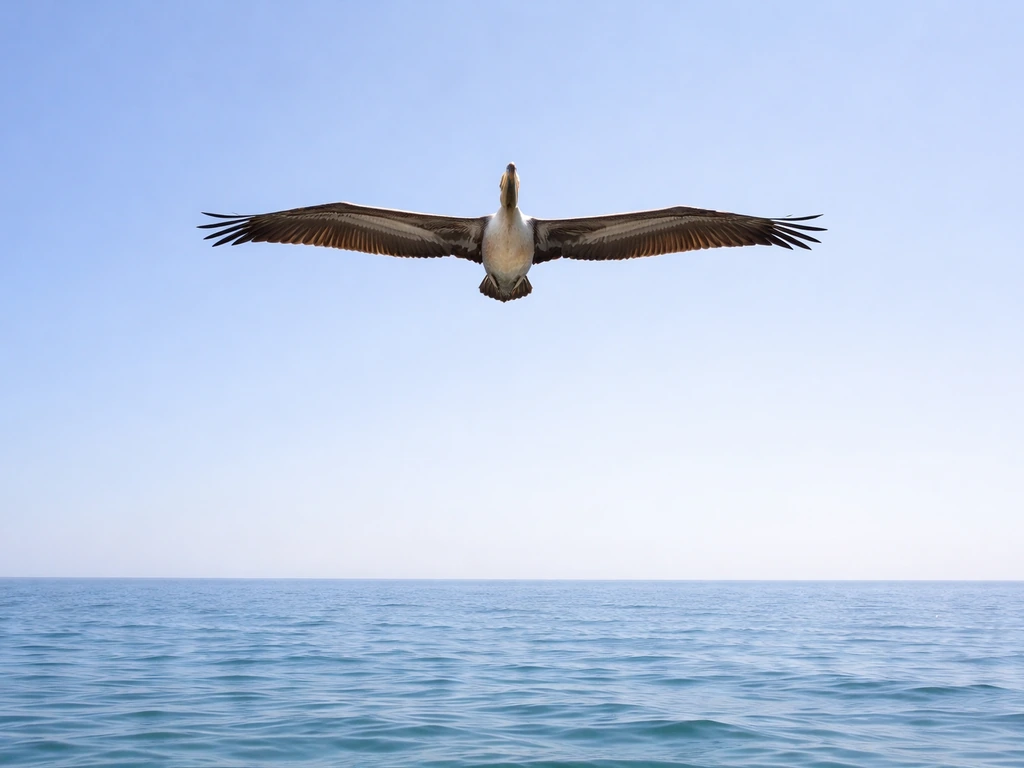
Flying overhead
A pelican soaring directly overhead, especially if it seemed to slow or circle, is one of the more striking encounters. Overhead in spiritual symbolism often represents perspective: a reminder to rise above immediate circumstances and look at the bigger picture. Combined with pelican's core themes, this could be a nudge to look at a relationship or responsibility from a higher vantage point before reacting, or to recognize the broader meaning in a sacrifice you are currently living through.
Landing near you
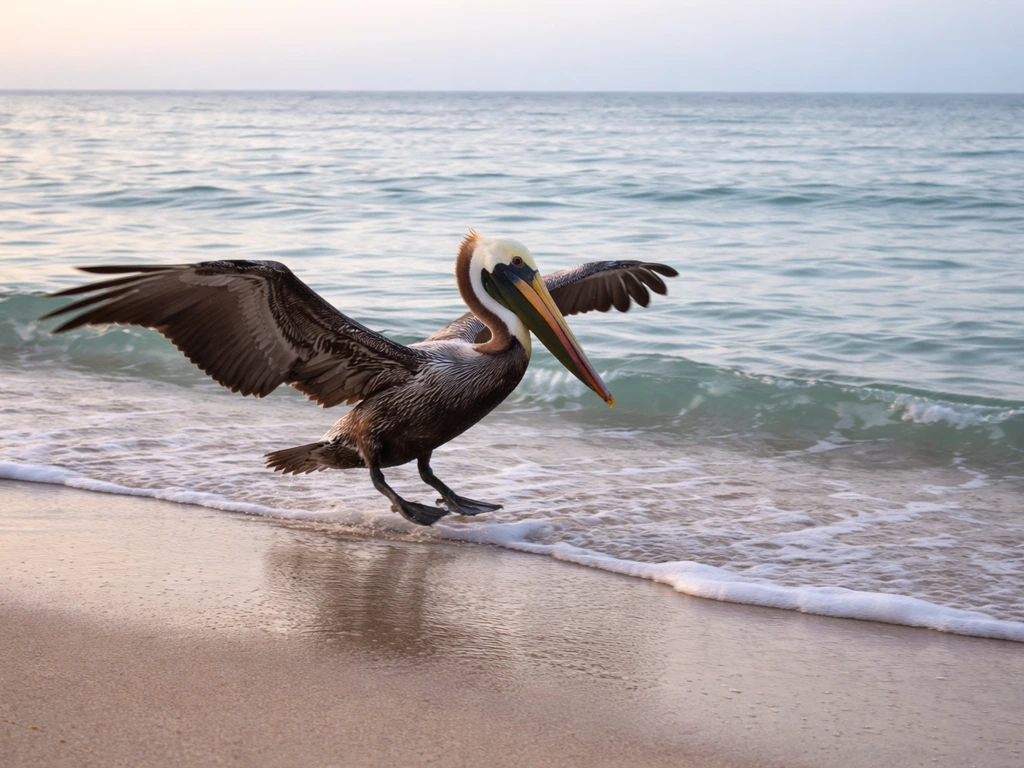
When a pelican lands close to you, especially without apparent fear, it is hard not to feel chosen. In spiritual terms, this proximity is often interpreted as direct communication: the message is personal and immediate. Pay close attention to what you were thinking or feeling in the seconds before it landed. Pelicans are not typically comfortable approaching humans, so an unusually close landing amplifies whatever theme feels most relevant to your current life. Emotionally, this encounter most often aligns with healing: you are being told that the emotional work you are doing, or avoiding, matters.
Diving into water
Watching a pelican plunge headfirst into water and resurface is a small piece of everyday magic that carries real symbolic weight. The dive represents a willingness to go beneath the surface, into uncomfortable emotional or spiritual depths, and the emergence represents renewal. If this behavior caught your attention, the message is likely about transformation: something in your life is asking you to stop skimming the surface and actually go in. The good news is that the pelican always comes back up.
Repeated sightings over days or weeks
Repeated encounters with the same species are among the most personally meaningful in bird symbolism. When you keep crossing paths with a pelican, or keep noticing pelicans in images, conversations, or dreams alongside real sightings, that pattern suggests a message your subconscious or spiritual environment is trying to make sure you actually receive. Repeated crossings are often linked to emotional turbulence or life transitions, the pelican appearing again and again until you sit down and actually engage with the theme it represents. Ask yourself what has been recurring in your thoughts or relationships during the same timeframe. The pelican and that theme are likely connected.
When the encounter feels dark: dead pelicans and signs of distress
Finding a dead pelican, or encountering one that appears sick or injured, is jarring and it is natural to wonder what it means spiritually. First, on a purely practical level: do not touch a dead or distressed wild bird with bare hands. The CDC recommends washing hands thoroughly after any contact with birds or their droppings, and wildlife health authorities advise reporting dead pelicans through appropriate local channels. The California Department of Public Health specifically advises the public to avoid contact with dead or distressed coastal birds, particularly given ongoing avian flu concerns. Report injured or sick pelicans to your local wildlife rescue organization or wildlife authority. That is the real-world first step, and it matters.
Spiritually, a dead pelican is not simply a bad omen. In many interpretive frameworks, death in animal symbolism represents endings that make space for transformation, not punishment. The pelican's associations with sacrifice and resurrection make this especially relevant: a dead pelican may signal that a cycle of self-sacrifice has completed, that you have given enough, and that something old needs to be laid to rest so something new can be nourished.
A respectful spiritual response might include a moment of acknowledgment, a prayer or quiet intention, or simply pausing to ask what in your life feels like it has run its course. Some traditions suggest honoring the bird's spirit through brief meditation and then releasing the encounter without clinging to dread.
What to do right now: journaling, reflection, and simple practices

The most useful thing you can do after a pelican encounter is not to look up a fixed definition and consider the matter settled. It is to sit with the encounter long enough to let your own intuition respond. Here are the steps I recommend, in order.
- Write it down immediately. Describe the sighting in plain detail: where you were, what the pelican was doing, how many there were, and what time of day it was. Add what you were thinking about or feeling before the encounter. This record will become valuable as you look for patterns.
- Answer this question in writing: 'What area of my life feels most like it is asking for more sacrifice, generosity, or emotional depth right now?' The first honest answer is usually the right thread to pull.
- Ask about your emotional state during the sighting: Were you feeling calm, anxious, grieving, hopeful? Your emotional register at the moment of encounter often mirrors the spiritual message being delivered.
- Sit in quiet for five minutes and visualize the pelican's behavior, the dive, the landing, the flight. Notice what images or memories surface. Do not force meaning; just observe what arrives.
- If the encounter felt significant, consider creating a simple affirmation based on the core theme that resonated most. Something like: 'I give freely from a full heart' or 'I trust the process of going deep and emerging renewed' can anchor the message in daily life.
- Over the next week, note whether the pelican theme (sacrifice, generosity, emotional healing, transformation) keeps appearing in other forms: in conversations, dreams, or decisions you face. Patterns across multiple channels usually confirm the message.
Whether you prefer prayer, meditation, or simply reflective walking, the practice matters less than the intention to genuinely engage with what the encounter surfaced for you. The pelican showed up; now it is your turn to respond.
Why pelican meanings vary: different cultures, different lenses
If you have read a few different sources on pelican symbolism today, you may have noticed that the meanings do not always line up. That is not a problem with the symbolism; it is how animal symbolism actually works. Meanings are shaped by the culture, history, and spiritual framework of the person interpreting them, and the pelican has traveled through a remarkable number of traditions.
In Christian tradition, as described above, the pelican became a symbol of the Passion of Jesus and Eucharistic nourishment from roughly the 12th century. In some Indigenous North American traditions, the pelican held the role of a medicine bird: among the Nez Perce, for instance, seeing a pelican in a dream or vision was considered a sign of granted spiritual power. Ancient Egyptian iconography interpreted pelicans as protective figures, particularly connected to guiding the dead safely through the underworld. Modern spiritual frameworks tend to blend these threads with psychological language around emotional intelligence, balance, and personal growth. There is no single correct interpretation across all of these, just different facets of a deep symbol.
The practical takeaway is that your own cultural background, spiritual tradition, and personal intuition are legitimate filters for interpreting your encounter. If a Christian lens resonates with you, lean into the sacrifice and redemption thread. If you are drawn to Indigenous perspectives, the medicine-bird and visionary-power angle may feel more alive. If your approach is more psychological and modern, the emotional balance and transformation framing will likely serve you best. You can also hold more than one lens at a time.
How the pelican compares to other large birds spiritually
It helps to understand what makes pelican symbolism distinct by seeing how it sits alongside similar birds. Large water-adjacent and soaring birds each carry their own spiritual fingerprint. Falcon bird spiritual meaning is another powerful lens for how people interpret bird encounters, especially when you want themes like focus, courage, and spiritual clarity.
| Bird | Core spiritual themes | Key distinction from pelican |
|---|---|---|
| Pelican | Sacrifice, nurturing, emotional healing, purification, transformation | Uniquely tied to self-giving nourishment and the 'blood sacrifice' motif; deeply communal |
| Vulture | Death/rebirth cycles, purification through release, patience | Focuses on what must be cleared away rather than what must be given; solitary shadow-work energy |
| Osprey | Precision, focused vision, diving into emotional depths with skill | More about targeted action and mastery than generosity; independent rather than communal |
| Falcon | Speed, clarity of purpose, higher perspective, spiritual messenger | Associated with divine messengers and swiftness; less tied to water/emotion than pelican |
| Condor | Death/life threshold, ancestral wisdom, vast perspective, renewal | Largest of these birds symbolically; linked to ancestral realms and collective spiritual memory |
| Merlin | Magic, transformation, inner knowing, forest/liminal spaces | Connected to mystery and inner wisdom rather than outward sacrifice or community |
If the pelican's themes of sacrifice and emotional nourishment feel only partially right for your situation, it is worth exploring whether a related bird's energy fits better. For example, if your encounter felt more about releasing something than giving it, the spiritual meaning of the vulture may offer a complementary angle worth reading. If it felt more about precision and diving courageously into a specific problem, the osprey's spiritual significance might resonate alongside your pelican encounter. And if what you felt was more like a swift, clear message from above, the falcon bird spiritual meaning is worth exploring for that sharper, more directive quality.
For those drawn to the deep transformation and threshold-crossing energy, comparing your experience to what people encounter with the condor's spiritual symbolism can be illuminating, especially if the pelican encounter felt connected to ancestors or a major life-death-rebirth cycle. And if the encounter had a distinctly magical, slightly otherworldly quality that felt more internal than communal, the merlin bird spiritual meaning offers a fascinating contrast for reflection.
Trusting your own read
At the end of the day, no external guide, including this one, can tell you with certainty what your pelican encounter meant. What guides like this can do is hand you a well-researched map of the territory, point out the most-traveled paths through pelican symbolism, and then leave the actual walking to you. The fact that you searched for meaning in this encounter already tells you something: a part of you recognized it as significant. That recognition is not nothing. It is actually the most important data point you have.
Sit with the themes that resonated most from this article. Write about them. Bring them into your morning routine for a few days and see what shifts. The pelican did not arrive in your life to deliver a message you will decode in ten minutes and forget. In every tradition that has found meaning in this bird, from medieval abbeys to coastal Indigenous communities to modern spiritual seekers, the pelican asks the same fundamental question: what are you willing to give, and who will be nourished because of it?
FAQ
If I saw a pelican once and it did not match my life right now, does that mean the sign is meaningless?
Not necessarily. A single sighting can be more of a prompt than a directive. Revisit the moment by writing what you were thinking, feeling, or deciding in the 10 to 60 seconds before noticing it, then wait one or two weeks to see which theme starts becoming relevant.
How can I tell whether the pelican message is about emotional healing versus active problem-solving?
Use the action level of the encounter. Calm gliding over steady water often points to regulating emotions and gaining perspective. Repeated diving, frantic movement, or a pelican in an unusual, urgent location tends to suggest surfacing something you have been avoiding and taking a concrete step (a conversation, boundary, or practical repair).
What if the pelican encounter felt negative or frightening, not comforting?
Fear does not cancel the spiritual reading. It can indicate that the theme is challenging, often related to generosity that costs too much, a responsibility you avoid, or grief you have not processed. Treat it as a signal to slow down, check consent with your own limits, and ask what you need to feel safe enough to give or change.
Does flying overhead always mean perspective and “look from above”?
Overhead is often associated with a broader vantage point, but circling or slow flight can also highlight indecision or looping patterns. If you felt stuck rather than enlightened, interpret it as a request to break the loop with a specific choice, not just a new viewpoint.
What should I do if I keep seeing pelicans but nothing changes in my life?
The most common cause is that you are staying in interpretation mode. Try a single experiment tied to the dominant theme, such as reducing a recurring over-giving habit, sending support to someone specific, or scheduling time to process a past emotion. If nothing shifts after a few weeks, reassess which lens fits (Christian, Indigenous, psychological, or another tradition).
Can I use pelican symbolism for relationship situations, like dating, marriage, or family conflict?
Yes, especially through the caregiving and sacrifice themes. A helpful question is, “Am I nourishing someone, or abandoning myself?” If the encounter coincides with ongoing resentment, the pelican may be pointing to purification (forgiveness work) or to renegotiating roles and expectations.
If I found a dead or sick pelican, how should I handle the spiritual side without romanticizing it?
Keep two lanes separate: immediate safety and practical reporting, then a respectful, grounded acknowledgment. After you wash hands and contact the right local authority or wildlife rescue, you can do a brief intention or prayer focused on endings and change, avoid assuming you caused it, and refrain from clinging to dread.
Is it okay to interpret pelican meaning through more than one tradition at once?
Yes, and doing so can reduce “forcing” a single story. Choose one dominant theme that strongly resonated, then add a secondary lens as texture (for example, emotional transformation from a modern psychological frame, plus sacrifice and renewal from a Christian or mythic thread). If two lenses contradict each other, prioritize the one that helps you make a healthier decision.
What common mistake should I avoid when interpreting a pelican encounter?
Avoid treating the first interpretation you find online as a fixed prophecy. A better method is to match the symbol to your encounter details (water conditions, proximity, time of day, solitary versus flock) and your current stressors, then confirm with your own intuition over a short window of days.
How do I use the “next steps” part practically, especially if I do not want to do prayer or meditation?
You can translate it into daily behavior. Pick one concrete action that reflects the theme (a boundary, a helpful deed with limits, a cleaning or releasing ritual, a forgiveness conversation, or journaling a specific repeating thought). Track what changes over three days, then adjust.
Could pelican spiritual meaning be related to abundance or finances, or is it only emotional and caregiving?
It can include resource themes, but often through the “nourishment” angle. If you have been giving too much time, money, or emotional energy, the pelican can point to rebalancing and replenishment, not necessarily earning more. The key check is whether your spending or support is aligned with values and replenishes you, even in small ways.
Next Article
Merlin Bird Spiritual Meaning: What It Usually Signals
Merlin bird spiritual meaning: sharper focus, awareness, swift change, protection, and what your encounter could signal