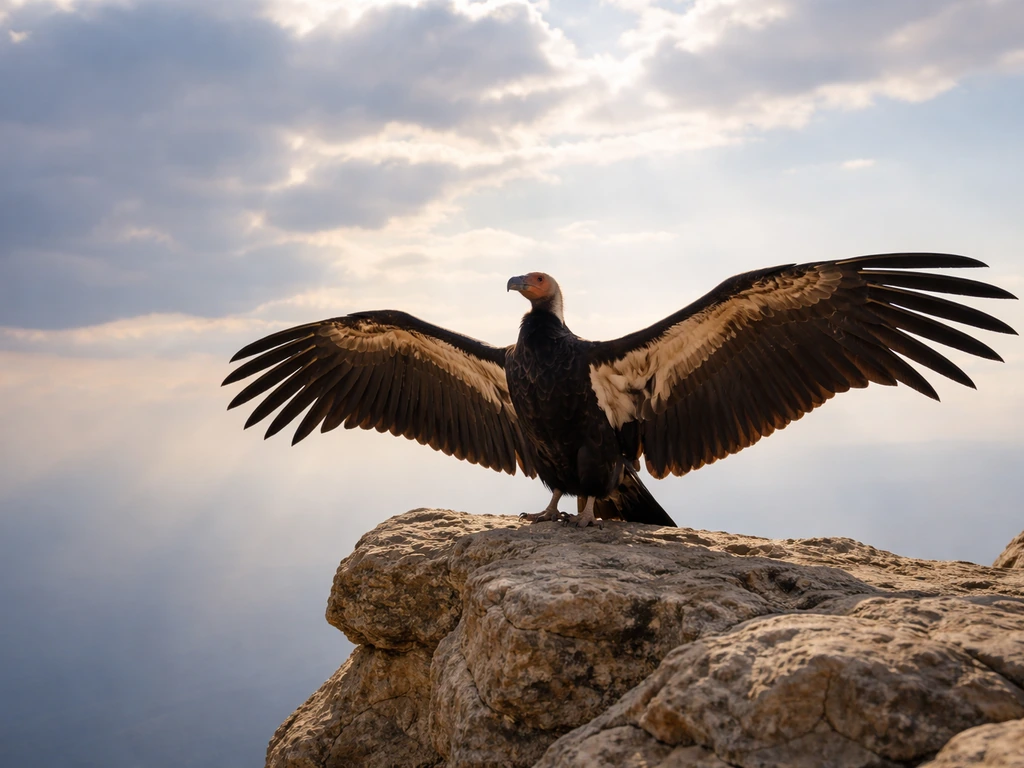
If you just saw a condor and felt something shift in your chest, you are not imagining it. Condors carry one of the most powerful spiritual signatures in the bird world, and a genuine encounter, whether a solo bird soaring high overhead, one circling near you, or even a dead condor on the road, tends to land with weight. The short answer: a condor most often signals that you are at a threshold.
Condor Bird Spiritual Meaning and What to Do Next

Eliza Thornwick
19 Apr 2026
Something in your life is ending or needs to end, and something larger, more expansive, and more aligned with your true path is waiting on the other side. The details of your encounter help you figure out exactly which part of your life that message is aimed at.
Why condors stand out in spiritual symbolism
Most birds carry spiritual symbolism, but condors occupy a different tier. Their physical reality alone is staggering: California condors can live up to roughly 60 years, and Andean condors can push even longer. They soar on thermal currents with barely a wingbeat, riding invisible columns of rising air near rock cliffs and mountain ridges for hours at a stretch. When you see one soaring, you are watching a creature that has mastered the art of rising without force. That is a potent metaphor, and ancient cultures picked up on it immediately.
Condors are also scavengers. They eat the dead. To modern sensibilities that can seem grim, but in spiritual frameworks, it positions them as agents of purification. They clear what is gone so that life can continue. That combination of extraordinary height and the function of renewal through death makes the condor spiritually distinct from, say, the osprey or the falcon, which are more about precision, focus, and active pursuit. The condor is slower, more patient, and concerned with cycles on a much larger scale.
There is also a cultural depth here that is hard to overstate. The California condor has been a sacred figure to many Indigenous peoples of the Pacific Northwest and California for thousands of years. The Yurok people, for example, have long understood condors as beings of great spiritual power, and shed condor feathers have been used ceremonially to treat illness. In South America, the Andean condor is the national bird of Bolivia, Chile, Colombia, and Ecuador, and its place in Andean spiritual cosmology is foundational. This is not a bird that crept into spiritual symbolism recently. It has been there from the beginning.
Core condor spiritual meanings: sky, renewal, and transformation
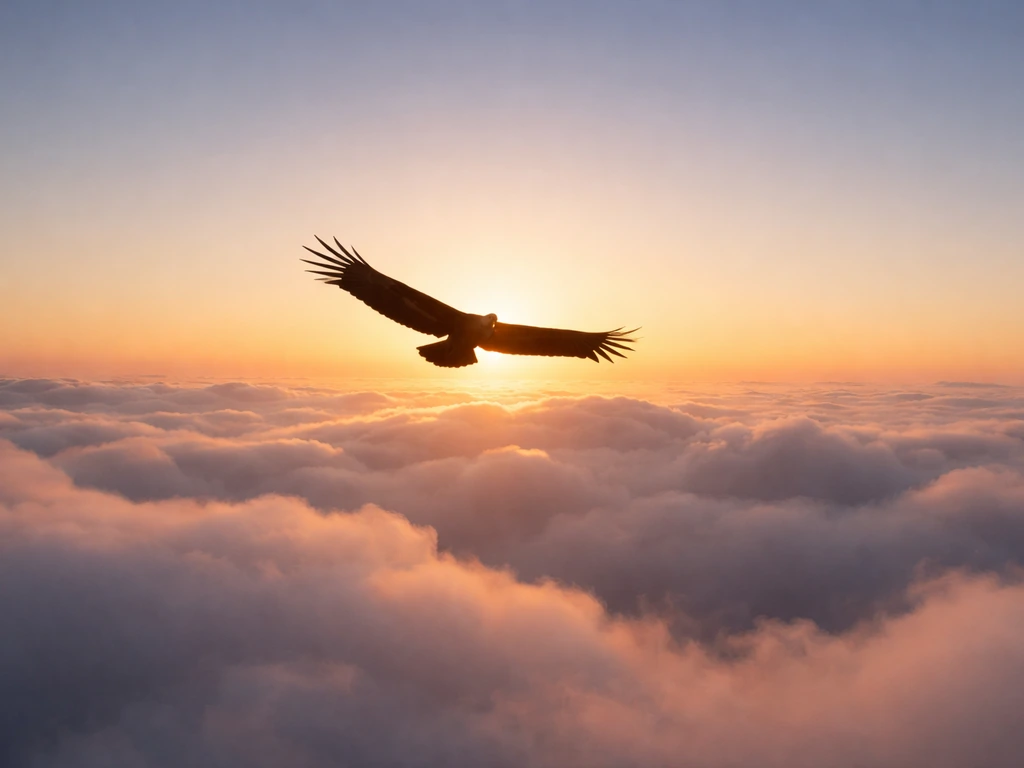
When you strip away the cultural variations and look at what themes keep appearing, three pillars show up consistently in condor symbolism: sky and higher perspective, purification and renewal, and transformation through releasing what no longer serves you.
Sky and higher perspective
In Andean cosmology, the condor is the ruler of the upper world, what the Quechua tradition calls Hanan Pacha. It is literally understood as the messenger between the celestial realm and the earth below. When the condor appears to you, one of its most consistent messages is: you are too close to the ground right now. You are caught in the details, the drama, the fear, and you need to pull back and see the wider shape of what is happening. The condor soars at heights that give it a view no other creature has. That is the gift it is offering you.
Purification and renewal

Because condors clear away what has died, they are intimately connected with purification. Not in a punishing way, but in a deeply necessary, life-sustaining way. If a condor has shown up during a time of loss, grief, illness, or a relationship ending, its presence often speaks to that exact process: something is being cleared so that something new can grow. In Andean traditions, indigenous communities today still connect the condor to health and the restoration of vitality. The bird does not dwell in death; it moves through it and keeps the cycle turning.
Transformation and endurance
A condor lives for decades. It does not rush. Its wide wings are built for soaring, not for speed. There is enormous endurance encoded in this bird, and that shows up in its spiritual meaning as a reminder that real transformation takes time and patience. If you are in the middle of a long, hard stretch of life and wondering whether anything will ever change, the condor says: keep soaring. Use the thermals, not your own exhausted effort. Trust the currents. You have more time and capacity than you think.
How to interpret your specific encounter

The raw symbolism is only the starting point. What actually matters is how the condor showed up for you, because the details of time, place, and behavior carry their own layer of meaning. Think of this as your personal meaning check, a simple process you can run through whenever you need to translate a bird encounter into something useful. If you want to go deeper into the pelican bird spiritual meaning, you can compare how its themes of emotion, healing, and spiritual tides may echo what your encounter is asking you to feel and release translate a bird encounter.
- What were you thinking about right before or during the sighting? Your mind's content at the exact moment of encounter is usually the first clue. If you were wrestling with a decision, a loss, a relationship, or a question about your path, that is almost certainly the area the message is speaking to.
- Where did it happen? Encountering a condor in the wild near its natural canyon and cliff habitat carries a different texture than seeing one unexpectedly near a suburban area or a road. Wild settings tend to amplify the spiritual message. Unexpected urban or roadside encounters can signal that the message is more urgent and immediate.
- How was the condor behaving? A condor soaring effortlessly high overhead speaks to perspective and freedom. One circling you or an area repeatedly suggests something in that location or life area needs attention. A condor that lands near you or makes unusual eye contact is a rare and direct encounter that traditionally signals a strong personal message.
- What else has been happening? Carl Jung's concept of synchronicity, the meaningful coincidence of events, is useful here. If the condor sighting is part of a cluster of unusual signs or if you have been seeing condor imagery in other forms, the message is being amplified.
- How did you feel? Your emotional response is data. Awe and calm suggest a message of confirmation or encouragement. Unease or fear might point to a shadow message that needs working through (more on that below).
Common scenarios and what they often signal
Here is a practical breakdown of the most common condor encounters people report and what each one tends to mean spiritually. These are not fixed rules; think of them as starting points for your own reflection.
| Encounter Type | Common Spiritual Signal | Reflection Prompt |
|---|---|---|
| Condor soaring very high, barely visible | Call to gain higher perspective on a situation; distance and patience needed | What are you too close to right now? What would you see if you zoomed out? |
| Condor circling overhead repeatedly | Attention is being drawn to something in your life that needs to be cleared or released | What are you holding onto that has already died or served its purpose? |
| Condor flying low or near you | A direct, personal message; a significant transition is close | What major life change are you resisting or approaching right now? |
| Condor landing nearby or making eye contact | Rare and powerful: a strong personal spiritual signal, often about healing or a life crossroads | What does your gut tell you needs to change most urgently? |
| Repeated sightings over days or weeks | The message is not being received; a theme in your life is asking for sustained attention | What have you been ignoring or postponing that keeps coming back? |
| Dead condor (roadside or near home) | A completion or ending cycle; also a reminder of impermanence and the invitation to appreciate present life | What chapter of your life is definitively closing, and are you ready to let it go fully? |
| Condor in a dream or vision | The condor's message is working at a deeper subconscious level; transformation is occurring internally even if not yet visible | What part of yourself is undergoing a death-and-renewal process? |
| Condor imagery appearing repeatedly (art, media, conversation) | Synchronistic amplification of the core message: you are being guided toward a broader view or a purification process | What theme keeps surfacing in your life that this imagery might be pointing to? |
What to do next: journaling, intentions, and life changes

Once you have a sense of what the condor might be pointing to, the real work begins. This is where most people stop, they say 'interesting' and move on, and the message evaporates. Here is a simple, practical sequence to actually work with a condor encounter.
Write it down first
As soon as you can, write down the full details of the encounter: time, place, what the condor was doing, and most importantly, what you were thinking and feeling in that moment. Do not censor or interpret yet. Just record it. Then write a single sentence about what is most alive or unresolved in your life right now. Very often, the connection between those two paragraphs becomes immediately clear.
Set a clear intention
The condor is a messenger of threshold and transformation, so the most potent response is to set an intention aligned with what needs to change. This does not have to be elaborate. It can be as simple as writing: 'I am willing to release [specific thing] and trust the process of renewal.' Setting this down in writing, especially shortly after the encounter, treats the synchronicity as a genuine spiritual prompt and anchors your response to it.
Take one concrete action
Spiritual messages have the most impact when they are met with even one tangible step in the waking world. Depending on what the encounter pointed to, that action might be having a conversation you have been avoiding, making a decision you have been circling for weeks, ending something that has been slowly dying, or simply spending time in an elevated physical space (a hill, a mountain view, even a rooftop) to practice the condor's perspective literally. The point is to move. The condor does not hover; it keeps soaring.
Return to it over the following days
Condor energy is not a quick fix. This bird lives for sixty years and soars with patience. Give your reflection a few days before declaring the message understood. Often a second layer of meaning surfaces once the initial 'what just happened?' energy settles down.
If the message feels scary: shadow meanings and grounding

Not every condor encounter feels light and uplifting. Some people feel unsettled, anxious, or even frightened. That is worth taking seriously rather than dismissing. The condor's connection to death and endings is real, and in many traditions a condor appearing during a period of illness, grief, or major loss is a direct acknowledgment of that reality, not a curse, but a witness.
The bird's function in nature is to clear away what has died so the ecosystem can continue. If you are in a dark period, the condor is not predicting more darkness; it is sitting with you in the difficulty and pointing toward the other side of it. If the same themes keep following you, you might also connect with what the merlin bird spiritual meaning teaches about focus, awareness, and timing.
If a dead condor appeared near your home or on a road, traditions across many cultures tend to read this as a transition marker rather than a doom sign. The 'memento mori' framing is actually useful here: the reminder of impermanence is an invitation to be more present in your actual life, to value what you have, and to stop postponing the things that matter. It is sobering but not sinister.
When a condor encounter feels heavy, grounding is the right first move. Before any interpretation, get physically present: feet on the ground, slow breath, a few minutes outside if possible. Then ask yourself honestly, 'Is this fear coming from the encounter itself, or from something in my life that I was already dreading before this happened?' More often than not, the condor is not creating the fear. It is reflecting something you were already carrying.
- Ground first: deep breathing, physical contact with earth or a solid surface, a walk outside
- Separate the bird from your anxiety: what were you already worried about before this encounter?
- Reframe the shadow: if something in your life needs to end, the condor's presence can be a sign that you will survive the clearing
- Avoid obsessive googling for the worst possible interpretation: no single omen determines your fate
- Talk it through: sharing the encounter with a trusted person often dissolves fear and clarifies meaning
Cross-cultural lens differences, and how to choose what fits you
Condor symbolism is not one-size-fits-all. Where you are standing culturally and spiritually shapes which interpretive framework makes the most sense for your encounter. Here is a practical comparison so you can choose the lens that genuinely resonates rather than grabbing the first interpretation you find.
| Tradition / Framework | Core Condor Meaning | Best Fit For |
|---|---|---|
| Andean Indigenous cosmology (Quechua, Incan) | Ruler and messenger of the upper world (Hanan Pacha); power, health, and connection between celestial and earthly realms | Those drawn to South American indigenous spiritual traditions or who encountered an Andean condor specifically |
| Pacific Northwest / California Indigenous traditions (e.g., Yurok) | Condor as a being of great spiritual power; feathers used for healing ceremonies; a sacred figure with direct ceremonial significance | Those with Indigenous heritage or living in condor historic range; respect for closed traditions is essential here |
| Modern metaphysical / spirit animal framework | Condor as a spirit guide or totem carrying personal messages about transformation, perspective, and life cycles | Spiritually curious individuals without specific cultural ties who want a personal, reflective interpretation |
| Jungian / synchronicity lens | The condor encounter as a meaningful coincidence reflecting an internal psychological or life process already underway | Those who prefer a psychological framing; useful for validating the experience without a religious framework |
| General cross-cultural bird symbolism | Birds as messengers, omens, and symbols of freedom, soul, and transition across many world traditions (ornithomancy has ancient roots across Greek, Roman, and other cultures) | Readers who enjoy drawing on multiple traditions and forming their own synthesis |
One important note on cultural sensitivity: the specific ceremonial use of condor feathers and the condor's role in living Indigenous traditions is not a metaphor or a borrowable symbol. If you are working with condor symbolism from outside those traditions, the modern metaphysical or synchronicity lens is the more respectful path. You can deeply honor the bird's power without appropriating a tradition that was not handed to you.
The honest truth is that the most meaningful interpretation is the one that sparks genuine recognition in you. When you read a particular framing and something in your chest says 'yes, that's it,' that is the layer of meaning worth working with. Condor symbolism, across all its cultural expressions, consistently points toward one thing: you are being invited to rise, to release, and to trust a process much larger than your current view. Whether you hear that through Andean cosmology, modern spirit animal work, or simple awe at a wild creature soaring overhead, the invitation is the same. Take it.
If you find yourself drawn to explore other large, high-flying birds in a similar symbolic light, the vulture shares the condor's purification and transformation themes in fascinating ways, and the falcon brings a sharper, more focused energy to the sky symbolism conversation. If you are curious about how that focused energy connects to your inner life, explore the falcon bird spiritual meaning too. If you are also drawn to vulture birds, exploring their spiritual meaning can add another layer to the themes of purification and transformation vulture bird spiritual meaning. Each bird offers its own angle on what it means to navigate from a place of elevated sight.
FAQ
What if I saw a condor but felt nothing, or I felt skeptical instead of emotional?
That can still be meaningful, just in a quieter way. Re-check the encounter details (time, location, behavior, what you were already dealing with) and compare them to your current “threshold” theme. If you feel no resonance after a few days, treat it as a prompt to pay attention rather than a message that you must act immediately.
How can I tell whether the “threshold” is about ending something or choosing something new?
Look for what feels most time-sensitive. If you keep circling closure, boundaries, or a goodbye, it points to an ending. If you keep feeling drawn toward a direction, commitment, or next step, it points to choosing. Often it is both, with the old needing release before the new can stabilize.
Does a condor have to show up during grief for the meaning to apply?
No. While many people report it during loss or illness, the underlying theme is transition and perspective. It can also appear when you are about to outgrow an identity, change jobs, move homes, or make a long-delayed decision. Use your “unresolved sentence” from the encounter as the deciding clue.
What if I see a condor repeatedly over weeks, but nothing in my life seems to be changing yet?
Repeated sightings often signal timing and a slow-building shift, not instant results. Consider choosing one small action that reduces “stuckness” (one conversation, one application, one boundary). If nothing can be done yet, focus on preparation steps, like gathering info, clarifying values, or creating space for a decision.
Can a dead condor mean something other than a transition or impermanence reminder?
In most spiritual readings it is treated as a transition marker, but your interpretation should match your emotional data. If the encounter reliably brings up themes of urgency, presence, or postponement, lean into that. If it triggers panic or obsessive thoughts, scale back interpretation and use grounding, because you might be reacting more to your fear than to a clear message.
I felt anxious when I saw the condor. Should I interpret that as “bad news”?
Not automatically. The article suggests distinguishing encounter-triggered fear from something you were already dreading. If the anxiety persists, try asking what you were avoiding before the sighting, then pick one actionable step that makes the situation safer or more honest, even if it is small.
What should I do if I cannot go “outside” or be physically grounded right away?
Use a micro-version: feet on the ground while seated, slow breathing for 60 to 90 seconds, then write two lines, “What am I feeling?” and “What in my life matches this theme?” This keeps the symbolism from becoming abstract and helps you translate it into a decision you can take later.
Is it respectful to use condor symbolism for manifesting or spirit work if I do not belong to Indigenous traditions?
Yes, as long as you avoid presenting ceremonial uses (like feathers used in specific healing contexts) as transferable tools. Keep your practice general (reflection, intention setting, releasing patterns) and frame it as your personal meaning, not as a borrowed ritual with claims of lineage or authority.
How long should I wait before deciding the message is “understood”?
Give it a few days, not hours. A second layer often appears once the initial shock, awe, or dread settles. If after a week you still cannot identify any relevant unresolved theme, treat it as a sign to gather more information and observe, rather than forcing a conclusion.
What’s the best first action when the condor message points to releasing something?
Choose a concrete release action that is measurable, such as ending a recurring behavior (notifications, a subscription, a late-night habit), having the conversation you have been postponing, or setting a boundary in writing. “Release” becomes real when it changes your routine or your relationships, not only your thoughts.
Does the condor’s behavior affect the meaning?
Yes, behavior acts like context. A condor circling near you can emphasize attention and timing, while a high, distant soar may point more strongly to “gain perspective” and pull back from the details. If you noticed how it positioned itself (nearby versus far above), use that distance as a metaphor for how close the lesson is to your daily life.
What if I feel the message is about death or health, and I’m worried it’s a prediction?
Use it as a prompt for presence and priorities, not as a prophecy. If you are concerned about health, channel the energy into practical steps (check-ins, appointments, support). If anxiety is intense or persistent, consider talking with a mental health professional, since fear can hijack spiritual interpretation.
Next Article
Pelican Bird Spiritual Meaning: Signs, Messages, Next Steps
Interpret pelican bird spiritual meaning through real sightings, behaviors, and signs. Includes journaling and next step