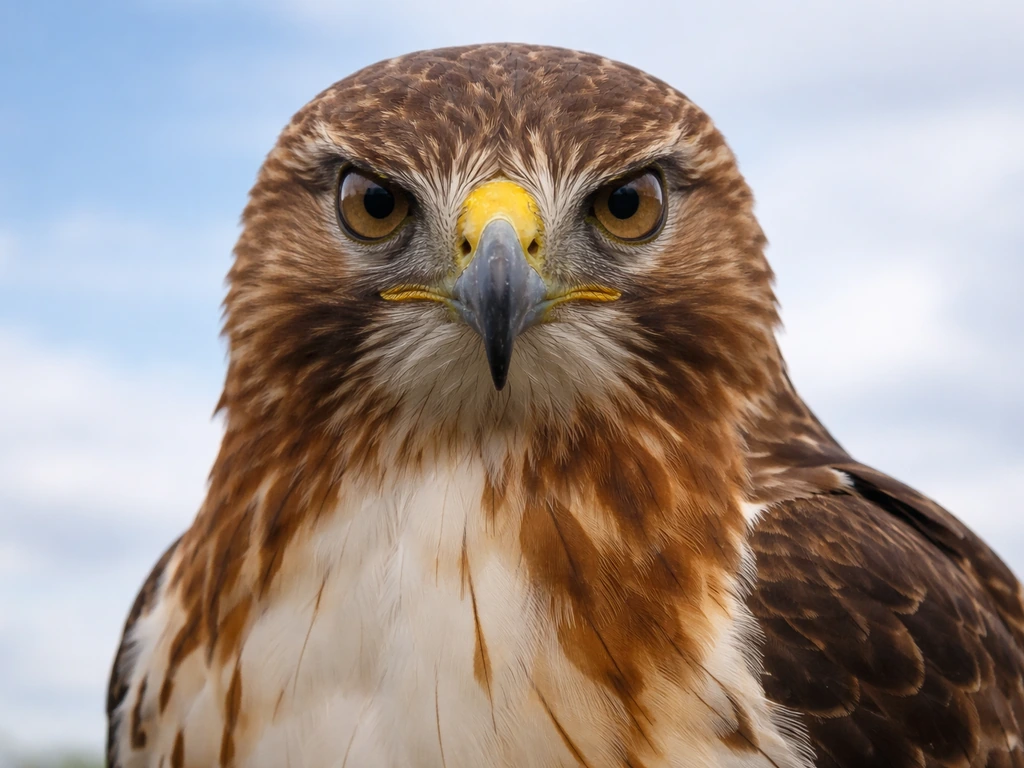
When a hawk shows up in a way that stops you in your tracks, most people feel it immediately. Something about the encounter feels deliberate, almost like the bird is holding your gaze on purpose. Spiritually speaking, hawks are almost universally associated with heightened vision, sharp focus, courage, and the ability to see the bigger picture. They show up in your life, according to many spiritual traditions, as a nudge to raise your perspective, trust your instincts, and pay close attention to what is unfolding around you right now.
Hawk Bird Spiritual Meaning: Signs, Messages, What to Do

Eliza Thornwick
10 Apr 2026
The core spiritual symbolism of the hawk
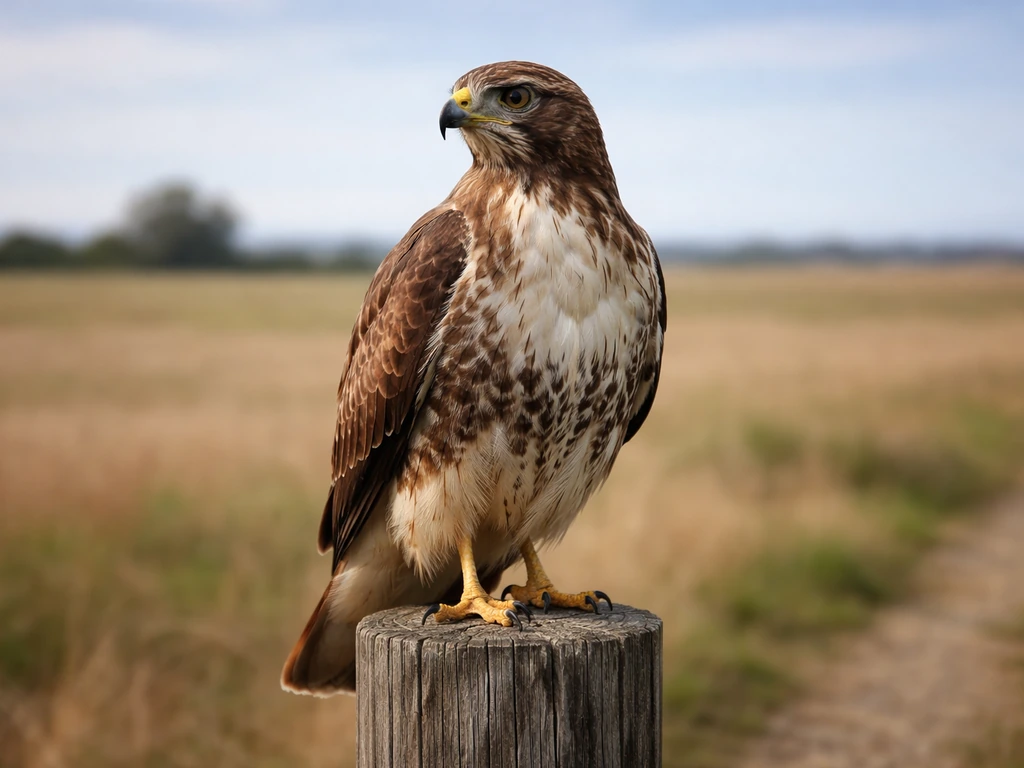
The hawk's physical gifts pretty much map directly onto its spiritual symbolism. Hawks have extraordinary eyesight, the ability to soar above the noise, and a precise, focused strike when they move. Spiritually, that translates into themes like: clarity of vision (literally and metaphorically), the courage to act decisively, a call to widen your perspective beyond day-to-day distractions, and a reminder that you already have the awareness you need. You just might not be using it yet.
Many spiritual writers also connect the hawk to protection, strength, and what some traditions call the "messenger" role, where the bird serves as a bridge between the earthly and the divine. If you are someone who works with spirit animals or totems, the hawk often signals a period where your intuition and perception are especially sharp, and where paying attention to signs and synchronicities is worthwhile. Think of it less as a cosmic telegram and more as a mirror reflecting qualities that are already alive in you.
It is also worth noting that the hawk family is enormous. The meaning can deepen or shift slightly depending on the specific species you encountered. A blank" rel="noopener noreferrer">[Cooper's hawk encounter](/birds-of-prey-meanings/cooper-hawk-bird-spiritual-meaning), for example, carries its own nuanced symbolism distinct from the broad hawk archetype. Red-tailed hawks, the most commonly spotted in North America, tend to carry the boldest, most universally recognized "big picture" energy.
What it means when a hawk shows up in your life
Before we get into specific behaviors, it is useful to talk about what "showing up" actually means. A hawk that crosses your path during a walk is different from one that has been nesting near your home for three weeks. USGS provides a [species-known-range dataset and range-map resource](https://www. usgs.
gov/data/red-tailed-hawk-buteo-jamaicensis-brthaxconus2001v1-range-map) for the red-tailed hawk (Buteo jamaicensis). Context matters a lot here. Red-tailed hawks, for instance, can have home ranges of roughly 0. 85 to 5.
2 square kilometers for a single pair, and in cities like New York, dozens of pairs nest across the five boroughs. The NYC Bird Alliance notes that red-tailed hawks have established nesting across all five boroughs, building on earlier nesting history such as Pale Male in Central Park nest across the five boroughs.
So if you keep seeing the same hawk near your apartment building, there is a good chance it genuinely lives there. That does not strip the encounter of spiritual meaning, but it does help you interpret it responsibly rather than reading every sighting as a fresh divine message.
That said, when a hawk encounter feels charged, like it locks eyes with you, lands unusually close, or shows up on an emotionally significant day, many spiritually curious people find real value in pausing to reflect on what might be communicated. The most common themes people report connecting to hawk sightings include: needing to trust their own judgment, a decision that requires a wider view, a sense of being watched over or protected during a difficult period, or a push to focus after a season of distraction.
Hawk spiritual meaning by situation
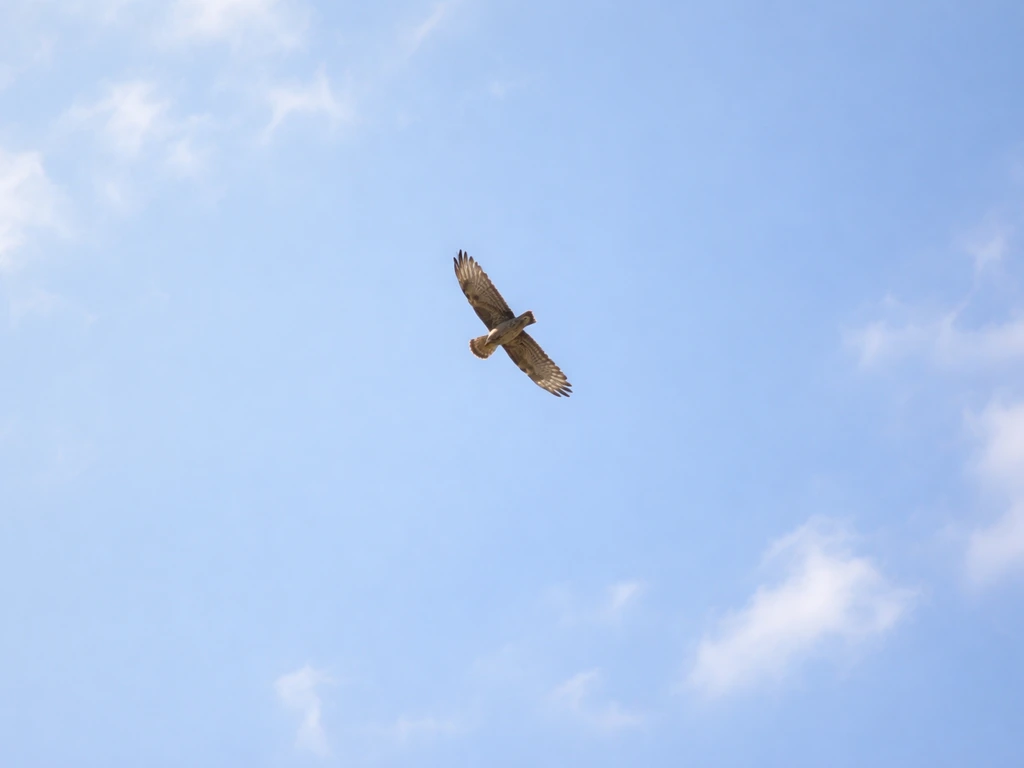
A hawk circling overhead
Here is where the ecological and spiritual perspectives actually work beautifully together. Hawks circle to ride thermals, which are rising columns of warm air that let them gain altitude and scan for prey without burning much energy. So a circling hawk is, quite literally, doing the most efficient thing possible to get the highest view. Spiritually, that is a near-perfect metaphor: you are being invited to rise above the immediate situation, see the full landscape, and find the most efficient path forward without burning yourself out. If you are caught in the weeds of a problem right now, a circling hawk is a pretty direct prompt to zoom out.
A hawk swooping low or diving near you
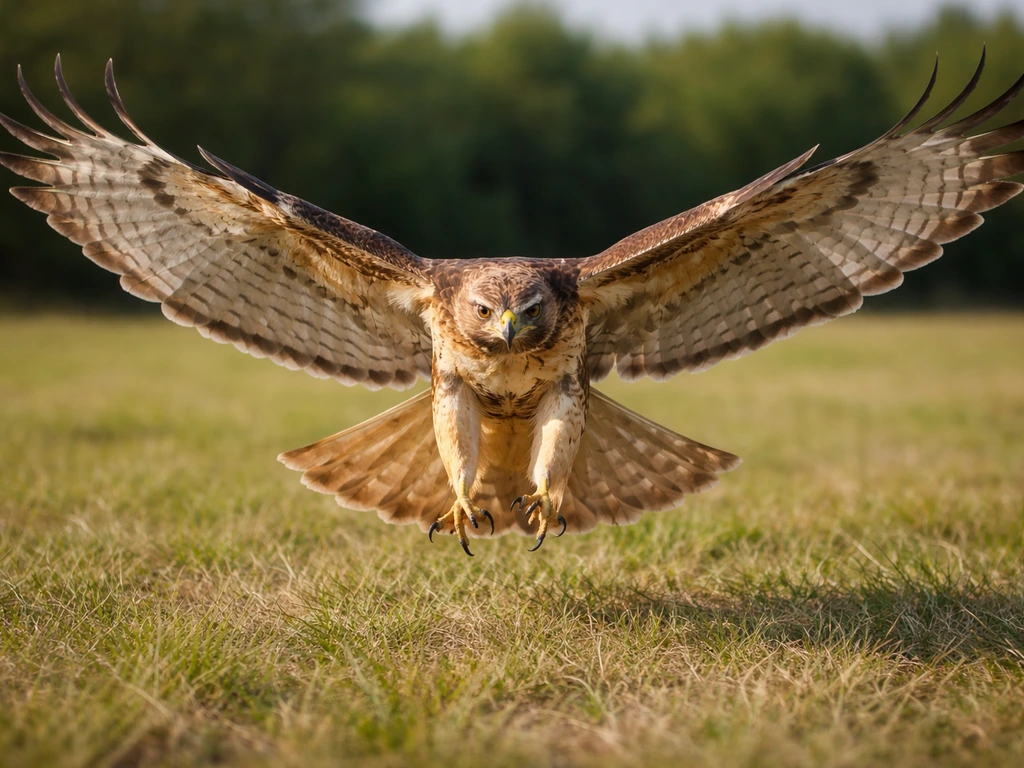
A low swoop that feels deliberate, especially if the hawk makes eye contact, is often read as a call to action. Where circling says "get perspective," swooping says "now is the moment to move." It can signal that you have been watching long enough and it is time to make the precise, focused strike on whatever goal or decision you have been circling yourself. It can also be a gentle but firm boundary-setting message: the hawk is telling you to protect your territory or your energy.
A hawk landing near you or holding its ground
This is the encounter that tends to feel most personal. When a hawk lands close and stays calm in your presence, many people describe feeling seen in a way that is hard to put into words. Spiritually, this is often interpreted as direct confirmation: you are on the right path, a spirit guide or protective energy is close, or something you have been doubting deserves your trust. It can also be a reminder to be still, to stop pushing, and to let clarity come to you rather than chasing it.
Repeated hawk sightings over days or weeks
As mentioned above, repeated sightings often have a simple ecological explanation, especially during nesting season when hawks are highly territorial and visible. But if the sightings feel meaningful across multiple locations or life moments, the repeating symbol is generally read as a persistent theme your awareness keeps returning to. It is less about the individual encounter and more about the pattern: what question or life theme keeps reappearing alongside these sightings? That thread is usually the message.
How different spiritual traditions read the hawk
One of the things I appreciate most about hawk symbolism is how consistently positive (though nuanced) it appears across very different traditions. That said, it is important to hold these interpretations lightly and avoid flattening rich cultural meanings into oversimplified summaries.
| Tradition | Common hawk symbolism | Notes |
|---|---|---|
| Indigenous North American (broadly) | Messenger, guide, protector, change-bringer | Varies widely by nation; avoid treating all Native traditions as one unified view |
| Ancient Egyptian | Sacred solar bird (linked to Horus); divine sight and kingship | The falcon/hawk was one of the most revered birds in Egyptian cosmology |
| Celtic | Keen perception, long memory, connection to the Otherworld | Hawks appeared in Celtic lore as omens requiring careful interpretation |
| Biblical/Christian | Complex; 'hawk' in scripture often refers loosely to small raptors in translation | Symbolic use is filtered through old translation conventions, not a single fixed meaning |
| Korean historical | Courage and justice (hawks used as emblems for roles like the Imperial Censorate) | Cultural use of hawk imagery tied to integrity and sharp judgment |
| Modern/New Age | Spirit guide, heightened awareness, spiritual liberation, visionary power | Contemporary synthesis drawing from multiple traditions |
One thing worth flagging: some sacred meanings in Indigenous traditions are intentionally restricted and not meant for outside interpretation. Just as certain Apache ceremonial objects were considered too sacred for outsiders to observe or discuss, it is worth approaching culturally specific hawk symbolism with humility and genuine respect rather than borrowing it wholesale for personal use. You can draw inspiration from universal themes like vision and courage without appropriating a specific sacred practice that was never yours to use.
If you enjoy exploring how different birds carry spiritual weight across traditions, it is worth looking into how other birds in the raptor-adjacent world are interpreted. The nighthawk's spiritual meaning, for instance, adds a fascinating nocturnal and liminal layer that contrasts interestingly with the hawk's daytime, solar energy.
Is this a warning or a sign to move forward?
This is the question I get most often, and the honest answer is: it depends on what you are already feeling. Hawks are not inherently warning signs, but they are sharp-edged symbols that can cut in more than one direction depending on your current situation. Here is a simple way to think about it.
If the hawk encounter leaves you feeling expanded, clear, or quietly confident, that is typically your intuition recognizing a "green light" energy. Something in your life is aligned, a decision you have been sitting with is ready to be made, or you are being reminded that you have more strength and clarity than you have been giving yourself credit for. These encounters often show up right before a breakthrough or at a turning point where momentum is available.
If the encounter leaves you feeling unsettled, or if your gut tightens rather than opens, pay attention to that. Hawk energy can also signal that you are missing something important, that ego is driving a decision your deeper self disagrees with, or that you need to set sharper boundaries around your time, energy, or relationships. In these cases, the hawk is not a threat; it is the part of you that already knows something is off, using the encounter as a way to get your attention.
The key discernment principle here is to treat the encounter as a reflective prompt rather than a deterministic prediction. Spiritual signs are most useful when they open questions, not when they close them. Avoid spiraling into certainty about what "must" happen as a result of a hawk sighting. Instead, ask what the encounter is pointing toward in your current life and let that guide your reflection. If you enjoy this kind of intuitive inquiry through nature symbolism, you might also find it useful to explore hummingbird spiritual meaning for contrast, since the hummingbird's energy is almost a polar complement to the hawk's, focused on joy, lightness, and presence rather than wide-angle vision and decisive action.
How to personalize the meaning for your specific encounter
The most honest thing I can tell you is that no article, including this one, can give you the definitive meaning of your particular hawk encounter. What I can do is give you a simple method to figure it out yourself, because the meaning that resonates most deeply is always the one your own awareness produces.
Start with four factors: your feelings, the timing, the location, and your current life context. These four variables will tell you more than any symbol dictionary.
- Your feelings: What was your immediate gut response? Awe? Unease? A sense of recognition? Your first emotional reaction before the analytical mind kicks in is usually the most accurate data point.
- Timing: Was this encounter during a moment of decision, grief, transition, or celebration? Symbols land differently depending on what chapter of your life they arrive in.
- Location: Was this near your home (personal life), near your workplace (career/purpose), during a commute (transition), or in nature (inner life/spiritual matters)? Location often points to the area of life being highlighted.
- Current life context: What is the single biggest question or challenge you are sitting with right now? Hold that question up against the hawk's core themes of clarity, vision, focus, and courage. Where does something click?
Some birds carry gentle, song-like energy in their spiritual symbolism, and the contrast can help you sharpen your hawk reading. The nightingale's spiritual meaning, for example, tends to be connected to emotional expression and inner voice, while the hawk is more about external perception and decisive clarity. If both themes feel relevant to your situation right now, that combination is itself worth exploring in your reflection.
What to do right now: reflection prompts and next steps

If you have had a hawk encounter and you want to work with it meaningfully, here is a simple process you can start today. You do not need any special tools, just a few minutes and something to write with.
- Write down the encounter in as much detail as you can remember: the time of day, the weather, what the hawk was doing, how long it lasted, and what you were thinking about immediately before it happened.
- Note your gut reaction in one sentence: what did it feel like in your body when it happened? Did you feel called to pay attention, relieved, or cautious?
- Write down the one biggest life question you are currently wrestling with. Now read the core hawk themes (vision, focus, courage, protection, seeing the bigger picture) and ask: which of these directly addresses where I am stuck or what I need most right now?
- Ask yourself: 'If the hawk were reflecting something back to me about how I am showing up in this situation, what would it say?' Write the first answer that comes, without editing it.
- Give it 48 hours. Sit with the message rather than forcing certainty. Notice if the theme shows up again in other forms: a conversation, a dream, a line in a book. Repetition across multiple channels tends to confirm what the initial encounter pointed toward.
- If the sighting felt heavy or anxiety-inducing, ground yourself first. Take a walk, breathe, and remind yourself that animal signs are reflective, not predictive. They do not cause outcomes. They invite awareness.
You might also find it useful to compare the hawk's energy with another large, soaring bird in the spiritual symbolism space. The buzzard's spiritual meaning, for instance, often deals with themes of release, transformation, and patience that overlap with but differ from the hawk's more action-oriented, visionary energy. If your hawk encounter felt more about letting go than moving forward, the comparison might help you refine your interpretation.
A few grounding reminders before you walk away
Hawk encounters are meaningful when you treat them as invitations to reflect, not as commands or prophecies. The bird is doing what birds do: hunting, flying, nesting, riding thermals. The meaning layer you add to that is yours to create and yours to benefit from. That is not a reason to dismiss it; it is actually what makes the process powerful. You are the one who noticed, you are the one who felt something, and you are the one who gets to decide what resonates.
Stay curious, stay grounded, and trust that your own perception, much like the hawk's, is sharper than you think.
FAQ
How can I tell whether my hawk sighting is a spiritual prompt or just a normal seasonal behavior?
Use the four-factor check (how you felt, timing, location, and what was already going on). If the timing matches nesting season, the hawk stays visible in the same local area, and you feel neutral or only mildly curious, a normal ecological explanation may be enough. If the encounter clusters around a key decision moment, and you felt a clear emotional spike (calm certainty or genuine unease), treat it as a personal prompt and reflect, not predict.
Does the hawk’s direction of flight (toward me, overhead, away) change the meaning?
It can, as a pattern you notice, but keep it flexible. Toward or overhead often reads as “direct attention” (becoming aware of something). Away can feel like “release” (you are being nudged to stop chasing the answer). The practical test is your body response, if your chest relaxes it likely points to alignment, if it tightens consider boundaries or a missing piece.
What if I feel scared or threatened during the encounter, what should I do spiritually and practically?
First handle safety: give the hawk space and avoid approaching if it is nesting or defending. Spiritually, fear often signals a boundary issue, not a doom message. Ask, “What in my life am I trying to rush or control?” then take one small grounded action that restores choice (write the decision, set a limit, ask for clarity), rather than waiting for another sign.
Do different hawk species always have different spiritual meanings?
They often shift the emphasis, but the strongest signal is still your lived reaction. A red-tailed hawk is commonly read as bold “big picture” clarity, while other species may feel more specific or situational. If you cannot identify the species, don’t force it, instead focus on the encounter details you do know (distance, behavior, your emotion) and let that guide your interpretation.
What should I do during a hawk moment if I’m trying to make a major decision?
Use the hawk’s “precision” energy as a decision tool. Take 5 minutes to list the options, then choose the one that lets you see the bigger context and act cleanly. If you feel unsure, do one reality check step (gather facts, talk to someone affected, set a deadline). Spiritual prompts work best when they turn into concrete next actions.
If I keep seeing hawks repeatedly, does that mean the same message every time?
Usually it means the same theme is returning, not an identical literal message. Each sighting may point to a different layer, such as clarity in one instance and boundaries in another. Track patterns in a quick note: date, location, what you were thinking about, and your emotion. After a few entries, the recurring “question” becomes easier to see.
Is it okay to treat a hawk sighting as a sign that something bad will happen?
Be cautious. The article’s discernment approach applies here: hawk symbolism is not inherently predictive, it is reflective. If you start spiraling into certainty or fear, pause and ask what belief you are trying to protect (avoidance, guilt, control). Then ground yourself with one tangible step that supports your well-being, like limiting doom-scrolling or making a plan for what you can influence.
How do I know whether to interpret the hawk as protection versus a warning?
Look at your emotional baseline. “Protection” often feels like steadiness, being held, or renewed confidence, while “warning” often feels like discomfort that points to a misalignment or boundary you are ignoring. If you feel uneasy, translate it into an action item: what limit needs to be set, what conversation needs to happen, or what information is missing.
Can I work with hawk symbolism in a spiritual practice without appropriating Indigenous meanings?
Yes, if you stay with universal themes and avoid borrowing sacred protocols. Focus on general qualities like vision, courage, and perspective, and treat specific Indigenous ceremonial meanings as off-limits unless you have direct, respectful permission or guidance. A good rule is, if a practice is tied to a specific community’s sacred role, keep your use as personal reflection rather than adopting rituals or claims.
What should I write down right after a hawk encounter to get clarity quickly?
Write four short lines: your feeling (expanded, calm, unsettled), timing (what day and what you were facing), location (home, work, road, outdoors), and the life context (what decision or issue was active). Then add one sentence starting with, “This sighting invites me to…” and make it an action you can do within 24 to 48 hours.
Is a hawk crossing your path the same spiritually as a hawk nesting nearby for weeks?
They can feel different because the “story” differs. A cross-path encounter is often read as a timely prompt, something meant to interrupt your pattern right now. A hawk repeatedly nesting nearby often suggests an ongoing theme, more like a background lesson about focus, boundaries, or perspective that evolves as your life situation changes.
How can I compare hawk meaning with other birds without confusing myself?
Use contrasts sparingly. One useful method is to choose one “complement” bird for comparison and stop there. If you compare too many birds, your interpretation becomes a collage. Ask one question only: “Does the hawk’s message lean toward action and wide-angle clarity, or does it need emotional expression or presence instead?” Let that single contrast refine your next step.
Next Article
Humming Bird Spiritual Meaning: What Your Encounter Says
Interpret a humming bird encounter spiritually with practical signs for love, joy, change, messages, and next steps.