A Cooper's hawk crossing your path spiritually points to one core theme: seeing clearly and acting with precision. Whether it locked eyes with you from a fence post, circled low overhead, or has been showing up near your home repeatedly, the message most people receive from this bird circles around focused awareness, sharpening your perception, and trusting your instincts enough to move decisively. That said, what the encounter means for you specifically depends heavily on context: what you were doing, what was on your mind, how the bird behaved, and whether this feels like a one-off or a pattern.
Cooper Hawk Bird Spiritual Meaning: What It Means for You

Eliza Thornwick
7 May 2026
What a Cooper's hawk symbolizes spiritually
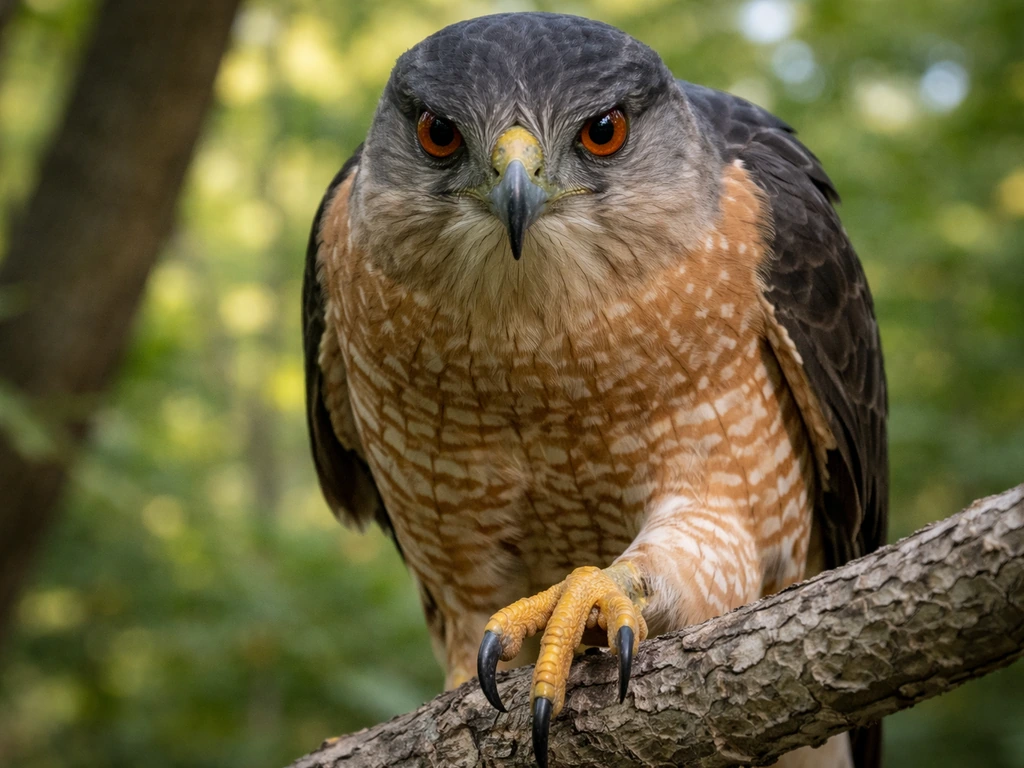
Cooper's hawks are built for precision. They're agile, fast, and intensely focused hunters, capable of threading through dense forest at speed to catch prey that other predators would miss entirely. That biology maps almost perfectly onto the spiritual symbolism most traditions attach to this bird. The Cooper's hawk is widely associated with keen vision (both literal and intuitive), purposeful pursuit, and the ability to see what everyone else overlooks.
At its heart, the Cooper's hawk asks: are you really paying attention? Not just looking, but seeing. Animal communicators and spiritual teachers consistently frame hawk presence as a nudge to cut through noise and perceive what is actually in front of you, not what you expect or hope to find. That might mean seeing a relationship more honestly, recognizing an opportunity others are missing, or finally acknowledging something you've been avoiding.
Beyond vision, this hawk carries themes of protection and drive. Cooper's hawks are famously bold, known to defend their nests against animals many times their size and to pursue prey with almost reckless determination. Spiritually, that translates to themes of protecting what matters to you, committing to a pursuit with your whole self, and not flinching when things get difficult. If the general hawk is a messenger of vision and awareness (which you'll find explored in broader hawk symbolism), the Cooper's hawk specifically adds an edge of precision and tenacity to that message.
- Keen sight and heightened perception, both outer and inner
- Focused drive and purposeful pursuit of goals
- Protection of what you love and value
- The courage to see truth clearly, even when it's uncomfortable
- Precision and decisive action at the right moment
- Awakening intuition and trusting your instincts
How to read a Cooper's hawk encounter
Not every hawk sighting carries the same weight, and reading the encounter honestly is the most important part of working with this symbolism. A Cooper's hawk passing overhead once while you're walking to your car is a very different experience from one that lands ten feet away and stares at you for two minutes. Context is everything here.
Just seeing one
If you simply spotted a Cooper's hawk in passing, take it as a soft prompt. Hawk symbolism around 'activate your inner vision' works well here: it's an invitation to pay closer attention to what's around you, particularly anything you've been moving through on autopilot. Ask yourself what you were thinking about just before you noticed the bird. First impressions after a sighting often carry the most honest intuitive data.
Watching you or holding eye contact
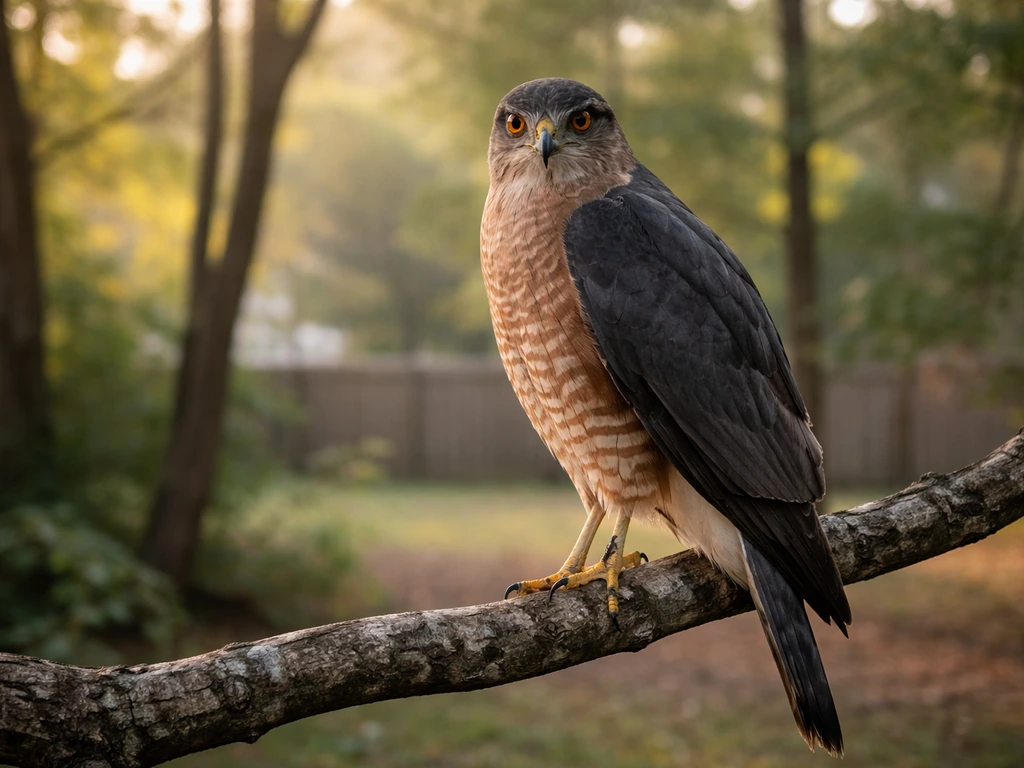
When the bird seems to focus on you specifically, whether it's perched and watching, or holds your gaze, the sense of being 'seen' is usually the message. This often arrives when someone is being less than fully honest with themselves or others. The hawk's unflinching stare is a kind of spiritual mirror. What would you see if you looked at your current situation with that same clear, steady gaze?
Flying low over you or circling overhead
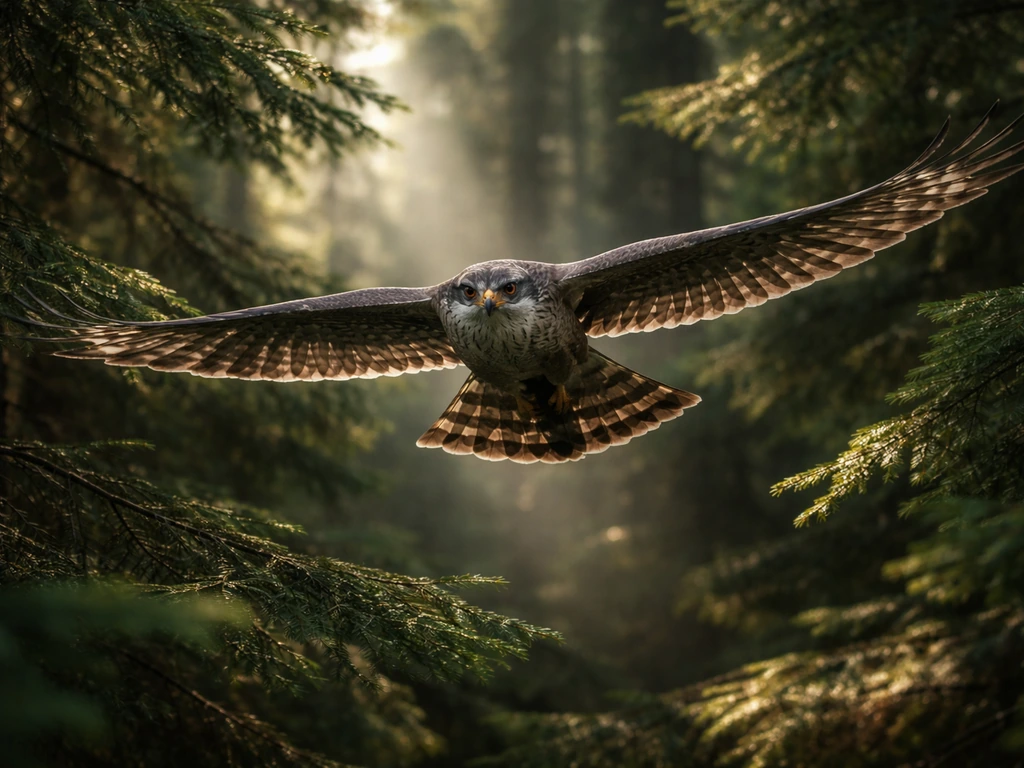
Low flight directly over a person feels deliberate and often signals that a message is close and urgent. Circling overhead, though, can mean a few different things. Spiritually, it often suggests a watchful, protective presence: something or someone is keeping an eye on a situation you're navigating. Before you assign that meaning, though, it's worth knowing that Cooper's hawks and other raptors perform slow, arcing soaring flights during courtship and territorial display. If it's spring or early summer and the bird is circling broadly, that may simply be natural behavior rather than a sign pointed at you.
Repeated or unusually frequent sightings
Repeated encounters are the ones that feel hardest to dismiss, and often they shouldn't be. When a Cooper's hawk keeps appearing over several days or weeks, especially during a period of stress or decision-making, the core invitation is usually to slow down and actually do the inner work the symbolism is pointing toward. That said, a practical note matters here: Cooper's hawks are increasingly common in suburban and urban areas, and if your yard or neighborhood has bird feeders or dense shrubs, you may simply live in a good habitat for them. Repeated sightings can absolutely carry spiritual weight and have a mundane explanation at the same time. Both things can be true.
What Cooper's hawk behavior tells you spiritually
The hawk's specific actions during an encounter can shift or deepen the message considerably. Here's how to think through the most common behaviors people report.
Stalking or hunting near you
Cooper's hawks are famous for stalking prey with patience and then striking with explosive speed. If you witness this hunt up close, the spiritual message tends to be about strategy: don't rush. Watch. Gather information. Act only when you have a clear opening. This hawk isn't an impulsive hunter. It waits for the moment when success is almost certain, and that's a very direct piece of advice if you're facing a decision or opportunity right now.
Landing very close to you
A Cooper's hawk landing nearby, especially if it lingers, tends to feel like the most personally directed encounter people experience. Spiritually, this is typically read as a very clear, close-range message: pay attention right now, in this situation, in this relationship. The proximity can also suggest that the protection theme is active in your life, that someone or something is watching over a situation with care.
Attacking or dive-bombing
This one needs a straightforward practical note first: Cooper's hawks regularly defend their nests by dive-bombing anyone or anything that gets too close, and this behavior is most common from roughly January through August. If a hawk is attacking you, check whether you're near a nest before assigning it a spiritual meaning. That said, if the behavior feels spiritually significant to you, the message is usually about boundaries. Are you in someone else's territory? Are you ignoring a clear warning in a relationship or situation? The hawk protecting its nest is completely unambiguous about what it values and what it will defend.
Sitting still and watching without moving
When a Cooper's hawk perches quietly and simply observes, this is the clearest embodiment of its core message. Be still. Watch more than you move. There is information available to you right now that you'll only receive if you slow down and look carefully. This encounter often comes to people who are rushing decisions or feeling scattered.
Cooper's hawk near your home: windows, yards, and nests
Hawks showing up specifically around your home feel personal in a way that passing encounters don't, and there's a lot of rich symbolism to work with here. The home in spiritual terms represents the self, the family, and the inner life. A hawk engaging with your home space often carries messages about protection, domestic truth-telling, or sharpening awareness within your closest relationships.
Hawks and windows
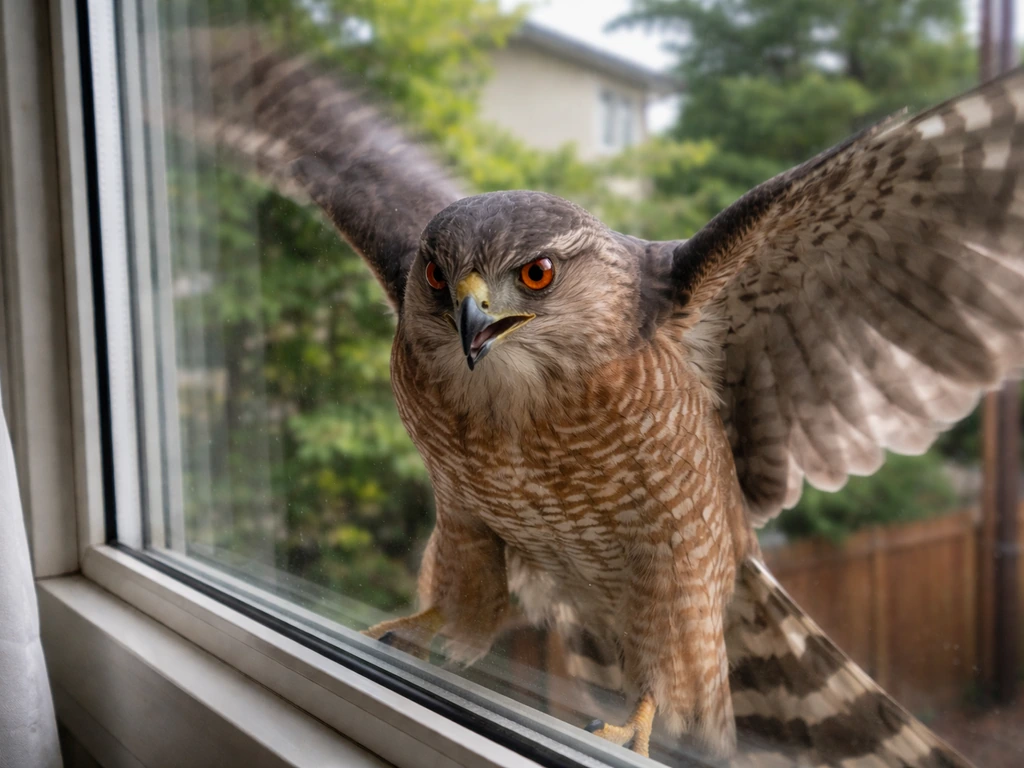
A Cooper's hawk hitting or repeatedly engaging with a window is one of the most common encounters people report as spiritually significant. Before going deep on meaning, it helps to understand what's likely happening physically: [birds hit windows because they see a reflection of trees or sky in the glass and don't realize the glass is there. ](https://www. allaboutbirds.
org/news/why-birds-hit-windows-and-how-you-can-help-prevent-it/) A hawk may also repeatedly strike a window because it sees its own reflection and interprets it as a rival. Both of these have clear behavioral explanations. Spiritually, however, a window encounter often symbolizes something you're not seeing clearly, a barrier between you and a truth, or a situation where what looks transparent is actually reflecting an illusion back at you.
Birds hit windows because they often mistake reflections of trees, sky, or other landscapes on the glass for open space, and they do not realize there is a hard barrier in between reflecting an illusion. If this is happening at your home, it's worth sitting with both explanations and seeing which resonates.
On the practical side, if a hawk is striking your windows repeatedly, you can reduce this by applying tape or decals to the outside of the glass in a grid pattern (spacing no more than 2 inches between horizontal marks, 4 inches between vertical ones). This breaks up the reflection and protects the bird.
Hawks in your yard or returning to your property
Cooper's hawks are regular visitors to yards with bird feeders, not because they want seeds, but because the small birds that come to feeders make easy hunting. If a Cooper's hawk has adopted your yard as a regular hunting ground, there's a solid natural explanation. Spiritually, a hawk making your property its territory often symbolizes protection being extended to your home and family space. It can also be a prompt to look carefully at the ecosystem of your household: what is thriving, what is being neglected, and what needs your focused attention?
Nesting near your home
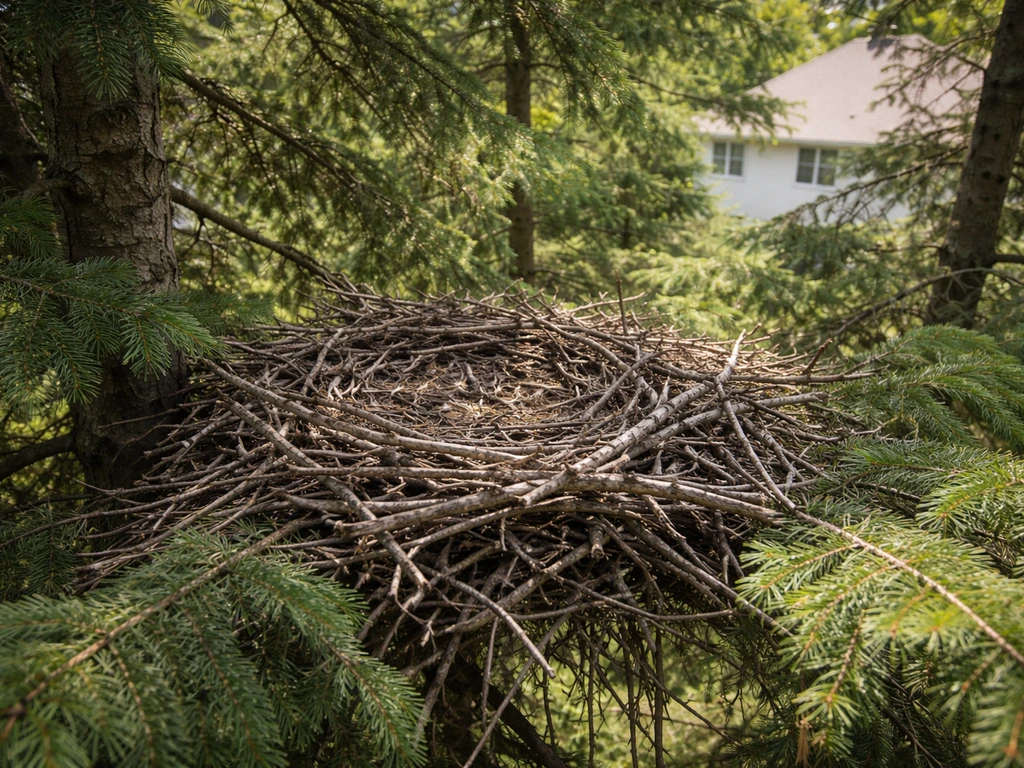
Finding a Cooper's hawk nest in or very near your yard is a significant encounter. Nests are typically built in dense trees, 25 to 50 feet off the ground, and made of sticks with a somewhat flat profile. If a pair has chosen your property to raise young, the spiritual reading leans strongly toward themes of new growth, family protection, and fertile beginnings. This is a bird that has decided your space is safe and worthy of its most precious investment. That's not a small thing, either in nature or in spirit.
Translating the message into your real life
Symbolism is only useful if it helps you do something. Here's how the Cooper's hawk themes translate into the life areas where most people are seeking guidance.
| Life Area | Cooper's Hawk Message | What to do today |
|---|---|---|
| Focus and clarity | You're spreading your attention too thin | Pick the one thing that matters most right now and give it your full attention for 24 hours |
| Relationships | You may not be seeing someone or something clearly | Ask yourself what you'd notice if you looked at this relationship without hoping or fearing anything |
| Boundaries | Something important to you needs defending | Name one boundary you've been hesitating to set and write down exactly what defending it would look like |
| Truth and honesty | A convenient story may be replacing a real one | Identify one thing you've been telling yourself that you aren't sure you actually believe |
| Decisions and timing | Act precisely, not impulsively | List what information you still need before moving. The hawk doesn't strike until the moment is right |
| Personal growth | Your intuition is sharper than you're giving it credit for | Write down one instinct you've been dismissing and consider what it would mean to act on it |
How to work with this symbolism practically
The most grounded way to work with a hawk encounter is to write it down while the details are fresh. Not just what happened, but what you felt in the moment. Where in your body did you feel it? What thought arrived unbidden the second you noticed the bird? Those first-flash responses are usually the most honest intuitive data you have, before your thinking mind starts building a narrative around the experience.
Journaling prompts to try today
- Describe the encounter in plain detail: where, when, what the hawk did, how long it lasted, and how close it was.
- What were you thinking about in the hours or minutes before you saw the hawk? Is there any connection between that and the symbolism?
- What is the one area of your life right now where you feel least clear or most confused? Does the hawk's message speak to that?
- If the hawk could say one sentence to you, what would it be? Write the first thing that comes, without editing.
- What would it mean to act with a Cooper's hawk's precision in your current situation? What would you stop doing, and what would you commit to fully?
A simple reflection practice

After journaling, try sitting quietly for five minutes with the image of the hawk in your mind. Not analyzing it, just holding it. Notice what feelings or images arrive. Hawk energy in meditation is often sharp and clarifying rather than soft or warm. If something uncomfortable surfaces, that's often exactly the thing the encounter is pointing toward. You don't have to solve it in the moment. Just acknowledge it.
A caution about over-interpreting
One thing worth saying plainly: not every hawk encounter is a personal message. Cooper's hawks are increasingly common in cities and suburbs, and if you live near trees, feeders, or open water, you may simply be in their habitat. The encounters that carry spiritual weight tend to feel different from incidental sightings. They're unusual in some way, they arrive during a charged moment, or they repeat in a way that doesn't seem coincidental. If a sighting felt like nothing more than a nice moment with a wild bird, it's completely okay to let it be just that. Forcing meaning onto every encounter dilutes the ones that are genuinely significant.
Cultural and folk traditions: what they add to your reading
Different traditions bring different lenses to hawk symbolism, and knowing even a little about them can help you find the framing that fits your own background and beliefs.
Native American traditions
Across many Indigenous North American cultures, hawks are considered sacred messengers and protectors, often serving as intermediaries between the human and spirit worlds. It's important not to collapse dozens of distinct nations into a single 'Native American belief,' because tribal traditions vary considerably, and many have specific stories and protocols around hawk clans and hawk medicine that belong to those communities. What can be said broadly is that the hawk as messenger and protector appears across multiple traditions, and if you have specific Indigenous heritage, exploring your own people's relationship with this bird is far more meaningful than a generic interpretation.
Celtic and European folk traditions
In Celtic tradition, birds of prey were often associated with clarity of thought, warrior energy, and the ability to perceive beyond surface appearances. Hawks appearing in folk omens across European traditions were generally read as signs of a message incoming, or as portents that required you to be alert rather than passive.
Judeo-Christian references
Hawks appear in the Bible primarily in the context of God's creation and wisdom, with references that emphasize the hawk's instinctive flight patterns as evidence of divine design. While hawks aren't assigned a specific spiritual message in scriptural texts the way some animals are, the overarching theme in biblical reference leans toward natural wisdom and the idea that creation itself communicates.
Japanese tradition
In Japanese culture, dreaming of a hawk (particularly as part of the Hatsuyume, or first dream of the new year) is considered a very fortunate omen, associated with strength, good luck, and successful ambitions for the year ahead. This framing is notable because it aligns the hawk with aspiration and forward momentum rather than warning or caution.
How to choose the meaning that's right for you
With all these frameworks available, the question becomes: which one do you use? The most honest answer is to start with what resonates emotionally before you reach for a tradition. Read through the themes above and notice which framing made you feel something, a recognition, a small jolt of 'yes, that.' Your gut response to the symbolism is itself an act of the hawk's core gift: seeing clearly. If you come from a specific cultural background where hawk symbolism is part of your tradition, start there. If you're drawing from multiple traditions or none in particular, lean into the universal themes: perception, precision, protection, and truth. Those translate across every framework.
The Cooper's hawk is a distinct species from the broader hawk family, and its spiritual identity shares ground with general hawk symbolism while bringing its own specific qualities of agility, urban presence, and relentless focus. The buzzard bird spiritual meaning is another powerful way to explore what your sightings might be pointing you toward.
Explore the hawk bird spiritual meaning in a broader sense to see how similar themes of perception, protection, and instinct show up across different hawk types. If you find yourself exploring the spiritual meaning of hawks more broadly, the nighthawk, the buzzard, and other hawk-adjacent birds each carry their own distinct symbolic energy worth exploring separately.
If you are drawn to the spiritual meaning of the Nightingale bird, it carries a different kind of symbolism rooted in song, beauty, and emotional expression spiritual meaning of hawks more broadly. The nighthawk bird spiritual meaning can add a helpful extra layer to your interpretation of nighttime signs and intuition.
Whatever framework you land on, the Cooper's hawk's gift is ultimately the same: it shows up and asks you to look more carefully. If you're specifically curious about humming bird spiritual meaning, the same themes of heightened awareness and intuitive guidance can show up in a softer, more heart-led way. At your situation, at yourself, at what you've been half-seeing and half-ignoring. That's not a complicated message. But acting on it, really acting on it, is exactly the kind of precise, committed move this bird embodies.
FAQ
My cooper hawk encounter felt unclear. How can I figure out what it was pointing to?
If the meaning feels confusing, use a two-step filter. First, check what you were doing right before you noticed the hawk, because timing often links the message to the decision you were already weighing. Second, compare the bird’s behavior to your current emotional state: a watchful perch and steady gaze usually points to clarity and truth, while a fast, purposeful hunt-like pass often points to strategy and timing.
How do I know whether my cooper hawk sighting is spiritual or just random wildlife?
Yes. One of the easiest mistakes is treating every sighting as a destiny message. A more practical approach is to only elevate the encounter if something “sticky” happened (your attention was strongly captured, it repeated in a short window, or it showed a distinctly directed behavior like holding your gaze). Incidental sightings, especially in bird-rich suburbs, are best kept as neutral observations.
If a cooper hawk keeps hitting my windows, should I treat it as a spiritual sign or a physical issue?
Window strikes are sometimes interpreted as a spiritual warning, but the immediate cause is usually optical, reflection-based behavior. If you want to blend both, do the practical fix first (apply decals or tape in a tight grid on the outside of the glass). Then, when you still feel an inner “truth is being blocked” theme, take that as reflection of what you are avoiding, rather than as proof that the hawk is delivering a direct psychic warning.
My cooper hawk shows up around my house a lot, but it doesn’t attack me. What does that usually mean?
If a hawk lingers near your home but seems indifferent to you, the message often leans toward awareness and protection rather than direct confrontation. People commonly overread the “personal” aspect when the bird is simply using your area for prey. A good decision aid is to look at the surroundings: did you recently change lighting, add feeders, or notice more small birds? Those changes can turn your property into a hunting hotspot.
How can I tell if a cooper hawk circling overhead is just territorial behavior or a message meant for me?
Courtship and territorial display can look like “targeted messaging,” especially when birds are circling broadly. A helpful cue is season and pattern: broad, arcing circles in spring or early summer are often natural behavior, while repeated low, direct passes close to your path during a high-stress period are more likely to feel like a prompt. Still, you should treat seasonality as a modifier, not as a full explanation.
If the hawk seems to return to the same spot (like near a doorway or window), what should I do with that?
If you notice the hawk near a window, fence post, or specific doorway repeatedly, it can be worth doing a “boundary inventory” of that exact life area. Ask what is on the other side of that boundary (a conversation, an agreement, a decision, an emotional wall). If your feeling is “I keep putting this off,” that aligns well with the hawk’s theme of precision and decisive action, not vague rumination.
What should I prioritize if the cooper hawk is dive-bombing or acting aggressively?
If you ever experience an actual dive-bombing or aggressive behavior, treat it as an urgent safety cue before anything spiritual. Check for a nest nearby, especially in the typical January through August period, and keep distance from the area. After you address safety, you can still reflect on the symbolism as “clear boundaries,” but do not assume the bird is attacking you because of your thoughts.
After I interpret a cooper hawk spiritual meaning, what practical step should I take?
For most people, the best next step is a short “precision action,” not an abstract vow. After journaling or meditation, choose one concrete move that matches the hawk’s nature: send the email you are delaying, set a firm boundary with a specific person, or make a decision using the information you already have. If there is no clear action you can take within 24 to 72 hours, the symbol may be prompting awareness rather than immediate action.
Next Article
Nightingale Bird Spiritual Meaning: What It Signals Now
Interpret nightingale signs now: love, healing, inner guidance, renewal, protection, plus journaling and simple intentio