
A feather shows up on your path, your windowsill, or right outside your door, and something in you pauses. That pause is worth paying attention to. In spiritual and animal-symbolism traditions, bird feathers are widely understood as messengers: small, physical nudges that prompt you to reflect on where you are, what you need, and what might be shifting in your life. This guide is going to help you move from "I found a feather, now what?" to a clear, personal interpretation and a concrete next step, all grounded in the specific feather in front of you.
Bird Feathers Spiritual Meaning: How to Interpret a Feather

Eliza Thornwick
5 Apr 2026

What people actually mean by "bird feather spiritual meaning"
When someone searches for this, they usually just found a feather and want to know if it means something. The answer across most spiritual traditions is: yes, it can, and the meaning is almost always layered. Modern spiritual writers overwhelmingly frame found feathers as prompts for reflection about your current path, with recurring themes of guidance, protection, and intuition. The idea is not that the feather is a fortune-telling device; it is more like a tap on the shoulder from the universe (or your higher self, your ancestors, or a spirit guide, depending on the tradition that resonates with you).
One of the most frequently cited themes is transformation. Finding a feather, especially during a period of uncertainty or change, is often interpreted as an invitation to lean into that shift rather than resist it. Think of it less as a prophecy and more as a question the feather is asking you: "What is trying to change in your life right now?" That framing keeps the meaning useful rather than overwhelming.
It is worth noting one practical reality before going further. In the United States, the Migratory Bird Treaty Act makes it illegal to possess feathers from most native North American wild bird species without a permit. The U.S. Fish & Wildlife Service policy library explains that migratory bird permitting covers possession of feathers and other remains or parts under the Migratory Bird Treaty Act (MBTA) framework, including how permits apply. This applies even to feathers you find on the ground. So while you can absolutely pause, observe, photograph, and interpret a feather spiritually, be aware of the legal landscape around keeping it. When in doubt, leave it where it is or photograph it for your reflection later.
How to interpret the feather you found: a context checklist

The biggest mistake people make when looking for feather meaning is skipping straight to color symbolism without considering context. Where and how a feather appears shifts the message significantly. Work through these questions first, and your interpretation will be far more personally relevant.
Location: where exactly did you find it?
- On your body or clothing (landed on you): This is widely considered one of the most direct and personally addressed signs, often interpreted as protection or an immediate message from a guide or loved one who has passed.
- On your doorstep or threshold: Thresholds carry deep symbolic weight in most traditions. A feather here often signals a transition or invitation: something new is about to enter your life, or you are being protected at the boundary of your home.
- Indoors (on a windowsill, floor, or bed): An indoor feather is rarer and often treated as a stronger signal because there is no obvious explanation for how it got there. Many people interpret this as a message from a deceased loved one or a spirit guide.
- Near a window (especially after a bird strike or tapping): The window itself carries meaning as a threshold between your inner world and the outer world. If a bird was involved, exploring the spiritual significance of a richly feathered bird encounter can add a valuable layer to your interpretation.
- Outdoors on a trail, yard, or open field: This is the most common scenario. Here, the meaning tends to be more general: a reminder to stay aware, to trust your path, or to pay attention to what you were thinking about in the moments before you found it.
Timing: when did it appear?
Were you in the middle of a difficult decision? Grieving someone? Feeling stuck? The feather appearing in the context of a specific emotional state or life question is the universe (or your own intuition) giving you material to work with. Note what you were thinking about in the ten or fifteen minutes before you found it. That mental and emotional context is often the most important data point you have.
Condition: what does the feather look like?
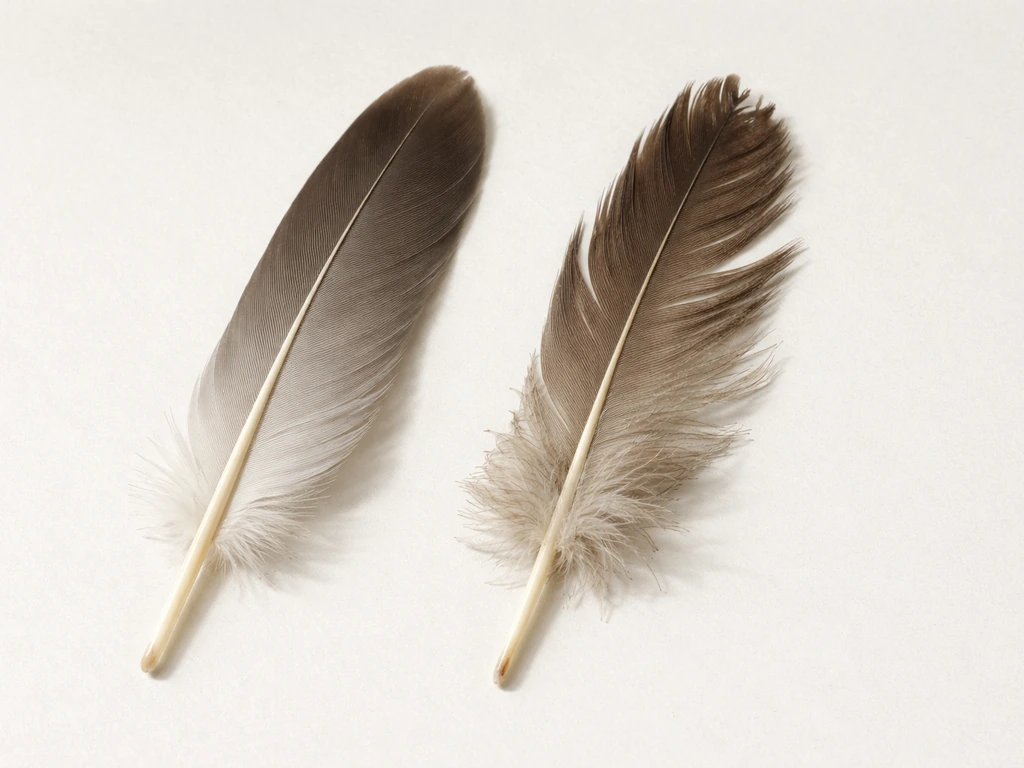
- Fresh, clean, and whole: Generally interpreted as a clear and positive message, something undiluted and direct.
- Worn, damaged, or fragmented: May signal that a transition is incomplete, that you are still in the middle of a process, or (in some traditions) that extra cleansing or grounding is needed.
- Small downy feather vs. large flight feather: Down feathers are often linked to comfort, gentleness, and nurturing energy. Large primary flight feathers tend to carry stronger associations with freedom, direction, and movement.
- Unusual placement (upright in soil, arranged with other objects): When a feather seems deliberately placed, most spiritual practitioners treat it as a heightened or more intentional sign.
Spiritual messages by feather color
Color symbolism is probably the most widely searched aspect of feather meaning, and for good reason: color is the first thing you notice. Here is how the most common colors are interpreted across modern spiritual and animal-symbolism frameworks, along with a note on where traditions tend to agree and where they diverge.
| Feather Color | Common Spiritual Theme | Good Questions to Ask Yourself |
|---|---|---|
| White | Purity, peace, protection, angelic presence, a message from a deceased loved one | Am I seeking reassurance? Is someone I have lost trying to reach me? |
| Black | Protection, the shadow self, transition, magic, mystery, or a call to look inward | What am I avoiding? What transformation am I resisting? |
| Gray | Neutrality, calm, patience, a need to find the middle path between two extremes | Where in my life am I being too rigid or too permissive? |
| Brown | Grounding, stability, home, earth energy, practical matters needing attention | What in my physical or material life needs tending? |
| Red or orange | Vitality, courage, passion, life force energy, creativity awakening | Where do I need to act boldly right now? |
| Blue | Communication, truth-speaking, spiritual insight, calm clarity | What truth am I avoiding saying or hearing? |
| Green | Growth, healing, heart opening, abundance, a new beginning in health or relationships | Where in my life is healing possible right now? |
| Yellow or gold | Optimism, intellect, solar energy, a call to reclaim joy or confidence | Where have I lost my sense of joy or purpose? |
| Iridescent or multicolored | Integration, wholeness, a message that multiple aspects of your life are converging | What seemingly separate parts of my life are actually connected? |
| Black and white | Balance, duality, the need to reconcile opposites in your current situation | Where am I seeing things as all-or-nothing when nuance is needed? |
One honest note: if you look up black feather meaning in ten different sources, you will get ten slightly different answers, ranging from "warning" to "powerful protection" to "a shift in consciousness." That range is not a problem; it reflects the genuinely diverse traditions that engage with feather symbolism. Trust the interpretation that lands most meaningfully given your current context rather than hunting for a single universal answer.
When you can identify the bird species

Knowing which bird left the feather adds a meaningful layer to the interpretation because each species carries its own set of spiritual associations. The Feather Atlas is provided by the U.
S. Fish and Wildlife Service and is an image database dedicated to identifying and studying North American birds’ flight feathers built from the National Fish and Wildlife Forensics Laboratory’s curated collection. The catch is that feather identification is genuinely tricky. Feathers vary depending on a bird's age, sex, and molt stage, and damage or wear can make visual ID even harder.
Rather than forcing a certain ID, it is better to narrow it down to two or three likely species and hold the meaning loosely. Treat it as "this feather might be from an X, which would suggest Y" rather than a definitive conclusion.
That said, some species are easy to identify by color and size, and their spiritual meanings are rich and well-established. If you found a small, streaky brown feather on your porch, it could well be from a sparrow, a bird whose spiritual meaning centers on community, simplicity, and finding value in the everyday. A small bright yellow or greenish feather might point to a finch, and the finch carries spiritual meaning tied to joy, cheerfulness, and a lightening of spirit.
If the feather has distinctive black and red or black and yellow markings, you might be looking at a woodpecker species. A black-spotted feather with a tan background could point to a flicker: the flicker's spiritual meaning is strongly connected to rhythm, awakening, and the return of light after darkness. More specifically, if you are in North America and the feather has salmon-pink or yellow shafts, it is likely a northern flicker, and the northern flicker's spiritual meaning carries themes of opportunity knocking and the courage to answer. If you can not identify the bird at all, lean on color and condition as your primary interpretive tools. The message is still there.
How different cultures read feather symbolism (and why meanings vary)
One of the most common frustrations people have when researching feather meaning is getting contradictory answers. A black feather is a warning in one source and a protection symbol in another. That contradiction is not a mistake; it reflects genuinely different cultural frameworks, each of which has its own internal logic.
- Many Indigenous North American traditions treat feathers as sacred objects carrying the spiritual power of the bird. Specific feathers (eagle, hawk, owl) are used in ceremony and carry precise meanings tied to that tribe's cosmology. These meanings are not generic and should not be appropriated or oversimplified.
- In Celtic traditions, birds and their feathers were often seen as messengers between worlds, particularly between the living and the dead. A feather found near a threshold or during a liminal time (dawn, dusk, seasonal transitions) was especially significant.
- Christian symbolism associated white feathers with angels and divine presence, while certain birds (the dove above all others) carried specific theological meaning.
- Eastern philosophical traditions, particularly those influenced by Taoism and certain Buddhist schools, tend to frame animal encounters including feathers less as directed messages and more as reminders of interconnection and impermanence.
- Modern Western spirituality and New Age frameworks synthesize many of these traditions, often layering color psychology, chakra associations, and numerology (for example, if you find three feathers) onto older symbolic foundations.
The reason meanings differ is not that one tradition is right and the others are wrong. It is that each tradition developed within a specific ecological, historical, and cultural context. An owl feather means something specific in a tradition where owls are seen nightly and associated with death and wisdom, and something different in a tradition where owls are rare and seen as purely magical. The most honest approach is to be aware of these differences, honor the source traditions with respect, and then ask: which framework resonates most authentically with my own experience and worldview?
What to actually do after you find a feather
This is where a lot of spiritual content drops the ball by stopping at the interpretation without giving you anywhere to go. Here is a practical sequence you can use today.
Step 1: Ground yourself before interpreting
Before you assign any meaning, take thirty seconds to ground yourself. Stand or sit, feel your feet on the floor or ground, take three slow breaths. This is not ceremonial fluff; it is practical. Grounding moves you out of the reactive, anxious interpretive state ("is this a warning?") and into a calmer, more receptive one. From there, the meaning that comes to you is far more likely to be useful.
Step 2: Journal with specific prompts
Open a journal or your phone's notes app and answer these questions honestly:
- What was I thinking about, worrying about, or asking about in the moments before I found this feather?
- Where exactly was the feather, and does the location feel significant?
- What is the feather's color, size, and condition, and what does my gut say those suggest?
- If I already know what I need to hear right now, what would that message be? Does it match what the feather seems to be saying?
- What is one small action I could take today that aligns with this message?
That last question is the most important one. A spiritual sign is only useful if it moves you toward something. If a white feather brings you comfort about a loss, the action might be writing a letter to the person you lost. If a red feather feels like a call to courage, the action might be sending one email you have been avoiding.
Step 3: Set a clear intention
Once you have a working interpretation, state it as an intention rather than a question. Instead of "I wonder if this means I should make a change," try: "I am open to the change that is coming, and I choose to move through it with courage." Stating an intention activates your own agency in relation to the message, which is the whole point.
Step 4: Simple protection and cleansing practices

If the feather's message felt heavy, unsettling, or ambiguous, a brief cleansing practice helps restore your sense of energetic clarity. You do not need an elaborate ritual. Some people smudge their hands with smoke, wash their hands with cold water while imagining static energy washing away, or simply say aloud: "I receive what is meant for me and release what is not." A brief gratitude practice, acknowledging three specific things you are grateful for right now, is one of the most consistently effective ways to shift from anxious interpretation to grounded receptivity.
Step 5: Keep a running feather log
If feathers show up in your life with any regularity, keeping a simple log (date, location, color, condition, what you were thinking about, and your initial interpretation) can reveal patterns over weeks or months that a single encounter cannot. You may find that certain colors appear during certain life phases, or that feathers consistently appear when you are at a decision point. That pattern becomes its own form of guidance.
FAQ
Is it okay to take a photo or keep a feather when I want to reflect later?
Yes for most people, photograph first so you do not lose context like exact location, lighting, and condition. If you plan to keep it, double check local and national rules where you live, since in the US many native bird feathers are protected even if they are found on the ground.
What does it mean if I find a feather but feel nothing emotional or spiritual?
Sometimes the “message” is simply your notice and attention shifting, not a strong symbol. Treat it as a prompt to ask one practical question, such as what you have been avoiding today, even if you do not get an immediate intuitive hit.
Should I trust the color meaning I read online, or should I ignore it?
Use online meanings as options, not conclusions. Your context from the minutes before you found the feather is a better anchor than a generic lookup, especially for shades like black that can carry very different interpretations across traditions.
What if the feather is damaged, dirty, or looks different than photos online?
Focus on overall cues instead of perfect matches, for example size, shaft color, pattern layout, and whether it seems freshly shed or worn. Damage and molt stage can change how a feather looks, so aim for “likely” rather than a forced identification.
How can I interpret a feather that shows up repeatedly, not just once?
If it repeats, shift from asking “what does it mean” to asking “what keeps coming up in my life right now.” A simple log (date, location, condition, your leading thought) helps you see whether the same theme returns at specific decision points.
What should I do if my interpretation feels scary, like a warning?
Pause and verify you are not projecting anxiety onto the sign. Ground first, then look for a concrete, non-catastrophic next step, such as setting a boundary, asking for clarification, or making a small plan, rather than assuming an outcome.
Can a feather meaning differ depending on where I found it (door, window, car, bed)?
Yes, location can act like an “activation field.” For example, near a door or window often feels like an invitation to pay attention to what is entering or leaving your life, while inside spaces may point to inner work like a conversation you need to have.
How do I handle contradictory meanings, like black being “warning” in one source and “protection” in another?
Choose the framework that best matches your current emotional state and what you are already sensing. A helpful test is actionability: the interpretation that moves you toward a healthy step, not fear, is usually the one to follow.
Is it disrespectful to assign spiritual meaning to a feather from a bird I cannot identify?
No, it is still meaningful when you stay humble and interpret loosely. Use what you can observe, color, condition, and your context, and treat any species-based layer as “possibly,” not as a definitive claim.
What is the most useful next step after I interpret the feather?
Turn it into an intention and then choose one small action within 24 to 48 hours. Intention alone can stay abstract, so pair it with something concrete, like writing a message, starting a task, or making a decision you have delayed.
Next Article
Hamerkop Bird Spiritual Meaning: Messages, Encounters, Guidance
Hamerkop bird spiritual meaning by encounter, covering intuition, boundaries, protection, love guidance, and a daily rit