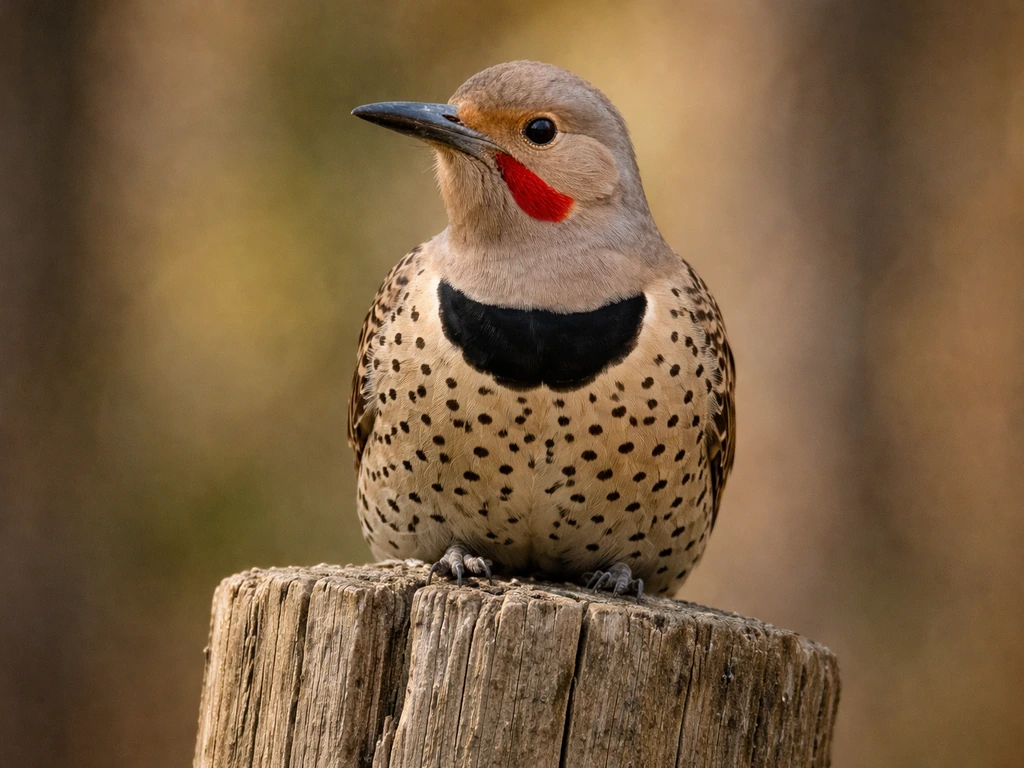
The Northern Flicker is carrying a message, and the specifics of your encounter matter more than you might think. Whether it was drumming on your roof at dawn, flashing those brilliant wings as it flew past you, or sitting on the ground in your yard looking almost too calm, there is a meaningful spiritual thread running through each of those scenarios. This guide will walk you through how to read your specific encounter and, more importantly, what to actually do with it today.
Northern Flicker Bird Spiritual Meaning and What to Do

Eliza Thornwick
14 Apr 2026
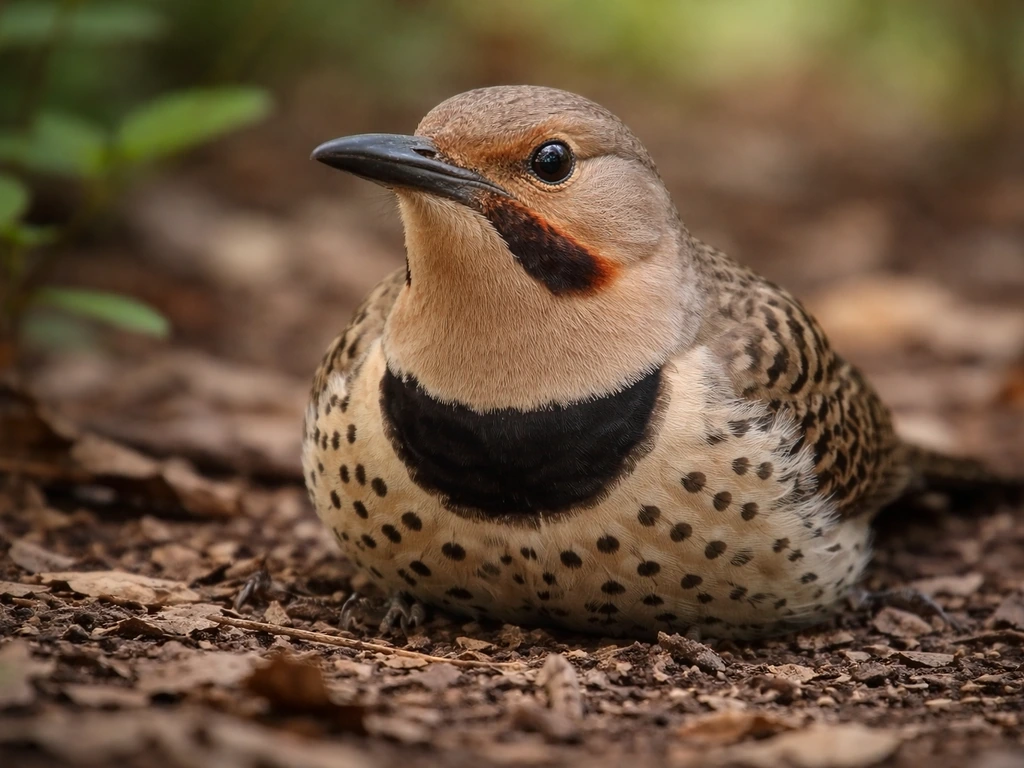
First: make sure you actually saw a Northern Flicker
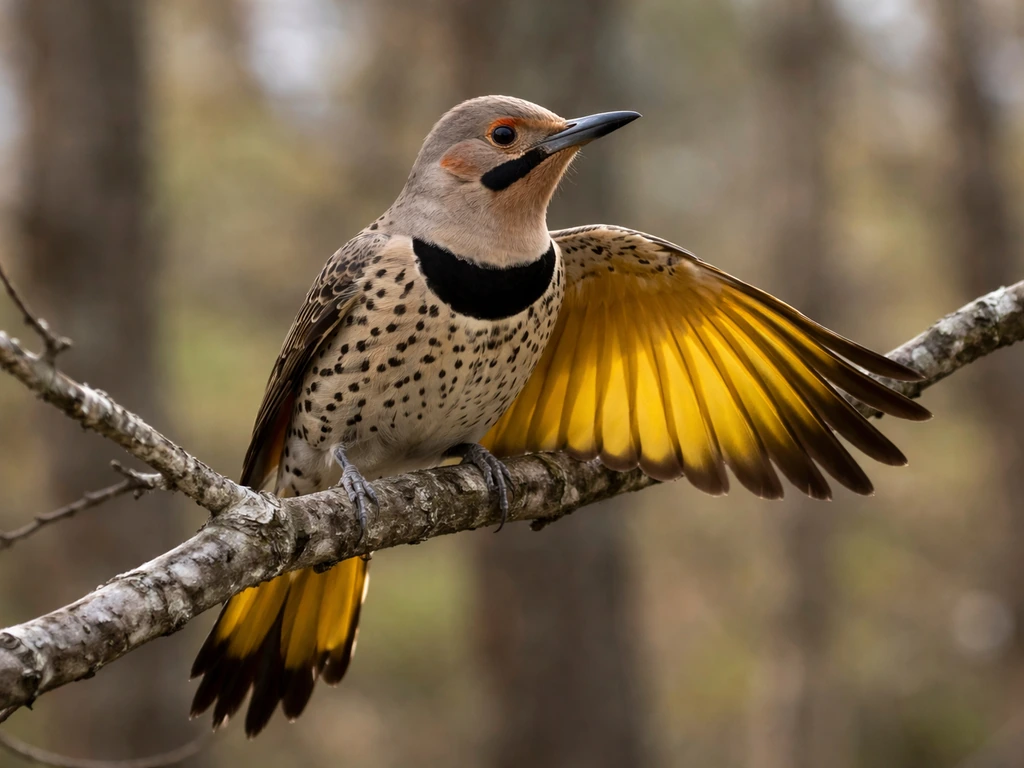
Identification matters here because the spiritual meaning shifts depending on which bird you actually encountered. The Northern Flicker is a woodpecker, but it behaves in ways that set it apart from most other woodpeckers. The single clearest field mark is the flash of color under the wings and tail when it flies. If you are in the eastern United States or Canada, that flash will be a bright, unmistakable yellow. If you are out west, it will be red. These two groups are called the Yellow-shafted and Red-shafted Flicker respectively, and they are the same species.
Male flickers also carry a bold cheek stripe called a malar mark. On yellow-shafted birds, that stripe is black. On red-shafted birds, it is red. Females have none, which can make them look plainer at first glance. The other big giveaway is behavior: Northern Flickers spend a lot of time on the ground, poking through leaves and grass for ants and beetles. Most other woodpeckers you might confuse them with stick almost entirely to tree trunks and branches. If you saw a robin-sized bird with a spotted breast, a black bib, and a swooping, undulating flight that revealed vivid color underneath the wings, that was almost certainly a Northern Flicker.
One more nuance: if you live in a region where the eastern and western ranges overlap, you might see an intergrade bird with blended traits. Audubon reports that Northern Flickers can hybridize in hybrid zones, where mixed lineage can lead to wing and shaft color changes in intergrade birds blank" rel="noopener noreferrer">intergrade bird with blended traits. In those cases, the underwing and undertail color combined with your geographic location are still your most reliable guides. If you want to deepen your understanding of how feathers and their colors factor into spiritual interpretation, the broader topic of bird feathers and their spiritual meaning is worth exploring, because the yellow or red shaft of the Flicker is itself symbolically loaded.
Getting the species right matters because the Northern Flicker carries a very specific symbolic signature, distinct from the smaller, tree-bound woodpeckers many people conflate it with. Confirming you saw a Flicker means the themes below apply directly to your experience.
The core spiritual themes of the Northern Flicker
Across multiple traditions, the Northern Flicker shows up as a messenger of transition, persistence, and deep listening. In several Native American traditions, the Flicker is associated with healing, the heart, and protection of the home. Its red or yellow coloring links it to the south or east on the medicine wheel depending on the tradition, connecting it to warmth, new beginnings, and the life force. Celtic and earth-based traditions tend to read woodpecker energy, including the Flicker, as a call to pay attention to rhythms, both in nature and in your own life.
The Flicker's ground-feeding habit is also spiritually significant. Unlike most of its woodpecker relatives that work exclusively high on trees, the Flicker comes down to earth. Many people who encounter this bird describe it as a grounding message, a reminder to root back into what is foundational, your home, your body, your relationships, and your sense of purpose. It does not abandon its ability to climb and drum. It just is not afraid of the ground either. That balance of high and low, spiritual and practical, is one of the Flicker's defining symbolic gifts.
The drumming behavior adds another layer. The Flicker is one of the loudest drummers in the bird world, and drumming in shamanic and indigenous traditions is a language of its own. Audubon Field Guide also notes that Northern Flickers have ringing calls and short bursts of drumming heard in spring across most of North America. It breaks through ordinary awareness to signal something worth hearing. When a Flicker drums, it is not just looking for food. It is also communicating. Spiritually, that translates to a nudge to listen more carefully, to what others are telling you, to what your body is saying, or to guidance you may have been too busy to notice.
The Flicker's call, a sharp descending "klee-yer" that carries a long distance year-round, reinforces this theme of communication. It is not shy. It announces itself. As a spiritual symbol, this bird often arrives when you need to stop holding back your own voice or when an important message is about to reach you.
What your specific encounter probably means
Seeing one in passing
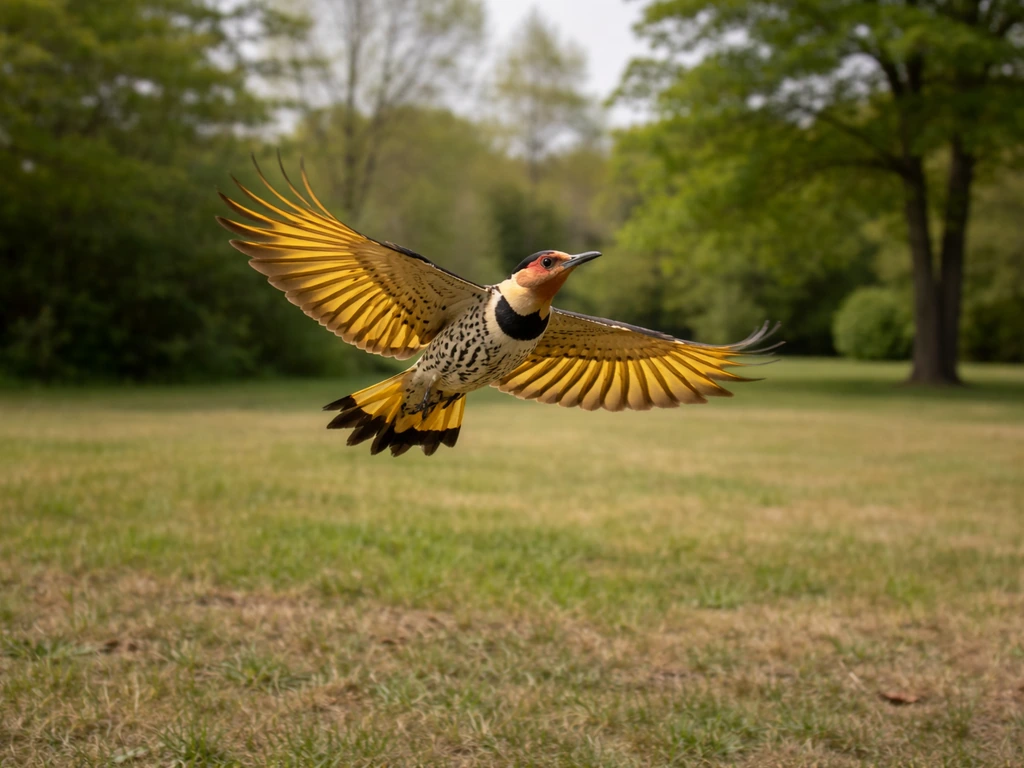
A single sighting of a Northern Flicker flying overhead or foraging in a nearby field is generally read as a gentle reminder. The universe is flagging something for your attention. What were you thinking about when you saw it? That context is often the most useful clue. The flash of yellow or red as it takes flight is a classic symbol of insight arriving suddenly, a bright idea, a moment of clarity, or a sign that something hidden is about to be revealed. Sit with whatever came to mind in that moment. It probably was not accidental.
Hearing it without seeing it
The Flicker's loud, carrying call is the bird's way of being present without being visible. If you heard that descending "klee-yer" and looked around but could not find the source, this is often interpreted as a message to trust what you sense but cannot yet see. Something is happening in your life that is not fully visible yet, maybe a relationship dynamic that has not surfaced, an opportunity that has not announced itself clearly, or guidance that is coming from a direction you have not thought to look. Hearing without seeing invites patience and inner listening.
A close flyover or near pass
When a Flicker flies close enough that you feel the air or lock eyes with it even briefly, that is a much more personal encounter. The closer the bird, the more directly the message is meant for you. A close pass often signals an urgent nudge toward a transition you have been resisting or delaying. The Flicker coming into your personal space is essentially asking: what are you waiting for? This is a good moment to ask yourself honestly where in your life you have been stalling.
Reading the behavior: drumming, pecking, and nesting
Tapping or drumming on your home
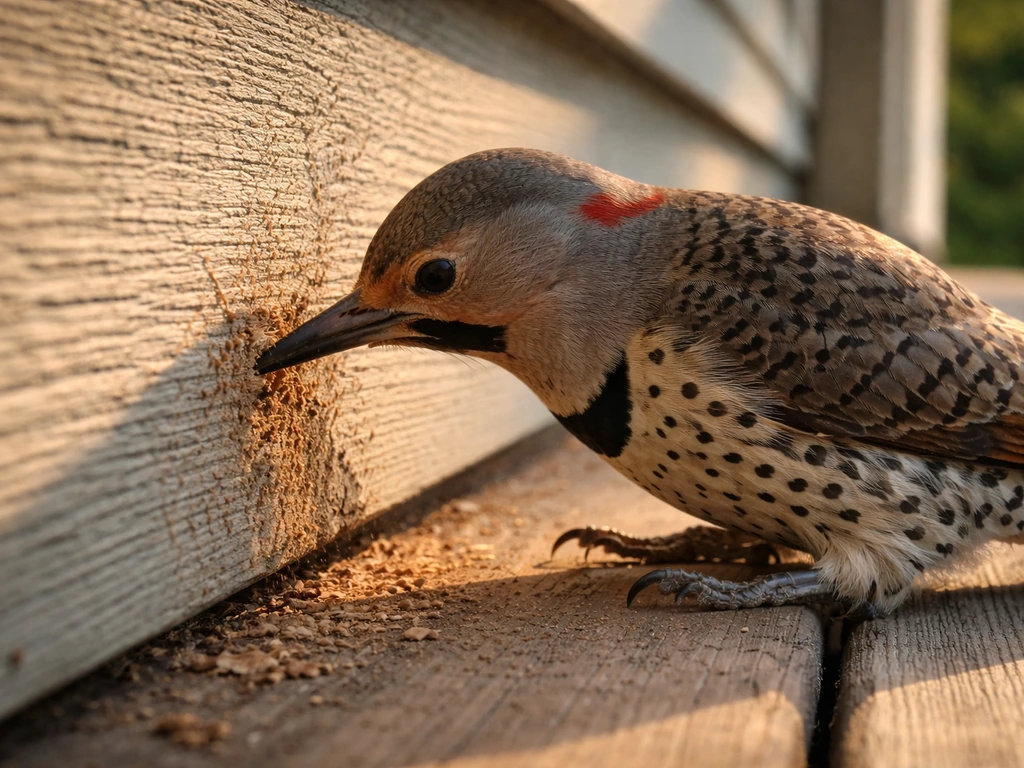
This is probably the most reported encounter, and it comes with both a spiritual and a practical dimension. Spiritually, a Flicker drumming on your house is a strong message about your home life, your foundations, and the structures you have built, both literally and emotionally. In many traditions, this is read as a call to examine what needs renovation, not necessarily the siding, but the habits, relationships, or patterns that form the walls of your daily life. Is there something at home that needs more honest attention?
The drumming can also be a message about communication within the household. Flickers drum to announce themselves, to claim space, and to find a mate. If conflict or silence has settled into your home, the Flicker drumming on it may be asking you to break that silence, to speak up and be heard.
On the practical side, a Flicker drumming on wood siding, a chimney cap, or gutters is sometimes looking for insects, which means there may be an actual infestation worth investigating. Spiritual signs and practical problems are not mutually exclusive. You can honor both by acting on the physical message (checking for wood damage or insects) while also sitting with the reflective questions the bird raised.
Pecking holes or excavating wood
Flickers excavate nest cavities in dead or dying trees and occasionally in wooden structures. Finding a Flicker actively drilling a hole carries a layered message. On one hand, it speaks to persistence and the willingness to do the hard work of making something habitable. On the other, it asks: what in your life is dead wood that needs to be cleared away so something new can nest there? The Flicker does not excavate healthy, living wood if it can help it. It finds what has already given up its vitality and makes something useful from it. That is a powerful metaphor for grief, release, and renewal.
Nesting near your home
Finding a Flicker nest, or watching a pair of Flickers set up house near yours, is one of the most positive signs you can receive from this bird. It speaks directly to protection, fertility, and the anchoring of good energy in your home space. Multiple traditions read nesting birds near the home as a blessing on the household. This is a moment to set clear, grounded intentions about what you want to build in your own life, and to appreciate what is already working.
When it lands on you or keeps following you
A Northern Flicker landing on you is rare, and rare encounters tend to carry the strongest personal messages. If a Flicker lands on your hand, shoulder, or even your head, most spiritual traditions would read this as direct contact from a guide or messenger. The specific meaning depends on what is happening in your life, but the common thread is this: you are being asked to pay attention to your own inner guidance right now, not to default to other people's opinions or external validation. The Flicker chose you in that moment. That specificity matters.
If a Flicker seems to follow you through a yard, a park, or even over several days in repeated close encounters, it is worth considering whether you have been ignoring a persistent nudge about change. The Flicker is nothing if not persistent. It does not give up easily on something it has set its mind to. Repeated close appearances are often a spiritual pattern asking: are you listening yet? Keep a note of what themes keep surfacing in your life around the times of these encounters.
A useful reference point here is how other small but spiritually significant birds carry similar messages of personal guidance. If you have also been noticing sparrows and their spiritual meaning around you lately, the combination of both birds often amplifies themes of communication, home, and personal purpose.
Northern Flicker vs. similar birds: does the species change the meaning?
Yes, and here is a quick way to sort it out.
| Bird | Key Visual Clues | Main Spiritual Theme |
|---|---|---|
| Northern Flicker (Yellow-shafted) | Yellow underwings/undertail, black malar stripe (males), ground-feeding | Communication, transition, grounding, home |
| Northern Flicker (Red-shafted) | Red underwings/undertail, red malar stripe (males), ground-feeding | Vitality, courage, healing, renewal |
| Downy or Hairy Woodpecker | Black-and-white, small to medium, tree-bound, no wing flash | Persistence, detail-focus, uncovering hidden truths |
| Pileated Woodpecker | Very large, vivid red crest, loud, tree-bound | Power, major life changes, ancestral messages |
| Red-bellied Woodpecker | Red cap, barred back, tree-bound, no ground feeding | Creativity, resourcefulness, problem-solving |
The Flicker's ground-feeding and wing flash are your clearest confirmation markers. If the bird you saw matches those, you are in Flicker territory, and the themes in this article apply. The spiritual meaning of the flicker bird draws on a consistent symbolic core across traditions, so once you have confirmed the species, you can trust the interpretation.
The harder encounters: dead, injured, or damage-causing Flickers
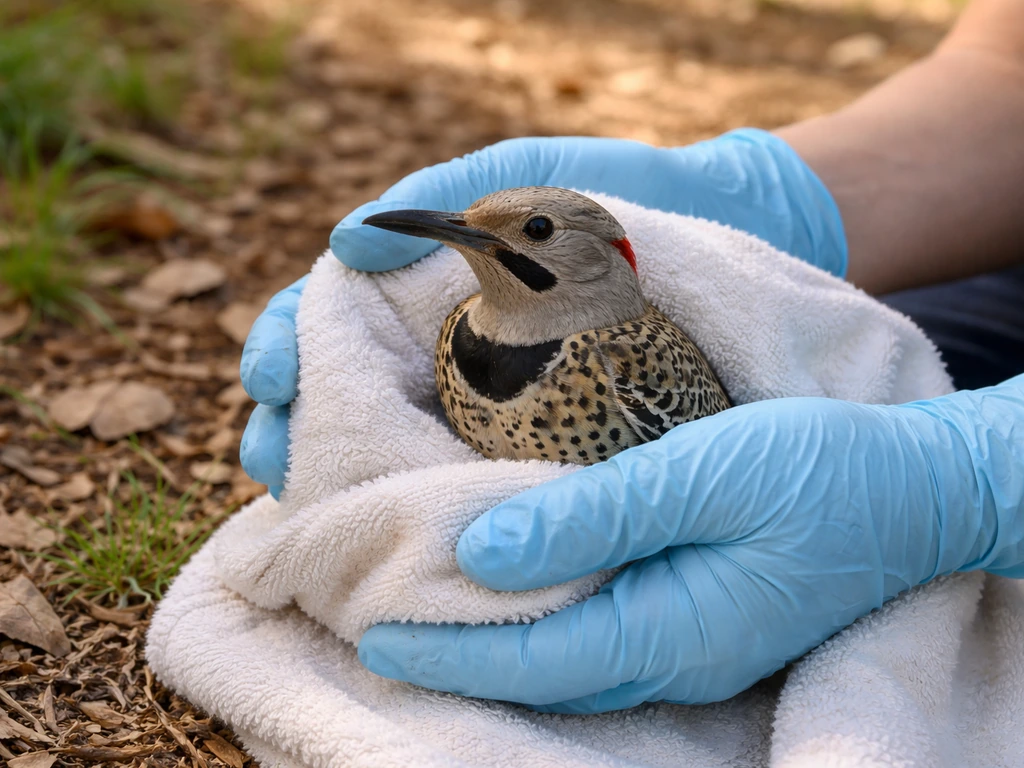
A dead Northern Flicker
Finding a dead Northern Flicker is jarring, and it is okay to feel that way. Spiritually, the death of an animal messenger is rarely a bad omen in the simple sense. More often, it signals the end of a cycle, something that needed to complete, a pattern, a relationship dynamic, a way of being that has run its course. The Flicker's themes of communication and transition applied to death carry a message about letting go of something that has been holding you. What in your life has already run its course, even if you have been reluctant to admit it?
On the practical side, if you find a dead Flicker on your property, handle it carefully with gloves if you need to move it. Contact your local wildlife agency if it appears to have died from an unusual cause. Spiritually, many people choose to acknowledge the encounter with a small gesture: a moment of stillness, a word of thanks, or placing a stone nearby. The act of acknowledgment, however simple, closes the energetic loop.
An injured Flicker
An injured bird that you cannot simply walk away from brings both a spiritual and a practical obligation. Practically, your best action is to contact a local wildlife rehabilitator or your regional animal control service. Do not try to keep or treat a wild bird yourself. Spiritually, an injured Flicker is often read as a message about vulnerability and the limits of persistence. The Flicker, that relentless drummer and digger, brought low and unable to fly, may be asking you: where are you pushing too hard right now? Where do you need to stop, rest, and accept help rather than grinding on alone?
Droppings or wood damage
Flicker droppings on a car or doorstep are read by some as a mild luck symbol, similar to how many cultures interpret bird droppings in general. More relevant is wood damage from Flicker excavation. If a Flicker has drilled into your siding, deck, or eaves, that is a practical problem requiring attention: check for insect activity underneath (that is often what drew the bird), and consider a humane deterrent like reflective tape or hardware cloth over the affected area. Spiritually, the message overlaps with the drilling theme above: something in your home environment or the structures around your life needs to be looked at honestly.
There is also something worth noting about the <a data-article-id="20BA64FB-4DBA-8DB6-1F9FC1FC72E8">spiritual meaning of birds with many feathers or striking plumage, which applies here because the Flicker's dramatic wing coloration, only visible in flight, is often described as the bird revealing hidden gifts at the moment of departure. Even an encounter that feels disruptive carries that thread of something beautiful being shown.
What to actually do today
Here is a decision-tree style breakdown for turning your encounter into actionable reflection. Work through each step in order.
- Confirm the species: use the ground-feeding habit and underwing color (yellow or red flash in flight) to make sure you saw a Northern Flicker. If you did, the themes in this article apply directly.
- Note the context: where were you, what were you thinking about or dealing with that day, and what was the bird doing? These details are your personal decoder ring.
- Match the behavior: sighting or flyover (pay attention, clarity is coming), drumming on your home (examine what needs honest communication), nesting near you (set home and family intentions), landing on you (trust your inner guidance now), dead or injured (something is ending or asking for rest).
- Pick one reflection question: What transition am I avoiding? Where am I not speaking up? What in my home or foundation needs real attention? What am I being asked to let go of? Sit with one of these today, even for five minutes.
- Set a small intention: write it down. It does not need to be dramatic. Something like 'I will have one honest conversation I have been putting off' or 'I will look at what in my routine is dead wood' is more than enough.
- Take one practical step: if the bird caused physical damage, address it. If it died, acknowledge the encounter respectfully. If it nested nearby, celebrate that.
- Watch for repetition: if the Flicker keeps showing up over the next week or two, the message is amplifying. Keep a running note of what is shifting in your life alongside those sightings.
The Flicker is not a subtle bird. It drums loud enough to wake the neighborhood and flashes color that stops you mid-step. When it arrives in your awareness, it is not trying to be mysterious. It is trying to be heard. The most useful thing you can do right now is ask yourself what you have not yet listened to in your own life, and then sit quietly long enough to hear the answer.
If you find that bird encounters keep drawing your attention, it may be worth broadening your understanding of how other species carry related messages. The spiritual meaning of the finch, for instance, overlaps with the Flicker on themes of communication and joyful persistence, and if you are seeing multiple species, the combination often tells a richer story than any single bird alone.
FAQ
If I see a Northern Flicker only briefly, how can I tell what part of the message is most important for me?
Use the context anchor: what you were thinking, doing, or feeling in the seconds just before the flicker appeared. If the key moment was the underwing flash during flight, most people interpret it as “insight arriving,” while ground foraging often points to “rooting into fundamentals.”
I’m in an overlap zone and the bird’s color seems mixed. Does that change the spiritual meaning?
It may change which “palette” you assign (yellow-shafted versus red-shafted), but the core themes usually stay consistent. Focus first on the unmistakable field marks (ground behavior plus the wing and tail flash), then apply the directional nuance only if you can confidently identify the shaft color.
Does hearing the “klee-yer” without seeing a bird mean anything different spiritually?
Yes. Many traditions read “heard but not seen” as guidance that you should trust internally first (senses, hunches, emotions) before you look externally. Practically, it can also mean the bird is close but out of sight, so avoid rushing into conclusions and instead pay attention to what is about to become clear.
What if I have several Flicker sightings but none are close or personal, only passersby in the yard?
Treat it as a gentle, ongoing “theme check” rather than an urgent sign. A useful approach is to keep a short log for a week, noting whether the sightings cluster around the same daily situation (work stress, family conversations, home projects).
Is it a bad omen if a Northern Flicker lands near my doorstep or on my property repeatedly?
Not necessarily. Repeated close appearances are more often read as a nudge toward attention to your home rhythms, communication patterns, or a decision you are postponing. If you are already in a major transition, this can be the bird “mirroring” that shift rather than predicting danger.
What should I do spiritually and practically if a Flicker is drumming on my house?
Do both in parallel. Practically, inspect for insect activity and check nearby wood trim, eaves, or chimney areas for fresh pecking. Spiritually, frame it as a prompt to speak up about a need you have been avoiding, especially if the drumming started during a period of silence or tension at home.
Could drumming on a roof or gutter be just for feeding rather than a “message”?
It can be. Flickers may drum as part of foraging or to probe for insects, so treat it as information about your environment first. You can still use the spiritual layer as reflection, but don’t skip the physical inspection, since wood damage and insect attraction can be real.
If I find a dead Northern Flicker, what is the most grounded way to respond?
Start with safety and cause-checking, especially if there was an impact, odd weather, or nearby hazards like windows, cats, or pesticide use. Spiritually, many people choose a brief acknowledgment (quiet moment, gratitude) without escalating into fear, then ask what cycle in their life has run its course.
How should I handle an injured Flicker that I cannot easily move safely?
Call a local wildlife rehabilitator or animal control and describe where the bird is located and whether it can stand or fly. Avoid attempting to feed, hydrate, or keep it, because improper handling can worsen injuries and can also pose safety risks for you and the bird.
Is it okay to try deterrents like reflective tape if a Flicker is excavating into wood?
Yes, but make sure the area is secured correctly and humanely. Reflective tape may help for a time, and hardware cloth or blocking entry points can reduce repeat drilling, but check the underlying cause (often insects) so you are not only chasing the symptom.
What if the bird drops or droppings are on my car or step, does that definitely mean luck?
Many people assign “luck” meaning to droppings, but it is not a reliable signal on its own. A more actionable read is to focus on whether there is ongoing activity near your home that could indicate excavation or insect attraction.
Can I misidentify a Flicker and still use the spiritual interpretation?
Try not to. Misidentification is the biggest pitfall because the symbolism in this article depends on the Flicker’s distinctive behaviors (especially ground feeding and the wing flash). If you are unsure, wait for clearer confirmation before treating it as a specific northern flicker bird spiritual meaning message.
Next Article
Flicker Bird Spiritual Meaning: How to Interpret It
Flicker bird spiritual meaning decoded: symbolism plus what to do next based on sightings, calls, timing, and behavior.