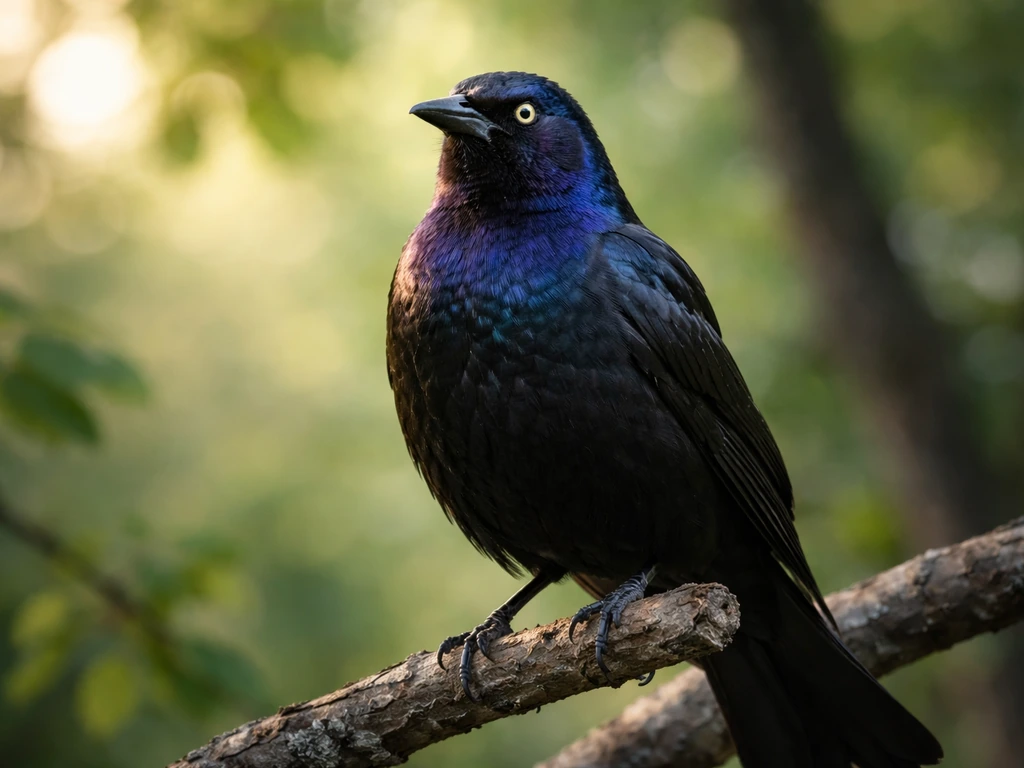
What was actually happening when you saw it
Before you settle on any one interpretation, do a quick mental reconstruction of the moment. Spiritual encounters with birds tend to mirror what's already happening inside you, and the grackle is no different. Think of this as your personal context checklist. Run through it honestly and you'll narrow down the meaning faster than any generic list of symbols can.
- What were you thinking about right before the grackle appeared? A specific person, a decision, a worry?
- Where were you, and does that location carry personal significance (home, workplace, a place tied to grief or change)?
- Were you alone or with someone? If with someone, is that relationship relevant to anything you've been turning over lately?
- Was the grackle alone or part of a flock? One bird vs. many changes the tone of the message.
- What was the bird doing specifically: calling, watching you silently, flying at or near a window, foraging, or following?
- How did you feel in the moment, before you started analyzing it? Unsettled? Curious? Strangely calm? That gut reaction matters enormously.
- Has this happened before? A single sighting is one thing; repeated encounters are something else entirely.
That last question about repetition is worth sitting with. A grackle landing near you once is a nudge. The same bird (or birds) showing up across multiple days or settings starts to look more like a pattern, and pattern recognition is very much part of the grackle's spiritual territory. Write down your answers before reading further, even just a few bullet points in your phone's notes app. You'll use them later.
What the grackle's behavior is actually pointing to
The behavior you observed is probably the most reliable piece of interpretive data you have. Here's a breakdown of the most common grackle behaviors people report feeling spiritually significant, and what those behaviors tend to point toward.
Calling or vocalizing loudly near you
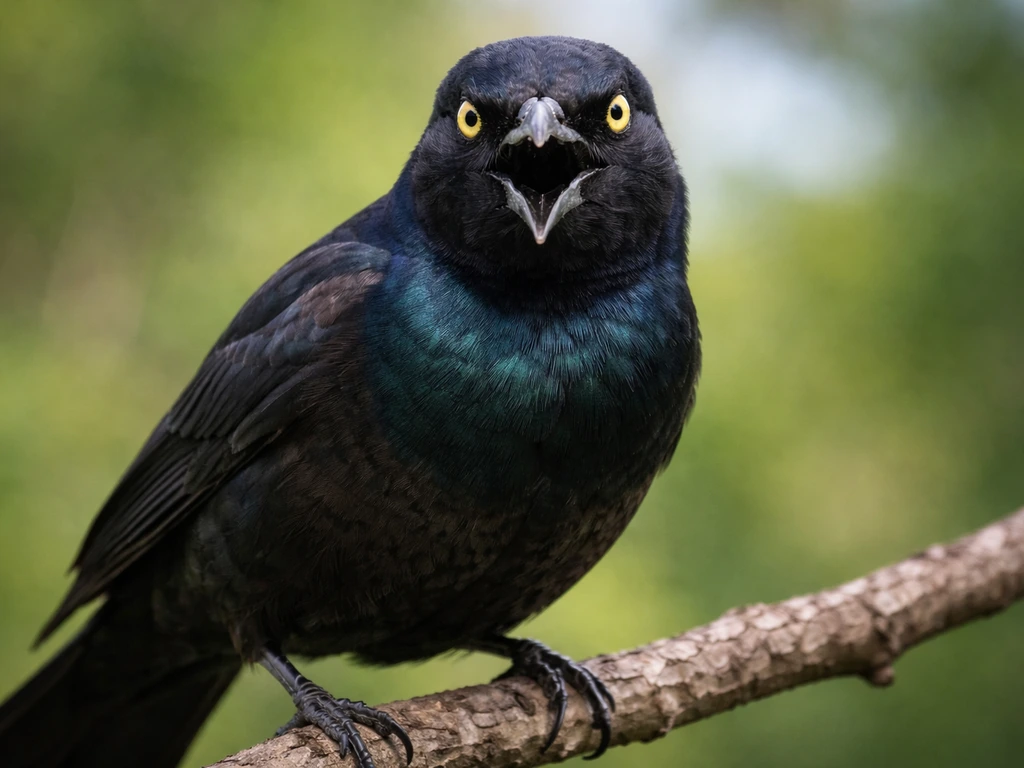
Grackles are noisy birds with a wide range of calls, from melodic whistles to harsh, metallic screeches. If the calling felt directed at you or unusually loud, the message is almost always about communication and expression. Multiple sources in the spiritual symbolism world link the grackle directly to the throat chakra energy: speak up, say the thing you've been sitting on, stop muting yourself in a situation that needs your voice. If you've been staying quiet in a relationship, a workplace dynamic, or even in your own inner dialogue, this one is pointed squarely at that.
Following you or tracking your movement
A grackle that seems to follow you across a parking lot, down a trail, or from tree to tree as you move is one of the more unsettling encounters people describe, and also one of the most personally significant. Think of it as the bird mirroring something that's been shadowing your thoughts. This behavior most commonly maps to adaptability: the grackle is showing you it can move with you, change course, pivot. It may be asking whether you're willing to do the same. It's also worth considering whether something in your life is literally following you, a decision you keep postponing, a conversation you keep almost having.
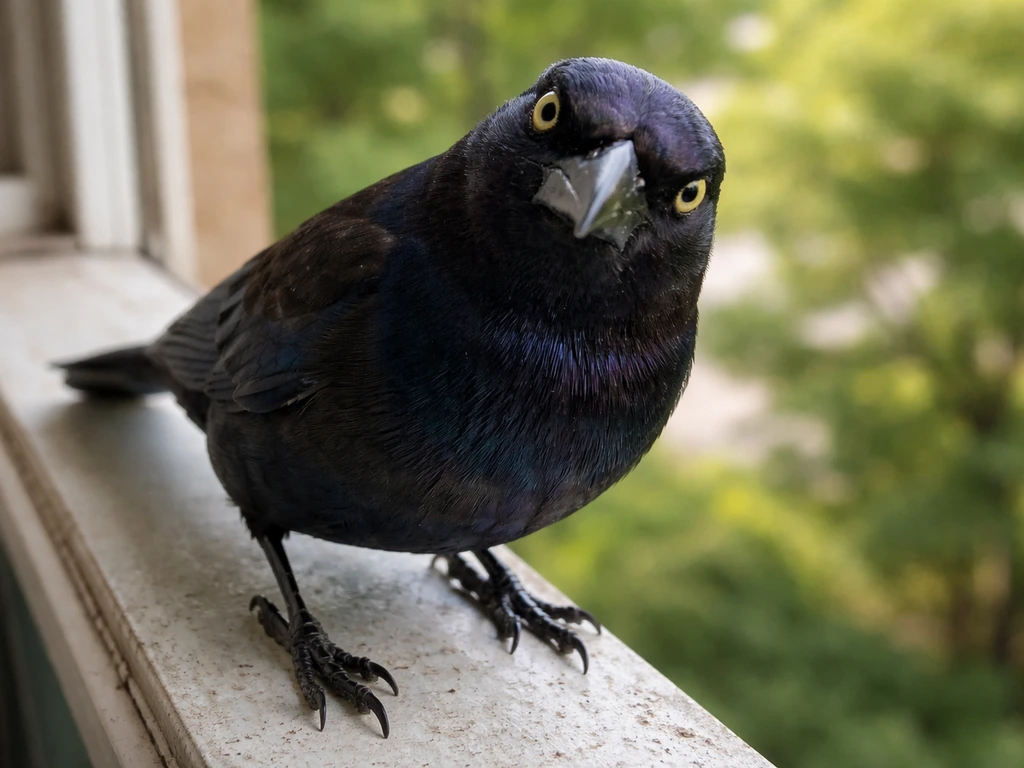
When a grackle lands unusually close, within a few feet, or holds direct eye contact with you, that's generally interpreted as a message delivered with intention. The grackle in this context functions a bit like a messenger that wants to make sure you received it. The spiritual theme here connects to intuition: something you already know on some level is being confirmed. Spirit-animal traditions frame grackle energy as supporting your ability to make right choices by trusting what you already feel, rather than endlessly seeking outside validation.
Tapping on or hitting a window
Window-tapping encounters tend to land differently than other grackle sightings because they feel more urgent and harder to dismiss. Spiritually, a bird striking a window is widely interpreted as a wake-up call, something rattling the boundary between your familiar, comfortable view of things and a larger reality. A peer-reviewed analysis of bird-window strikes, based on bird biology and building and window attributes, discusses why these collisions happen and what factors influence them [bird striking a window](https://pmc. ncbi.
nlm. nih. gov/articles/PMC4701451/). One specific interpretation frames it as 'what is clear and obvious to you is being shaken,' which is worth sitting with.
If there's something in your life you've been pretending you don't already know, this encounter may be calling that out directly. Framing it as a message responding to thoughts or questions you've been pondering, rather than a random scare, usually makes the most sense. The spirit world, as one source puts it, rarely shouts, but window events are as close to a shout as it gets.
Foraging nearby in a way that feels intentional
Grackles are highly resourceful foragers, and if you watched one working methodically through the grass or debris near you, the symbolism often maps to resourcefulness and practical intelligence. This behavior tends to appear when someone is in a season of problem-solving or feels like they don't have enough (enough time, money, options, support). The grackle here is essentially modeling: look harder at what's already around you. The answer or resource you think you're missing may be closer than it appears.
Appearing as part of a large flock
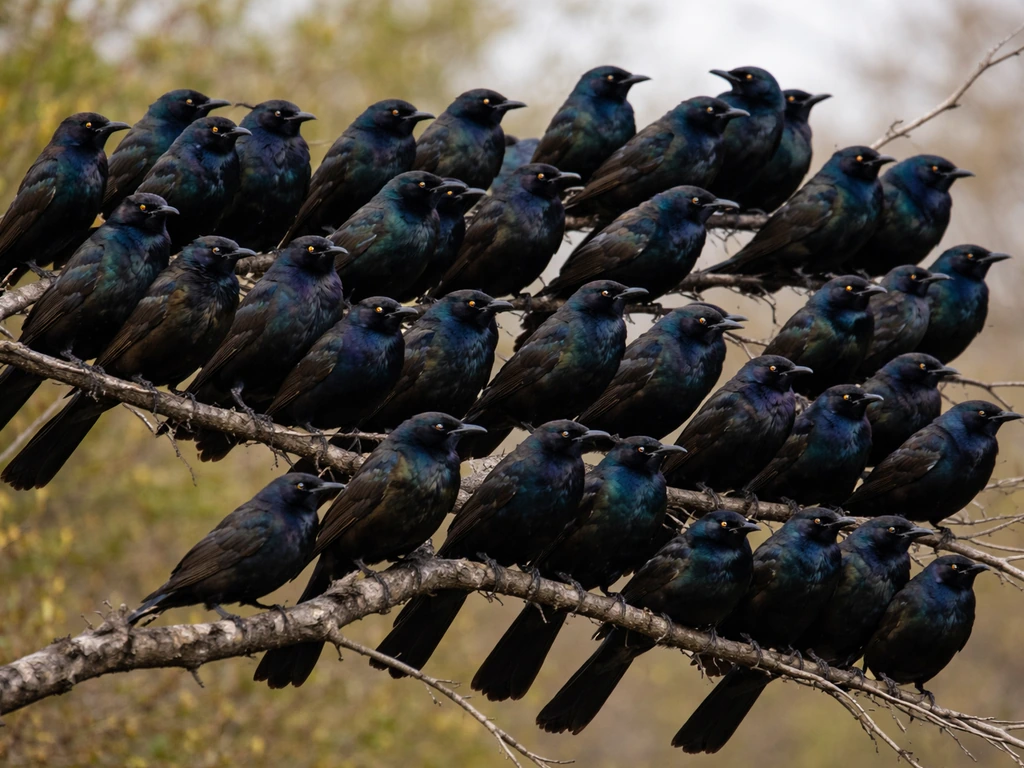
Grackles are intensely social birds, and encountering a large group of them is almost universally linked to themes of community. In its natural history context, the National Park Service also notes grackle migration can involve very large flocks, including an instance estimated at roughly 800,000 to 1,000,000 birds in Hennepin County, Minnesota. Are you feeling isolated right now? Have you been pulling away from people, or has something disrupted your sense of belonging? The flock encounter tends to be a prompt to re-examine your relationship to your social world, not necessarily to go make friends, but to ask whether you're letting others in or keeping them at arm's length for reasons worth examining.
What your emotional reaction is telling you
This section matters more than most people expect. Your gut-level emotional response to the grackle encounter is one of the most reliable interpretive tools you have. In animal symbolism work, emotion tends to speak louder than imagery. The way an encounter lands in your body often tells you more about its personal relevance than the symbolic definitions themselves.
If you felt a sense of calm or quiet recognition when you saw the grackle, that's generally a signal that the encounter is confirming something you already intuitively know. Lean into that. The grackle may simply be reflecting your own intuition back to you. If you felt unsettled, anxious, or even briefly afraid, it's worth asking whether that reaction belongs to the bird or to something the bird reminded you of.
Grackles have a reputation for being polarizing, edgy, associated with darkness in some folk traditions. But your fear in the moment may actually be about the message rather than the messenger. And if you felt curious, drawn in, even charmed? That usually signals the encounter is an invitation rather than a warning.
One simple test: try to recall whether the feeling was calm and knowing, or reactive and panicky. Spiritual sign recognition, across multiple traditions, tends to arrive as a quiet inner voice or a spontaneous sense of knowing, not as overwhelming dread. If it felt grounded and clear, trust it. If it felt purely alarming, give yourself a day before drawing conclusions.
When the signs feel heavier: dead grackles, droppings, and persistent visits
Some grackle encounters go beyond a single sighting. These more intense signs tend to carry more weight, and they deserve their own interpretation space.
Finding a dead grackle
A dead bird encounter almost always shakes people, and it should be handled carefully rather than with immediate panic. In spiritual symbolism, a dead grackle typically points toward the end of one phase and the beginning of another, transformation in its most literal, unavoidable form. The grackle's core energy around adaptability and change becomes especially pointed here: something is ending, and the message is asking whether you're willing to release it rather than hold on.
This doesn't mean something terrible is coming. More often, it points to a necessary letting go, of a relationship dynamic, an identity, a way of coping. When this happens near a window, the additional layer of 'what you thought was clear is shifting' applies as well. Approach it with curiosity, not fear.
Droppings landing on you or near your property
Bird droppings are one of the oldest cross-cultural good luck symbols (as counterintuitive as that sounds), and the grackle's dropping landing on or near you is generally not a negative sign. It tends to be interpreted as unexpected change or a surprising shift in fortune, often positive. If it felt humorous or shocking, that contrast itself may be meaningful: the grackle is a bird that punctures pretension and reminds you not to take everything so seriously.
Persistent or repeated visits over days or weeks
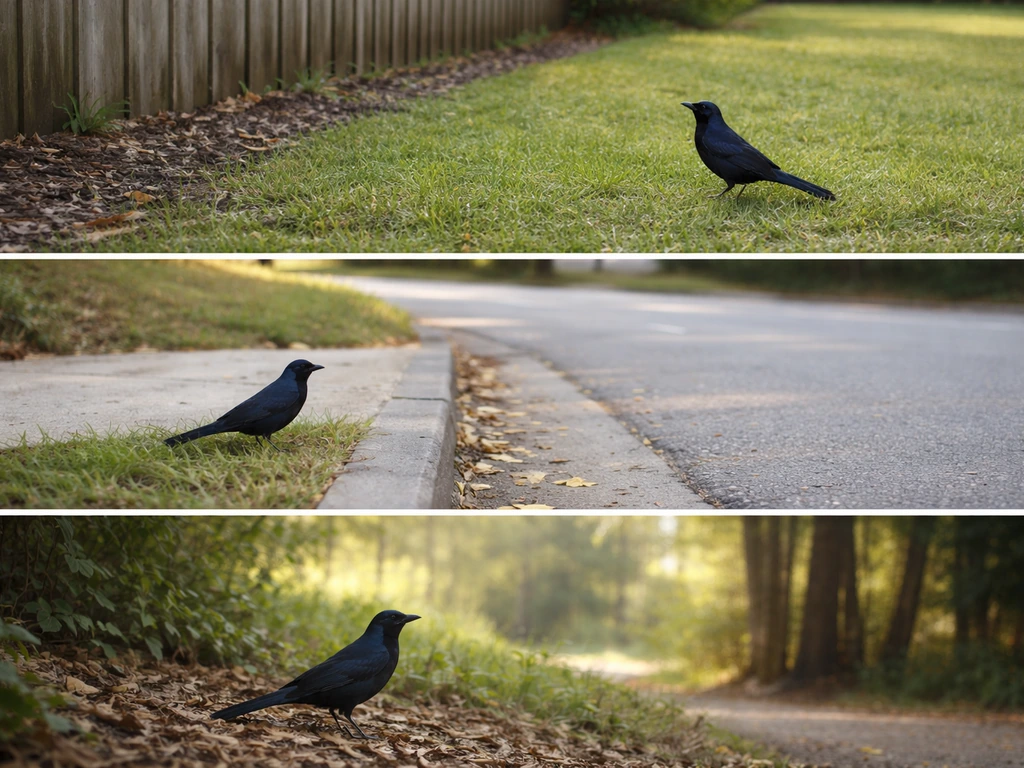
If you've been seeing grackles repeatedly, in different settings, at moments that feel personally loaded, take it seriously. Persistent visits amplify whichever core message applies to your situation right now. They can also signal that you haven't yet acted on the first prompt. The grackle is a resourceful, persistent bird, and its energy in your life may simply be matching your own resistance to change or communication. Ask yourself honestly: what have I been putting off that I already know I need to do?
How to actually use this today
Receiving a spiritual message and doing something with it are two different things. Here's how to move from interpretation to action in a way that's grounded and practical.
- Write down everything you can remember about the encounter: where, when, what the bird was doing, what you were thinking, and how you felt. Do this before the memory fades. Journaling sign patterns over time is one of the most reliable ways to validate whether an encounter was spiritually significant or simply coincidence.
- Identify the most alive question in your life right now, the thing that's pressing on you, even if you've been trying not to think about it. Hold that question next to the encounter and notice whether anything clicks.
- Pick one behavior from the list above that best matches what you saw, and sit with its corresponding message for at least 24 hours before deciding what it means for you. Resist the urge to over-interpret immediately.
- If the message seems to be about communication, schedule one honest conversation you've been avoiding. Not a confrontation, just a conversation. The grackle's energy supports direct, clear expression.
- If the message seems to be about adaptability or change, write down one thing in your life that you've been trying to keep exactly the same, and ask honestly whether that's still serving you.
- Return to your journal in a week and see whether anything has shifted in your life or in how the encounter feels. Patterns reveal themselves over time, not instantly.
You might also find it useful to explore how other birds in your environment are showing up. For example, if you've been noticing multiple kinds of birds lately, reading about the brown thrasher bird's spiritual meaning alongside the grackle's can help you see whether multiple messengers are pointing toward the same theme. Birds rarely show up in isolation when you're in a period of significant transition.
The grackle vs. other birds: how its message compares
It helps to understand what makes the grackle's symbolism distinct, especially if you're regularly tuned in to bird encounters. Here's a quick comparison of the grackle against a few similarly-themed birds in the symbolic tradition.
| Bird | Core Spiritual Themes | Tone of Message | Best Fit For |
|---|
| Grackle | Communication, adaptability, community, resourcefulness, shadow work | Bold, urgent, hard to ignore | People resisting change or avoiding a necessary conversation |
| Thrasher | Boundaries, persistence, protective instincts, creative energy | Assertive but personal | People needing to defend their space or speak up for themselves |
| Thrush | Inner voice, healing, hope, return of joy after difficulty | Gentle, melodic, uplifting | People in emotional recovery or seeking renewed sense of purpose |
| Gray Grasshopper Bird | Patience, timing, tuning into subtle signals | Quiet, observational | People who need to slow down and listen rather than act immediately |
The grackle stands out because its energy is direct and communal rather than solitary and introspective. Where the spiritual meaning of the thrush bird tends to arrive softly, like a gentle reminder of hope, the grackle arrives loudly, like a friend who grabs your arm and says 'hey, are you paying attention?' Both are valuable, just different in delivery.
Clearing up the most common misunderstandings
The grackle gets a bad reputation in some spiritual communities, and it's worth addressing that directly because the misconceptions can send you in completely the wrong interpretive direction.
Misconception 1: Black birds are inherently dark omens
The grackle's iridescent black plumage tends to trigger folk associations with darkness, death, or bad luck, a bias that runs deep in Western superstition. Many black-feathered birds, from crows to ravens to grackles, have been filtered through a lens of fear in various folk traditions. But this is cultural projection, not universal spiritual truth. The grackle's actual symbolic tradition is overwhelmingly tied to intelligence, community, and communication, not doom. If your first instinct is to interpret a grackle as a bad omen, ask whether that reaction is intuition or inherited superstition.
Misconception 2: There's one fixed meaning you need to find
Spiritual animal symbolism is not a lookup table with fixed entries. The most useful framing I've come across is this: it's your omen, and only you know what it truly means, because only you know the questions that are pressing on your heart right now. Forcing a generic definition onto a personal experience is the fastest way to miss the actual message. Similarly, the thrasher bird's spiritual meaning will land differently for two people facing different life circumstances, even if the symbolism is technically the same. Context and personal resonance are everything.
Misconception 3: A grackle encounter is proof of something definitive
Spirit animal work is not prediction or proof. It's invitation. An encounter with a grackle isn't confirming that something specific will happen; it's prompting you to look at something you may be avoiding or undervaluing. Treating it as a guaranteed omen of change (good or bad) misses the point and also adds pressure that tends to block genuine reflection. Stay curious, not certain.
Misconception 4: If you don't feel anything, you missed it
Not every bird encounter is spiritually charged. Some grackles are just grackles. If you're trying to force significance out of a bird that walked past you in a parking lot while you were distracted, you may be manufacturing meaning rather than receiving it. Genuine spiritual encounters tend to arrive with a quality of attention, yours and the bird's, that feels noticeably different. And if you're exploring how your instincts respond to subtler signs, reading about the gray bird grasshopper's spiritual meaning can offer a useful contrast, since that bird's symbolism centers specifically on the art of tuning into small, easy-to-miss signals.
How to choose the right interpretation for your situation
If you've run through everything above and you're still sitting between two or three possible meanings, here's the simplest filter: which interpretation asks more of you? The grackle's spiritual tradition is built around action, speaking up, adapting, engaging with community, being resourceful rather than passive. The interpretation that challenges you to do something, to have the conversation, to let go of the familiar plan, to reach out to someone you've been keeping at a distance, is almost always the closer one. Comfort is not really the grackle's area. Growth is.