
The kingfisher is most commonly interpreted as a spiritual messenger of clarity, calm, and well-timed action. When one shows up in your life, the core message tends to be this: stillness is your superpower right now. The bird's ability to hover motionless above turbulent water, then strike with perfect precision, is basically a living metaphor for trusting your intuition and moving decisively when the moment is right. Many spiritual traditions also tie the kingfisher to good fortune, healing, and the flow of abundance, but those themes nearly always trace back to that same root idea of being still enough to see clearly.
Spiritual Meaning of Kingfisher Bird: Symbolism and What to Do

Eliza Thornwick
17 May 2026

The main themes behind kingfisher symbolism

Before diving into your specific encounter, it helps to understand the handful of core themes that show up again and again in kingfisher symbolism across different spiritual traditions. None of these are absolute rules, but they give you a working vocabulary to interpret what you experienced.
- Clarity and stillness: The kingfisher finds peace amid chaos. It hunts in rushing streams and murky waters, but it only strikes when the moment is perfectly clear. Seeing one is often read as a nudge to pause, get quiet, and trust what you can see when you stop moving.
- Halcyon calm and protection: The word 'halcyon' literally comes from the kingfisher. In Greek mythology, Alcyone was transformed into a kingfisher and her father (the wind god) calmed the seas for two weeks so she could nest safely. That's where the phrase 'halcyon days' originated, and it's why the kingfisher has carried associations with a blessed, protected interval of peace for thousands of years.
- Good fortune and abundance: Many modern spiritual writers interpret a kingfisher sighting as a sign of alignment with prosperity, specifically that you're moving with the current rather than against it. This isn't about luck falling from the sky; it's more about recognizing you're in flow.
- Intuition and overcoming self-doubt: The kingfisher's dive is not cautious or hesitant. It reads the situation from above, then commits completely. This connects to themes of trusting your gut, releasing limiting beliefs, and learning new ways of thinking rather than staying stuck in old patterns.
- Healing and renewal: Water symbolism runs through most kingfisher lore. Because the bird lives at the water's edge and literally dives into water as part of its daily life (including bathing by diving repeatedly into a stream), it's been linked to emotional cleansing, renewal, and healing from grief or stagnation.
- Communication and connection: Kingfishers are vocal birds. They have distinct calls for territory, for mates, and for their young. Spiritually, this ties into themes of speaking your truth, reconnecting with someone important, or paying attention to what's being communicated in your relationships right now.
How to interpret your specific kingfisher encounter
Context matters enormously here. A kingfisher that lands on the dock railing two feet from you while you're going through a difficult decision is a very different experience from spotting one through binoculars on a nature walk. Here's how to think through the key variables of sight, location, and timing.
What you saw (and how close it was)

Distance and directness carry spiritual weight. If the kingfisher was obviously aware of you and didn't flee, or if it seemed to hover in your direct line of sight, most interpretive traditions would treat that as a stronger, more personal message than a quick flash of iridescent blue at 100 yards. A very close, unexpected encounter is often read as the universe making sure you didn't miss the signal. Audubon’s Field Guide for the Green Kingfisher notes detectability details like low perching near water vegetation and sharp ticking calls, so an “unexpected” visit can reflect local visibility rather than spiritual intent. A more distant sighting is still meaningful but might be more of a gentle nudge than an urgent message.
Where it appeared
Location is one of the richest clues you have. Kingfishers live near water by ecological necessity, so seeing one near a stream, lake, river, or even a backyard pond is natural habitat behavior. That said, the water element itself is spiritually significant: water in most traditions represents emotion, the unconscious, flow, and change. If the kingfisher appeared at a water's edge, especially if that location has personal meaning to you, the symbolic layer is amplified. If one showed up somewhere unexpected, like a parking lot or away from any obvious water source, that unusual context is worth sitting with more carefully.
When it showed up
Timing is everything in omen interpretation. Ask yourself honestly: what were you thinking about just before the sighting? What situation are you currently navigating? A kingfisher appearing during a moment of personal crisis, a crossroads decision, or right after a prayer or intention is almost universally treated by spiritual practitioners as more significant than one spotted on an ordinary afternoon. Kingfishers also tend to be most visible during dawn and dusk when light conditions are favorable for hunting, so early morning and late afternoon sightings have a slightly different quality than a midday encounter.
Repeated sightings vs. a single encounter
One sighting might be meaningful. Three sightings in a week, especially if they feel surprising, is usually treated as a pattern worth tracking. A practical note here: kingfishers are territorial and return to the same perches and hunting spots daily, so if you're seeing one repeatedly at the same location, there may be an ecological explanation. For ecological guidance on Belted Kingfisher habitat and feeding, Cornell Lab of Ornithology’s All About Birds describes lakes and ponds and emphasizes hunting by diving for aquatic prey, which can explain repeated shoreline encounters as practical bird behavior blank" rel="noopener noreferrer">kingfishers are territorial and return to the same perches and hunting spots daily. But that doesn't necessarily cancel the spiritual layer. Many practitioners hold both things at once: yes, there's a real bird with a real habitat, and yes, it keeps appearing in your life at a meaningful moment. If the message still isn't clear after a few sightings, the recommendation from most omen-reading traditions is simple: write it down and look for correlations in your life over the next two to four weeks.
Kingfisher behavior clues and what they might mean
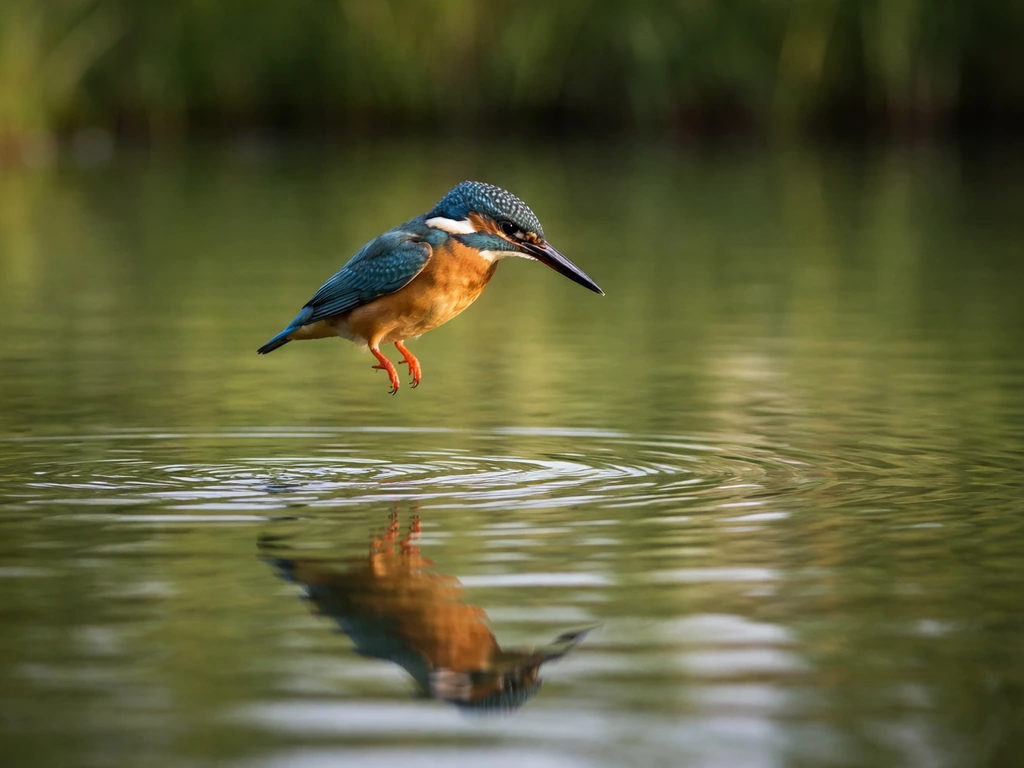
How the kingfisher was behaving when you saw it adds another interpretive layer. These aren't hard rules, but they're patterns worth noticing.
| Behavior you observed | Possible spiritual interpretation | Ecological grounding |
|---|---|---|
| Hovering perfectly still above water | Patience, perfect timing, trust the pause before action | Standard hunting technique: scanning for prey before diving |
| Diving sharply into water | Time to commit, take the leap, act on what you already know | Natural hunting strike; also used as an escape behavior from predators |
| Perching quietly and watching | Observation mode, stillness, being present before deciding | Resting or scouting from a favorite perch between hunts |
| Calling loudly | Communication, boundaries, speaking up about something important | Territorial warning or contact call between mates/offspring |
| Bathing by diving repeatedly | Cleansing, releasing what no longer serves you, renewal | Regular hygiene behavior; kingfishers bathe by diving into water |
| Flying directly toward or past you | A direct message, movement, a transition beginning | Flight between hunting sites or returning to a roost |
One particularly interesting behavioral note: when water conditions change, say after heavy rains make a stream murky and visibility poor, kingfishers adapt and switch prey rather than keep trying the same approach. Spiritually, that's a powerful parallel if you're in a situation where your usual strategy isn't working and you need to shift tactics rather than push harder.
How to apply the message today
Reading the symbolism is step one. Doing something with it is where the real value lives. Here's how to move from 'I saw a kingfisher' to actual clarity and direction.
Reflection prompts to journal on
Grab a notebook and sit with these questions. If you are also looking into the spiritual meaning of seeing a kite bird, treat the sighting as a prompt to observe what feels most true in your current life moment and respond from that clarity. Don't rush. The kingfisher doesn't rush either; it waits until the moment is right.
- What area of my life right now feels turbulent or unclear? Where do I need more stillness before I act?
- Is there a decision I've been hesitating on that I actually already know the answer to? What would it look like to dive in with full commitment?
- Where am I going against the current instead of moving with it? Is there a more natural flow available to me?
- What needs to be healed or released right now? Is there an emotional weight I'm carrying that this encounter might be pointing toward?
- Who do I need to communicate more honestly with? Is there something I've been holding back that needs to be said?
- Write down the full details of your sighting: date, time, location, what you were doing, what you were thinking, and how it made you feel. Date the entry so you can look back in a few weeks for correlations.
Practical next steps
- Sit near water if you can. Even a small pond or a fountain. The kingfisher's element is water, and spending ten quiet minutes near it while holding your question in mind is a simple, grounding practice.
- Try a short 'hover' meditation. Sit still, breathe slowly, and imagine you're the kingfisher above the water, watching with total focus before you move. Ask yourself what you can see from this elevated, still vantage point.
- Set an intention. If prosperity, clarity, or healing is the theme that resonates with your encounter, write a one-sentence intention that reflects what you're moving toward. Put it somewhere you'll see it this week.
- Track the pattern. If this is a repeated sighting, start a small omen journal. Note the date, location, and what was happening in your life. After two to four weeks, look for themes that align with the kingfisher's core messages.
- Express gratitude for the encounter. In most spiritual traditions, acknowledging a sign is part of completing the exchange. A simple mental 'thank you, I'm paying attention' is enough.
A quick checklist for confirming the message
After sitting with all of this, run through these checkpoints to see which interpretation resonates most for you right now.
- Does the 'clarity and stillness' theme match something you're currently navigating? If yes, the message is probably about pausing before acting.
- Are you in a period of transition, grief, or recovery? If yes, the healing and renewal thread is likely the most relevant.
- Have you been second-guessing yourself or feeling stuck in old thought patterns? The intuition and self-doubt theme is speaking to you.
- Does the timing feel too coincidental to ignore? If the sighting happened during or right after a meaningful moment, take that seriously.
- Has anything changed or aligned in your life within two to four weeks of the sighting? Note it down. That correlation is often where the real message becomes visible.
Cultural and spiritual variations worth knowing

No single spiritual tradition owns the kingfisher's meaning, and it's worth knowing that interpretations genuinely differ, sometimes dramatically, across cultures. The 'halcyon calm and good fortune' thread that dominates Western and modern spiritual writing is rooted in Greek mythology. The Roman poet Ovid told the story of Alcyone and Ceyx, where Alcyone's grief at losing her husband was so powerful that the gods transformed them both into kingfishers and calmed the seas each winter so she could nest safely. That story gave Western culture its template for the kingfisher as a symbol of serenity and divine protection.
Native American traditions are more varied. Different tribes assign different roles and meanings to the kingfisher, and there isn't one unified 'Native American kingfisher meaning' any more than there's one unified European meaning. Some tribal legends give the kingfisher a role as a provider or guide; others are more cautionary. You may also be curious about the red kite bird spiritual meaning, since different birds are often connected to different messages and life lessons. It's worth researching the specific tradition that matters to your own lineage or spiritual practice if that's relevant to you.
It's also honest to mention that not all traditions read the kingfisher positively. Some cultures, including the Dusun people, have historically considered the kingfisher a bad omen. This doesn't mean your sighting is negative, but it does underscore something important: the meaning that matters most is the one that resonates in the context of your own life, your own spiritual framework, and the specific circumstances of your encounter. Cultural symbolism gives you a toolkit; your intuition is what chooses the right tool. If you're also curious about the herring bird spiritual meaning, you can use the same approach to see what themes show up most for you.
If you're drawn to exploring other birds in this symbolic space, the kite bird carries some overlapping themes of vision and elevated perspective, and the kinglet shares the kingfisher's surprising intensity packed into a small, easy-to-miss bird. Kite bird spiritual meaning is often read through the same lens of vision, perspective, and being guided to see what others might miss. Each bird species tells its own story, and the kingfisher's is one of the richest. If you are looking into related small-bird symbolism, the kinglet bird spiritual meaning is often discussed as an adjacent spiritual lens for interpreting messages from nature.
FAQ
What should I do if I only saw a kingfisher briefly, and I cannot remember the details?
Start with what you do remember, your emotional state, the decision you were making, and whether you felt calm or urgency. If details are missing, avoid forcing a specific “message,” instead write a short note on what you were focused on in the prior few hours, then choose one small action that matches the article’s stillness theme (for example, pause before a reply, double-check a plan, or ask for a second opinion).
Can a repeated kingfisher sighting mean something spiritual, even if there is a local wildlife reason?
Yes. A territorial pattern can be real, but you can still treat it as a recurring prompt by tracking both ecology and synchronicity. For example, note the time of day and location (real habitat), then also note what issues were active in your life during each sighting. If the life theme stays consistent across weeks, that tends to feel more “message-like” than random chance.
If the kingfisher appeared far away, how do I judge whether it is an important signal or just a coincidence?
Use your attention, not distance, as the deciding factor. If it pulled your awareness in a way that changed what you did next, most practitioners treat it as meaningful. If it was merely noticed without any lasting shift, it may still be symbolic, but likely as a gentle nudge rather than an urgent omen, so keep your response small and reversible.
What does it mean if the kingfisher was acting unusually, like not flying away when I was near?
Many readers interpret reduced flight distance or “permission to observe” as heightened personalization. Still, rule out ordinary explanations first, like the bird being occupied (feeding, protecting a perch), nesting nearby, or poor visibility. If the behavior genuinely felt direct, respond with practical care, for instance, slow down your current plan or re-check your assumptions before taking the next step.
How should I interpret a kingfisher when I am not going through any big life event?
When there is no obvious crossroads, treat the message as timing guidance rather than problem-solving. Ask, “What decision am I quietly postponing?” or “Where am I trying to force outcomes instead of waiting for clear signs?” The stillness metaphor often shows up as permission to maintain a steady routine, review your goals, or let information catch up before acting.
What if my tradition or culture views kingfishers negatively, like as a bad omen?
Use a both/and approach: cultural meanings can highlight your need for caution, not necessarily doom. You can translate a “negative” framing into a practical safeguard, such as slowing down, verifying facts, and avoiding impulsive commitments. Also, consider how your body feels during the sighting, if it triggers fear, you might benefit from grounded steps rather than spiritual speculation.
Do I need to change my behavior immediately after a kingfisher sighting?
Not automatically. A useful method is to choose one action that can be taken within 24 hours and costs little (pause before responding, plan a mindful check-in, do a quick risk review). If the message truly matters, you should feel a clear, low-conflict next step, not pressure or panic.
How long should I wait before deciding what the kingfisher “meant” to me?
A practical window is two to four weeks, especially if you are trying to confirm a pattern. During that time, keep a brief log of sighting date, location, your topic of mind, and the action you took. If no correlation emerges after a few weeks, consider it a one-time nudge and move on rather than repeatedly reinterpreting.
What is a good question to ask myself right after the sighting to stay aligned with the message?
Ask: “Where in my life am I trying to see results without stillness?” Then pick the smallest place to practice it. Examples include taking one cleansing breath before a difficult conversation, postponing a purchase, or doing a focused 10-minute review of what you truly want before acting.
Next Article
Kinglet Bird Spiritual Meaning: What It Means and What to Do
Practical spiritual meaning of kinglet bird encounters, symbols, behaviors, and what to do for guidance and renewal.