
A kinglet crossing your path carries a message about resilience, renewal, and paying attention to the small but powerful things happening in your life right now. These tiny birds hold an outsized spiritual significance: they show up when you need a reminder that you are stronger than you look, that joy is available even in difficult seasons, and that protection and guidance are close even when you can't see them clearly. Whether a kinglet landed near you, appeared at your window, or keeps showing up in unusual ways, what you're picking up on is real and worth exploring.
Kinglet Bird Spiritual Meaning: What It Means and What to Do

Eliza Thornwick
4 May 2026
First, make sure you're actually seeing a kinglet

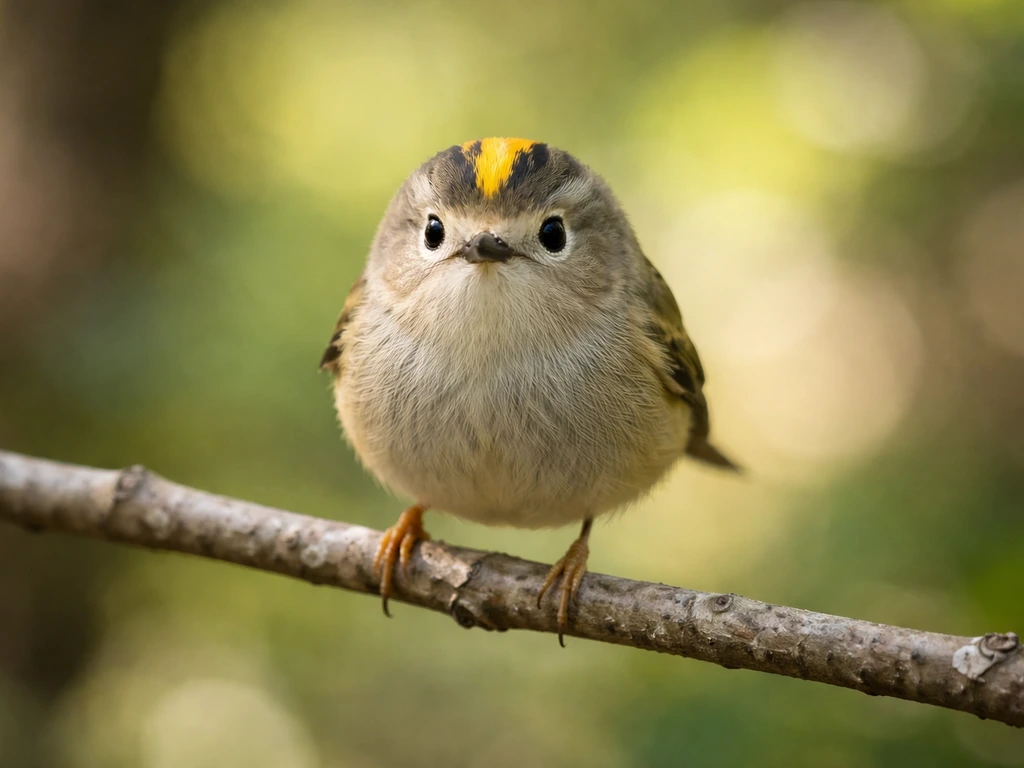
Before going deep on symbolism, it helps to confirm what you saw, because kinglets are easy to mistake for wrens, warblers, or other small birds. There are two species you're most likely to encounter in North America: the ruby-crowned kinglet and the golden-crowned kinglet. Both are tiny, hyperactive little birds, almost absurdly small, with blank" rel="noopener noreferrer">relatively large heads, almost no visible neck, short thin tails, and tiny tweezer-like bills. They never seem to sit still.
The ruby-crowned kinglet has olive-green plumage, two pale wingbars, and a distinctive broken white ring around the eye. The male has a brilliant ruby crown patch, but here's the catch: it's usually hidden unless the bird is excited, singing, or in a territorial display. The golden-crowned kinglet has a more obvious striped face pattern with a yellow or orange-yellow crown bordered by black and white stripes. Both species constantly flick their wings while foraging, which is one of the most reliable behavioral clues you'll see in the field.
If the bird you saw was noticeably larger, had a longer tail, or lacked those wingbars and eye markings, it may have been a wren or a warbler. That said, the spiritual frameworks below apply broadly to tiny, energetic songbirds that feel like messengers, so trust what felt meaningful to you and use the ID check as a starting point rather than a reason to dismiss the experience.
What a kinglet encounter generally means spiritually
The kinglet's core spiritual symbolism is built around a beautiful paradox: something very small carrying extraordinary power. These birds weigh less than a nickel, yet they survive harsh winters, migrate thousands of miles, and sing with an energy that seems almost too big for their tiny bodies. In spiritual terms, that translates directly. A kinglet encounter often arrives when you're underestimating yourself, when you've been feeling small, overlooked, or uncertain whether your efforts are actually making a difference.
The major themes that keep surfacing across cultural and spiritual traditions when it comes to kinglets include resilience and inner strength (don't judge your capacity by your size or circumstances), renewal and hope (especially tied to seasonal transitions, like spring migration), protection and guidance from unseen forces, joy as a spiritual practice rather than a luxury, and the importance of paying attention to subtle signs. If any of those themes feel immediately relevant to what's going on in your life, that's your entry point into interpreting this encounter.
Like the kingfisher, which carries themes of clarity and diving deep into emotional waters, the kinglet works in a different register: it's about lightness, quick movement, and finding sustenance and meaning in small moments. Both birds invite a kind of spiritual attentiveness, but the kinglet's message is particularly about trusting what you can't fully see yet, including your own hidden strengths.
Reading specific scenarios: what the encounter looked like matters
A kinglet landing on you or very close to you

This is the encounter people find hardest to dismiss, and rightly so. When a wild bird that's normally too busy foraging to give you a second glance actually lands on you or comes within arm's reach, it feels like direct contact. Spiritually, this kind of closeness is often interpreted as a message that whatever guidance or reassurance you've been seeking is right here, not somewhere distant. Some traditions would call it the presence of an ancestor, a guide, or simply the universe giving you a very literal nudge. Ask yourself: what were you thinking about right before it happened? What's been weighing on you lately? The answer to those questions is usually the message.
A kinglet tapping or hitting your window
From a purely physical standpoint, kinglets hit windows for the same reason most birds do: they see the reflection of sky or trees in the glass and don't recognize the barrier. Sometimes a male will attack his own reflection during breeding season, interpreting it as a rival. That's the practical reality. But spiritually, a bird repeatedly coming to your window is widely interpreted as a message trying to get through, something you haven't fully acknowledged yet.
It's worth sitting with the question: what are you not looking at clearly? What truth is knocking on the glass of your awareness? If the bird was stunned or injured from the strike, see the section below on challenging signs, and also take practical steps to make your windows more visible to birds (applying window tape or decals in a pattern spaced no more than 2 inches apart is the most effective method).
For specific, practical options to prevent bird-window collisions, American Bird Conservancy lists multiple solutions on its “Solutions for Homes” page make your windows more visible to birds.
A kinglet flying around you or following you
Kinglets are curious and not especially shy, so some of this is just bird behavior. But when a bird keeps returning to your proximity, hovering near your face, or appearing to track your movement, it does stand out. This kind of encounter is often read as a sign of spiritual accompaniment: you are being watched over, guided, or encouraged. It can also be a reminder to slow down and be present, which is almost funny coming from one of the most hyperactive birds on the planet, but the message is about presence, not pace.
Repeated sightings over days or weeks
One sighting might be a lovely moment. Three or four encounters with a kinglet in a short span, especially if they feel striking or out of place, start to feel like something worth paying attention to. In spiritual interpretation, repetition amplifies the message. Think of it as the universe turning up the volume because you haven't quite caught the signal yet. If you keep seeing kinglets, write down what's happening in your life at each moment of sighting. Patterns will usually emerge.
What kinglet behavior is telling you
Singing and calling
The ruby-crowned kinglet in particular is famous for its song, which is astonishingly loud and complex for such a tiny bird. Spiritually, a kinglet that is actively singing near you is often interpreted as a call to find and use your voice, to speak your truth, or to express something you've been holding back. It's also associated with joy and celebration: the song says that life, right now, is worth celebrating even if conditions aren't perfect. If the male was displaying his ruby crown while singing, that hidden brightness being revealed can symbolize your own gifts or strengths coming into the light.
Hovering and wing-flicking
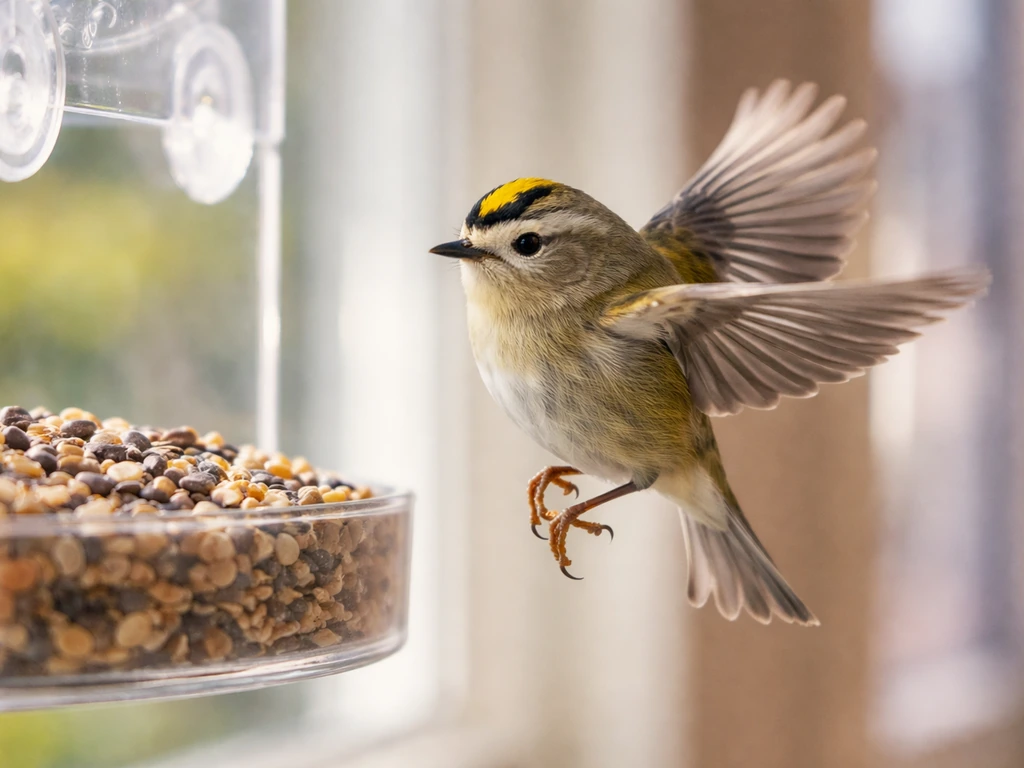
That constant wing-flicking behavior, where kinglets nervously flutter their wings while perching or foraging, is one of their most distinctive traits. In spiritual readings, hovering or fluttering energy is often associated with a state of transition: not quite here, not quite there, in the liminal space between two phases of life. If a kinglet seemed to hover near you or kept flicking its wings in your direction, consider where you are in a transition right now. The message is usually to stay active and keep moving through it rather than getting stuck.
Flocking behavior
Kinglets often travel in loose mixed-species flocks during migration. Seeing a group of kinglets, or noticing kinglets as part of a larger bird wave, can be spiritually significant as a message about community, collective energy, or the people around you. It might be prompting you to lean on your community, to recognize that you don't have to navigate your current challenges alone, or to pay attention to new connections forming in your life.
Seasonal and migration timing

Seeing a kinglet during spring migration is a classic sign of renewal and new beginnings, the world reopening after a period of dormancy. A fall sighting carries themes of preparation, release, and trusting the journey ahead even when you can't see the destination. Kinglets also overwinter in many regions, and seeing one in the depths of winter is particularly powerful: it's a small bright thing surviving the cold, a living reminder that resilience is possible and that light exists even in the hardest seasons.
When the signs feel challenging: injured, dead, or out-of-place kinglets
Not every bird encounter is uplifting, and it's worth being honest about that. Finding an injured or dead kinglet is unsettling, and the spiritual interpretation should be approached carefully, without either dismissing the significance or spiraling into fear.
An injured kinglet, especially one that has struck a window, often carries a message about something in your life that has hit an invisible barrier. You or someone close to you may be running into a wall you didn't see coming, perhaps something that looked like open space but turned out to be a boundary you hadn't recognized. The practical and spiritual response is the same: slow down, assess the situation gently, and give things time to recover. If the bird recovers and flies away, take that as a genuinely hopeful sign.
A dead kinglet is harder to sit with. In many traditions, finding a dead bird is not an omen of doom but rather a prompt to acknowledge an ending, something that needs to be released so that new energy can come in. It might be a relationship, a belief, a job, or simply an old version of yourself. The spiritual invitation here is grief and release, not fear. Give the encounter some respect: you might pause and offer a quiet acknowledgment before moving on.
Seeing a kinglet wildly out of season, or in an unusual location that genuinely doesn't fit their range or habitat, can point to a message about disruption or the unexpected. Something is shifting in your world that doesn't follow the expected pattern. That's worth noticing. It's not necessarily bad, sometimes the most important turning points come completely out of season.
How to interpret and act on the message
The best spiritual interpretation is always personal. You are the one who knows what's happening in your life, and the kinglet's symbolism is a lens, not a verdict. Here's a practical framework for working with whatever encounter you had.
Questions to ask yourself
- What was I thinking or feeling in the moments before and during the encounter?
- What area of my life feels most uncertain or challenging right now: relationships, work, health, creativity, spiritual path?
- Have I been underestimating myself or dismissing something important as too small to matter?
- Is there a message I've been avoiding or a truth I haven't been willing to look at directly?
- Is there something in my life that needs to be released so something new can grow?
- Where am I in a transition right now, and am I moving through it or resisting it?
Journaling the encounter
Write down everything you remember: the date, time, location, what the bird looked like, what it was doing, how long the encounter lasted, and how you felt during and after it. Then free-write for five minutes starting with the prompt: 'If this bird had a message for me, it would be...' Don't overthink it. Let your intuition take the lead and read back what you wrote with curiosity rather than judgment. Most people find the interpretation shows up in their own words before they've consciously worked it out.
Simple rituals and next steps
- Offer gratitude: step outside or sit by a window and quietly thank the bird and whatever force you believe sent it. This isn't about religion; it's about acknowledging that you received something.
- Set a protective intention: if the encounter felt like a warning or a challenging sign, light a candle (white or green works well for renewal and protection) and state clearly what you are releasing and what you are inviting in.
- Take one small, concrete action: kinglet energy is active, not passive. Whatever message you received, identify one small thing you can do today that reflects it. If the message was about resilience, do one hard thing you've been avoiding. If it was about joy, do one thing that makes you genuinely happy.
- Spend five minutes in mindful observation outdoors: no phone, no music, just watching. Kinglets reward attentiveness, and so does the spiritual dimension of daily life.
- Check in after a week: revisit your journal entry. Often the meaning becomes clearer with a little distance.
How different traditions read the kinglet
Kinglets don't appear by name in most ancient spiritual texts, so the symbolism we work with today is partly drawn from broader traditions around small songbirds and partly from contemporary nature-based spirituality. It's worth knowing which lens feels most resonant for you.
| Tradition / Perspective | How the Kinglet Is Read | Core Message |
|---|---|---|
| Native American (general) | Small birds often serve as messengers between the human and spirit worlds; tiny birds carry particular respect for surviving against the odds | Pay attention to subtle signs; guidance comes in humble forms |
| Celtic / Druidic | The wren (a close relative in spirit if not species) was the 'King of Birds' in Celtic lore despite its size; similarly, small but mighty birds carry royal spiritual authority | True power is not about size or status; hidden gifts are the most precious |
| Christian / Angelical | Small birds are protected by divine attention (the sparrow passage in scripture); their presence is a reminder of divine care and watchfulness | You are seen, known, and held even when you feel invisible |
| Eastern / Buddhist | Lightness, non-attachment, and the present moment; a small bird that lives fully in each second without grasping | Be here now; find joy in what is, not what you're waiting for |
| Contemporary Animist / Nature Spirituality | Kinglets as spirit animals or totems represent resilience, joy, the hidden self, and the power of the small | Your most important gifts may be the ones you haven't shown the world yet |
None of these frameworks is the 'correct' one. The most useful interpretation is the one that speaks directly to where you are right now. You might find that a kite bird encounter, by contrast, pulls more toward themes of vision and elevated perspective, or that a kingfisher sighting speaks to clarity and emotional depth.
Many people also explore the red kite bird spiritual meaning, where this powerful symbol is tied to perspective, guidance, and inner truth kite bird encounter. A black kite bird spiritual meaning can offer an extra layer of insight when you want to connect the message to vision, perspective, and guidance from above kite bird encounter.
If you're drawn to that imagery, exploring the kite bird spiritual meaning can help you interpret the message through the lens of vision and perspective. The kinglet is its own distinct energy: intimate, surprising, and quietly insistent that you notice what you've been too busy to see.
What stays consistent across all these traditions is the core invitation: don't underestimate what arrived. Something small and brilliant came close enough to catch your attention, and that's not nothing. Sit with it, write about it, and let it show you what's already there. If you want to compare that message with other spirit-sign sightings, exploring the herring bird spiritual meaning can add another layer of insight.
FAQ
What if I’m not sure it was actually a kinglet? (wrens or warblers look similar)
If you cannot positively identify the bird, treat the encounter as “tiny, energetic messenger” symbolism rather than a specific kinglet message. Use only details you’re sure about (size, wing-flicking, wingbars or crown pattern, behavior near glass). Then check whether your emotional takeaway still matches themes like renewal, underestimated strength, or paying attention to subtle signs.
Does the spiritual meaning change if the encounter felt scary or unsettling?
Start by distinguishing your body’s response from the bird’s behavior. If the experience felt peaceful, the message is usually interpreted as reassurance or a gentle nudge. If you felt fear or panic, shift the interpretation toward “boundary and protection” and also do a practical check for real-world stressors (safety, deadlines, unresolved conflict). Fear does not automatically mean doom.
How do I know whether I’m supposed to act or just reflect after seeing a kinglet?
A good decision aid is to ask, “What was I avoiding or minimizing?” If your first impulse after the sighting is to take action, the spiritual takeaway is often “do the small thing now” (send the message, make the appointment, start the habit). If your impulse is to ruminate, the takeaway is usually “return to presence,” not more thinking.
If a kinglet hits my window, how should I interpret it beyond symbolism?
Yes. A window strike can create an “invisible barrier” theme, but spiritually it still works best when paired with care. If the bird was stunned or injured, prioritize practical first aid steps (keep it still, provide a quiet dark space, contact a wildlife rehabilitator if possible). Spiritually, interpret the event as an opportunity to reassess what feels blocked or unclear.
What if I keep seeing kinglets but nothing seems to improve?
If you see the bird repeatedly but nothing “changes,” reinterpret repetition as an invitation to notice micro-shifts. Track one small pattern (mood, thoughts, timing) for a week. Kinglet messages are often considered incremental, so progress may look like improved attention, not dramatic outcomes.
How should I handle the spiritual meaning if I find a dead kinglet?
For a dead bird, the most grounded approach is to treat it as a prompt for an ending and a release, while also honoring your own emotions. If grief brings up intrusive thoughts or prolonged distress, consider talking with someone supportive. If you feel unsafe letting the idea linger, do a brief closure ritual (quiet acknowledgment, write “I release,” then move on).
A kinglet was singing near me. Does that always mean “speak your truth”?
Singing near you is commonly read as a call to express yourself, but “voice” can also mean creativity, honesty, or advocacy. Ask what part of you has been muted recently. If you’ve been holding back a request or boundary, that’s a common direction for the message.
How do I interpret kinglet sightings in a different season than expected?
Not necessarily. Migration timing is often a context clue, but the spiritual layer is usually personal. A spring sighting may emphasize renewal, while a fall sighting may emphasize preparation, but if your current life does not match the season theme, prioritize your real-life question over calendar symbolism.
Does the wing-flicking behavior have a specific spiritual message, or is it just normal bird behavior?
Wing flicking is often associated with transition energy, but it can also simply be foraging or resting behavior. Interpret it spiritually only when the overall encounter stands out (unusually close, repeated, or emotionally charged). Otherwise, keep the message broad: “you are in a change moment, stay adaptable.”
How can I tell if it’s a meaningful sign or just random chance?
A practical way to separate coincidence from pattern is to set a low threshold for evidence: two or more sightings within a short window (for example, a few days) plus a consistent trigger (same location, same time, similar emotion). Then record what you were thinking about right before each sighting to see if one theme repeats.
Next Article
Spiritual Meaning of Seeing a Kite Bird: Practical Guide
Practical framework to interpret the spiritual meaning of seeing a kite bird, based on behavior, context, and reflection