
A wax-eye sighting most often carries themes of new beginnings, fresh arrivals, and the invitation to notice something unfamiliar in your life. These tiny birds are spiritually linked to transition, curiosity, and the courage it takes to show up somewhere completely new. Whether the wax-eye landed near you, followed you around the garden, or simply caught your eye at an unexpected moment, the message tends to orbit around: pay attention to what is just arriving in your world, and be open to it.
Wax Eye Bird Spiritual Meaning: How to Interpret Your Sighting

Eliza Thornwick
29 Apr 2026

What the wax-eye bird symbolizes spiritually
The wax-eye (also called silvereye or tauhou) is one of those birds whose spiritual symbolism is almost written into its identity. Its Māori name, blank" rel="noopener noreferrer">tauhou, literally means 'stranger' or 'new arrival,' and that is not a coincidence worth skipping past. The bird colonised New Zealand from Australia in the 1850s, crossing roughly 2,000 km of open ocean on its own. That origin story is baked into every encounter. When a wax-eye appears, the core spiritual prompt is: something new is here, or something new is coming. Are you willing to receive it? If you also wonder about the silver bird spiritual meaning, the themes of new arrival and embracing the unfamiliar connect closely to what the wax-eye symbolizes.
Beyond the arrival theme, wax-eyes are small but extraordinarily social, often moving in flocks and calling to each other constantly. Spiritually, this translates to themes of community, communication, and the reminder that you do not have to navigate transitions alone. They are also bold for their size, which many interpret as a nudge toward courage in the face of the unfamiliar. If you have been hesitating about a change, a new relationship, a move, or a different direction, the wax-eye showing up can feel like a gentle but insistent 'go on, then.'
- New beginnings and fresh arrivals in your life
- Openness to the unfamiliar or the stranger
- Courage in making a long journey or a significant transition
- The value of community and reaching out to others
- Curiosity as a spiritual practice: leaning in rather than pulling back
- A reminder to pay attention to what has recently changed around you
It is also worth noting that the wax-eye shares family ties with other white-eye species globally. If you have read about the silver eye bird spiritual meaning, you will find considerable overlap here, particularly around clarity, small but significant signs, and the idea of seeing things freshly. The distinction with the wax-eye specifically is that 'tauhou' framing: the stranger arriving, the new chapter beginning.
Where and when you saw it matters a lot
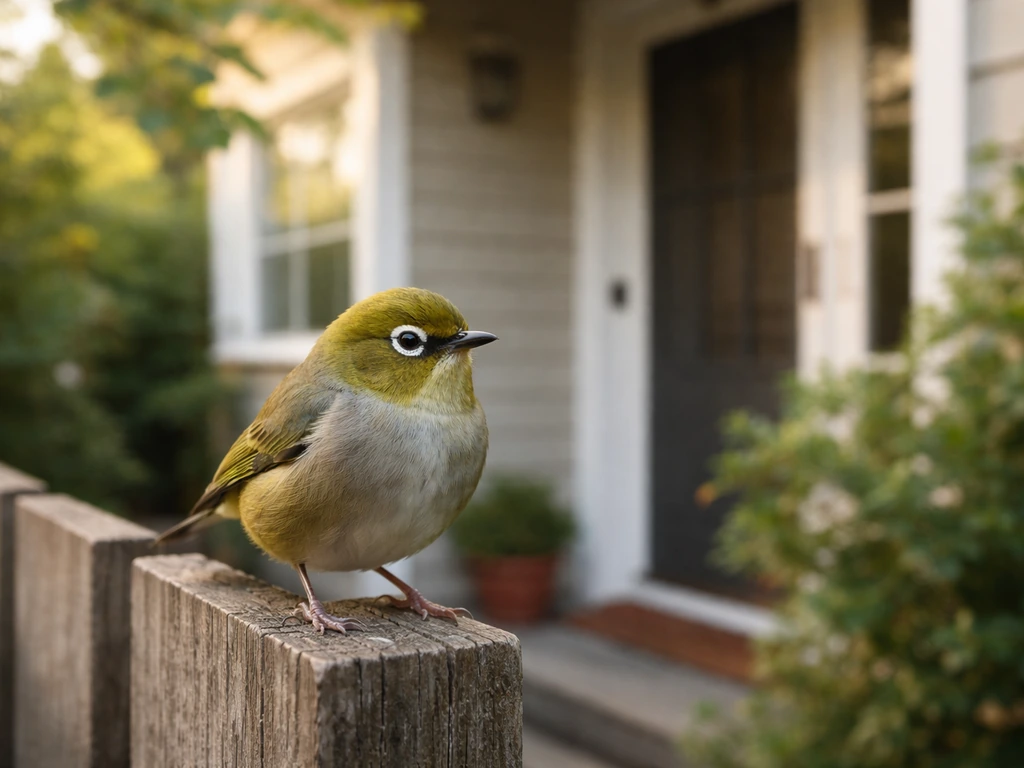
Context is everything in spiritual interpretation. Two people can see the same bird in the same week and get entirely different messages, simply because of where they were standing and what was happening in their lives. Here is how to think through the specifics of your encounter.
Location
A wax-eye appearing in your garden or near your home often signals that change is close to home, perhaps in your family, your living situation, or your domestic routine. If you spotted one at work or in a professional setting, the 'new arrival' theme might be pointing toward career changes, a new colleague, or a fresh approach to your work. Out in nature or on a walk, it tends to carry a more personal, internal message: something new is arriving within you, in your thinking or your emotional landscape.
Time of day

Morning encounters are traditionally associated with new energy and possibilities just beginning to take shape. A wax-eye at dawn or mid-morning can feel like a green light. Afternoon sightings often relate to decisions in progress, things you are actively working through. Evening or dusk appearances carry a quieter energy, sometimes suggesting it is time to reflect on what is ending so that the new can arrive properly. Night sightings of wax-eyes are rare since they roost at dark, so if it happened near dusk, pay extra attention.
Frequency and feeling
A single sighting can be meaningful, but repeated encounters over a short period tend to amplify the message. If you have been seeing wax-eyes everywhere for a week, the invitation is not to decode a specific event so much as to sit with the theme: 'what is new or unfamiliar in my life right now, and how am I relating to it?' The emotional quality of the moment also matters. Did the sighting feel surprising, comforting, startling, or joyful? Your gut reaction is data. Note it down.
What the bird's behavior is telling you

How the wax-eye behaved during your encounter adds another layer to the meaning. The same species can carry quite different messages depending on what it was actually doing.
| Behavior | Possible Spiritual Message |
|---|---|
| Lands very close to you or on you | A direct, personal invitation: the new thing is not abstract, it is right here for you specifically. Pay close attention to what you were thinking in that exact moment. |
| Follows you or reappears nearby | Persistence in the message. Something you have been avoiding or delaying is asking for your attention. The 'stranger' wants to be acknowledged. |
| Calls loudly or repeatedly | A call to listen more carefully, in your relationships, your inner voice, or a situation you have been tuning out. Communication is the theme. |
| Taps at a window | Often interpreted as a message trying to break through a barrier, something on the 'other side' of your awareness wanting to get in. Also worth checking for safety (see the section below). |
| Appears still or calm, watching you | A quieter sign of presence and witnessing. You are being seen. This can relate to ancestors, loved ones who have passed, or simply a moment of being fully met by the natural world. |
| Appears injured or unwell | A prompt to look at what in your life needs care or tending, not necessarily something broken, but something that needs gentle attention before it can move forward. |
Cultural and spiritual lenses: especially Māori and New Zealand perspectives
If you are in New Zealand or have any connection to that part of the world, the wax-eye carries a particularly rich cultural backdrop. The Māori name tauhou (stranger, unfamiliar one) was given to this bird because it literally arrived in Aotearoa uninvited and made itself at home. In a spiritual context, this is a powerful frame: the 'stranger' is not a threat but a teacher. It is the part of life, or the part of yourself, that you have not yet integrated. The wax-eye asks you to welcome what feels foreign rather than resist it.
It is worth being honest here: there is no ancient Māori omen system specifically tied to the wax-eye in the way that some cultures have developed elaborate bird-divination traditions. The bird was not part of pre-European New Zealand bird life, so there is no deep ancestral mythology around it. What we do have is the name and its meaning, and the story of its arrival, both of which are genuinely rich with interpretive possibility. Treat this cultural layer as a lens, not a rulebook.
Outside of New Zealand, the broader white-eye family (Zosteropidae) appears across Africa, Asia, and the Pacific. In many spiritual traditions, small birds that move in flocks and sing frequently are associated with community wisdom, the interconnectedness of people, and messages carried between the human and spirit world. The goldcrest bird, which shares the 'tiny but bold' archetype, carries similar themes around small signs with big meaning.
If you are curious about the goldcrest bird spiritual meaning, notice whether the message points you toward small, actionable shifts in your life. In Celtic and druidic traditions, any small songbird that comes unusually close to a person is considered a messenger, not a specific deity's envoy, but a natural conduit for intuitive information.
From an Eastern philosophical perspective, the wax-eye's readiness to migrate enormous distances for a new life echoes the concept of non-attachment: releasing what was in order to arrive fully in what is. If you connect with Buddhist or Taoist ideas, a wax-eye sighting might be an invitation to loosen your grip on the past and trust the journey.
How to reflect and what to do next

Spiritual encounters with birds become most useful when you do something with them. Here is a practical sequence you can move through right now, even if the encounter was days ago.
- Write down the encounter in detail. Where were you? What time was it? What were you doing, thinking, or feeling right before the wax-eye appeared? The thoughts running through your mind immediately before an encounter are often the key that unlocks the message. Do not edit or judge them, just get them on paper.
- Ask: 'What is new or unfamiliar in my life right now?' List anything that qualifies, a new relationship, a new job, a change in living situation, a new feeling or fear you have been aware of. The wax-eye as tauhou is almost always pointing toward something in this territory.
- Notice your emotional response to that 'new thing.' Is there resistance, excitement, grief, hope? Your reaction to what is unfamiliar tells you more about the real message than the bird alone does.
- Set a simple intention. You do not need a ritual for this. Just say clearly (aloud or in writing): 'I am open to noticing what is arriving in my life. I choose curiosity over fear.' That is enough.
- Spend five minutes in stillness if you can, outdoors ideally. Let your mind settle. You are not trying to manufacture a vision or a sign, you are just making room for whatever clarity is already there.
- Return to your notes in a few days and see if anything has shifted or become clearer. Spiritual messages rarely arrive complete. They unfold as you move through the days that follow.
Some journaling prompts that can help deepen this: 'What have I been avoiding that is actually new rather than dangerous?' / 'Where in my life am I acting like a stranger to myself?' / 'What would it look like to arrive fully in this moment or this chapter?' / 'Is there someone new in my life I have been slow to welcome?' These questions are designed to let the encounter speak to you specifically, rather than forcing it into a generic meaning.
Common misunderstandings about bird signs
A few things tend to go sideways when people interpret bird encounters spiritually, and it is worth naming them directly so you do not end up more anxious than when you started.
Treating the sighting as guaranteed fate
Seeing a wax-eye does not mean something specific is definitely going to happen. The bird is not a prediction machine. Psychologists call the habit of treating uncertain signs as certain outcomes 'fortune telling,' and it is worth knowing that tendency exists in all of us, especially when we are already anxious or hoping for a sign. Spiritual interpretation works best as a lens for reflection, not a fixed prophecy. The wax-eye points you toward themes and questions, not outcomes. Keep that boundary clear and the whole experience stays healthy and useful.
Seeing a dead wax-eye and assuming the worst
A dead bird near your window or in your garden is genuinely sad, but it is most likely the result of a window collision. Birds do not perceive glass as a barrier and frequently fly into reflections that look like safe passage through to habitat. Hundreds of thousands of birds die this way every year.
Spiritually, some traditions do read dead birds as a symbol of transition or the end of a cycle, but it is just as valid to read it as a practical prompt to place collision-deterrent decals or film on your windows. Do not let a window-strike spiral into a sign of doom. If the bird appears injured but alive, keep it in a safe, dark, ventilated box and contact a local wildlife rehabilitation centre.
Do not attempt to feed it or handle it with bare hands.
Ignoring real safety considerations
If you find a dead or sick wax-eye, avoid handling it with bare hands. Use gloves or a plastic bag as a barrier, dispose of it carefully, and wash your hands thoroughly. If the bird seemed visibly unwell before it died, contact your local wildlife or health authority. This is not about fear, it is just responsible. You can honour the spiritual moment and also look after your own health at the same time.
When the encounter connects to grief or ongoing distress
Sometimes a bird sighting lands in a moment of grief, loss, or longing, especially if you are missing someone who has died. If you are also curious about other birds, you may want to explore the galah bird spiritual meaning for extra insight. In those moments, the wax-eye can feel like a visitation, a presence, a hello from beyond. That experience is real and valid, and you do not need to explain it away.
But if you find yourself in significant emotional distress, interpreting every bird or small event as a message from a loved one, or feeling anxiety rather than comfort from these encounters, that is a signal to reach out for support. A grief counsellor, a therapist, or even a trusted spiritual advisor can help you process the loss itself, not just the symbols around it.
Bird symbolism can be a beautiful thread through grief, but it is not a substitute for care.
FAQ
How do I interpret my wax eye bird spiritual meaning if I keep looking for a specific outcome?
If you want a “yes or no” style takeaway, use the wax-eye themes to choose an action rather than a prediction. Ask, “What is one small, safe step I can take that supports newness or arrival this week?” Examples include starting a draft, introducing yourself, applying for something, or having a conversation you have delayed.
What if the wax eye bird sighting makes me more anxious than reflective?
Base the meaning on your emotional tone and behavior cues, then set a time limit. For example, reflect for one to three days, then decide what you will do. If you keep scanning the world for another “sign” and feel more anxious each time, it usually means you are using the bird as reassurance instead of using it for insight.
Does one wax-eye sighting mean less than repeated sightings?
A single wax-eye can matter, but the strongest signal is pattern plus context. If sightings cluster around your home, work, or a particular relationship, treat that location as the “chapter” the message is targeting. If you cannot link it to a meaningful context, interpret it more generally as curiosity and readiness rather than a specific event.
How should I interpret a wax-eye that looks injured or behaves unusually (without panicking)?
Yes, but only in a grounded way. If the bird seems unwell, your priority is safety and proper care (contact a local wildlife rehabilitation center). Spiritually you can still use the moment as “transition and care,” but avoid turning distress into a definitive omen.
What if I saw a wax eye bird during a season when many birds migrate, does that change the meaning?
Season and timing can shift the emphasis. If you live in a place where birds are migrating or breeding, new arrival symbolism may blend with real seasonal movement. Still, spiritually you can treat the sighting as permission to change something now, but keep one foot in reality by checking whether there is a local bird influx.
I am not in New Zealand, can I still use the tauhou (“stranger/new arrival”) angle?
If you do not live in New Zealand, the “tauhou” stranger lens can still help, but treat it as metaphor. Focus on how “unfamiliar” is showing up for you (new role, new feelings, new boundaries) rather than assuming the cultural arrival story applies literally to your life.
What if I found a dead wax-eye near a window, is it still a spiritual sign?
When window collisions happen, the spiritual lesson should not be doom-based. A healthier interpretation is “avoid preventable harm,” then take a practical step such as adding visible window decals or netting on larger panes. This lets the encounter become both meaningful and productive.
How do I know whether the wax-eye message is “for me” emotionally, or just me projecting?
Use your gut reaction as data, then verify. If the feeling is comforting or clarifying, lean into community, communication, or courage themes. If the feeling is heavy or obsessive, shift to a gentler prompt like, “What support do I need right now?” and consider talking to someone rather than intensifying spiritual decoding.
What if my wax eye bird sighting happens during grief or after losing someone?
If you see a wax-eye when you are grieving, allow the meaning as a personal visitation without replacing support. A practical boundary is, “I will honor this symbol, and I will still take one real-care step,” like contacting a grief counselor, attending a support group, or making a plan for the next difficult day.
What is a practical step-by-step way to act on the wax eye bird spiritual meaning after the sighting?
Yes. A simple reset is: write down the sighting details (time of day, location, behavior, your mood), choose one theme that fits (new arrival, community, courage), then pick one concrete action you can complete within 7 days. After that, stop rechecking for more signs.
Next Article
Hamerkop Bird Spiritual Meaning: Messages, Encounters, Guidance
Hamerkop bird spiritual meaning by encounter, covering intuition, boundaries, protection, love guidance, and a daily rit