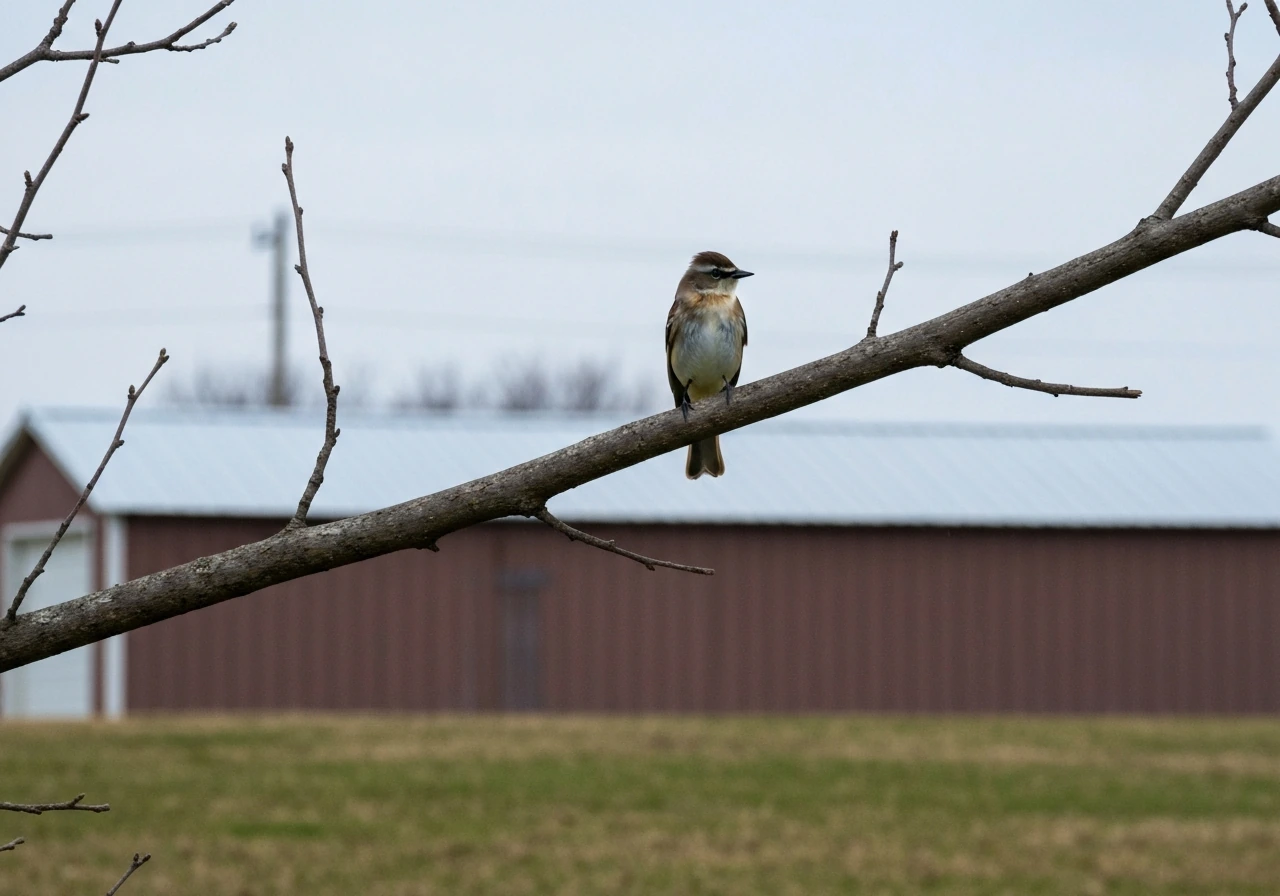
If a black phoebe just crossed your path and you felt like it meant something, you're probably right to pay attention. The black phoebe (Sayornis nigricans) is one of those birds that has a way of making itself noticed: perched low over water, slowly wagging its tail, then darting out with precision to catch an insect mid-air. There's something deliberate about it. Spiritually, that presence tends to carry themes of emotional clarity, boundary-setting, purposeful action, and messages from the in-between spaces of life. This guide will help you figure out what your specific encounter might be telling you today, without locking you into a single "this means that" answer.
Black Phoebe Bird Spiritual Meaning: Signs and What to Do

Eliza Thornwick
9 Apr 2026
What a black phoebe actually is (and why that matters spiritually)
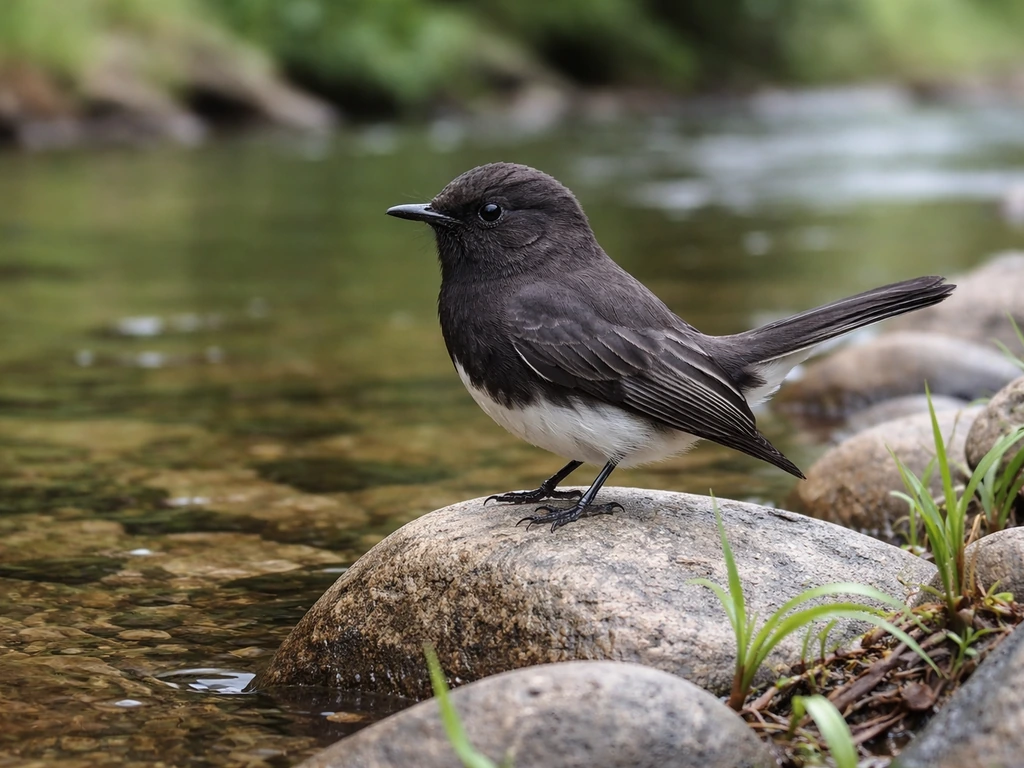
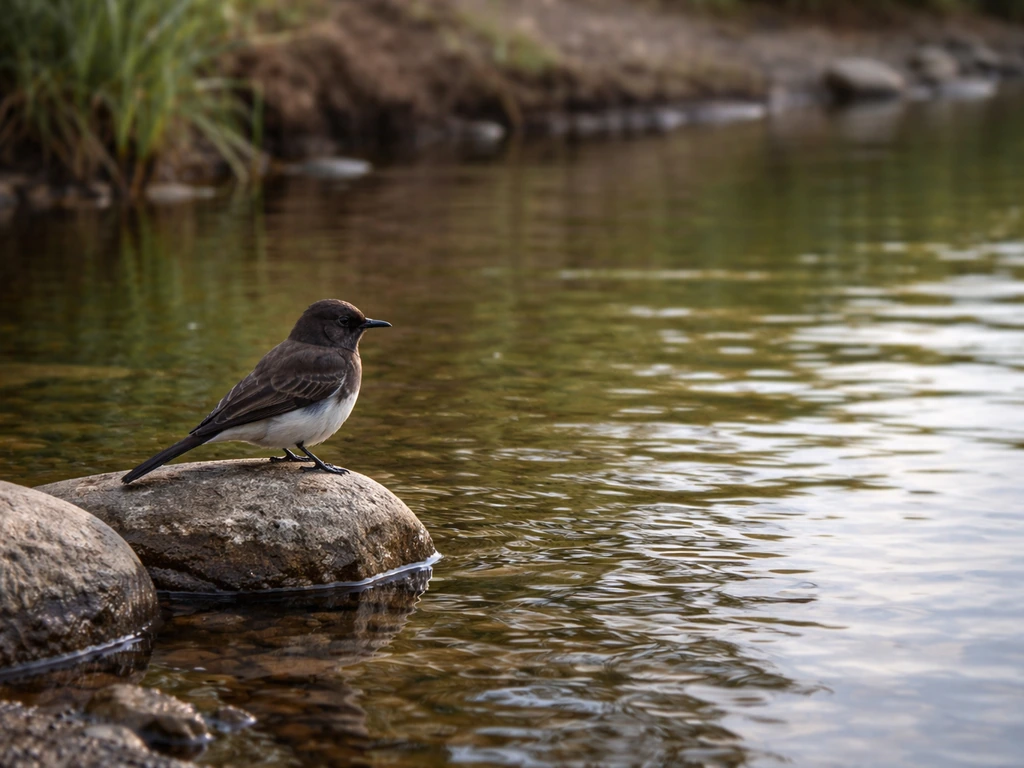
Before you can interpret a spiritual encounter, it helps to know what you're actually looking at. The black phoebe is a small passerine in the tyrant-flycatcher family (Tyrannidae), mostly dark charcoal gray or black across the head, back, and breast, with a clean contrasting white belly. It's plump and compact with a large head and a medium-length squared tail that it wags almost constantly. Its song is a thin whistled sequence: a rising "sa-wee" followed by a falling "sa-sew," strung together and described as plaintive and whistled. It also gives sharp "tsip" calls throughout the day and a more urgent "tweedle-deedle-eek" when chasing mates or intruders.
It lives along creeks, ponds, and water edges from coastal California and the U.S. Southwest all the way through Mexico, Central America, and into the Andes of South America. Unlike many birds, it's mostly a permanent resident, meaning it doesn't migrate in most of its range. It builds mud nests plastered to sheltered spots like cliff faces, bridge supports, culverts, and building eaves. All of these physical traits carry spiritual weight once you know what to look for. The bird's association with water, its preference for liminal spaces (edges between land and water, tucked under human structures), and its dual coloring all feed directly into its symbolic meaning.
The core spiritual meaning of the black phoebe
The black phoebe sits at the intersection of two powerful symbolic currents: the energy of black birds and the particular spiritual identity of the phoebe family. If you want to go deeper into the broader phoebe symbolism, the phoebe bird spiritual meaning covers the full phoebe lineage in detail. But for the black phoebe specifically, here are the core themes that come up repeatedly across traditions and encounters.
- Emotional clarity and depth: The black phoebe lives at water's edge. Water in almost every spiritual tradition represents emotion, the unconscious, and intuition. Seeing this bird is often read as a nudge to pay attention to what's flowing beneath the surface of your day-to-day life.
- Purposeful action over impulsive reaction: Watch a black phoebe hunt. It doesn't thrash around. It waits, watches, and moves with precision. This is a strong message about the power of stillness before action, especially when you're facing a decision.
- Liminal space and in-between times: This bird lives in the margins, between land and water, tucked under bridges and building eaves. In spiritual terms, liminal spaces are thresholds of change. A black phoebe encounter often signals you're in a transition, whether you feel it yet or not.
- Communication from beyond the ordinary: The phoebe's plaintive, whistled song has long been associated in folk traditions with messages from ancestors or guides. Its name, 'phoebe,' also echoes Phoebe, the Titan goddess of prophecy in Greek mythology, adding a layer of oracular symbolism.
- Cleansing and renewal: Black absorbs and transforms. White (the belly) reflects and purifies. The bird's dual coloring speaks to the spiritual process of taking in what needs to be processed and releasing what's clean and clear.
- Boundary and protection: The black phoebe is territorial and will chase intruders aggressively. As a spiritual symbol, it can signal that it's time to protect your energy, your relationships, or your creative space.
What your specific encounter probably means
The context of how you saw the black phoebe shifts the message considerably. A single sighting in passing is different from a bird that lingers, sings directly at you, or shows up at your window. Here's how to read the most common encounter types.
Seeing one near water
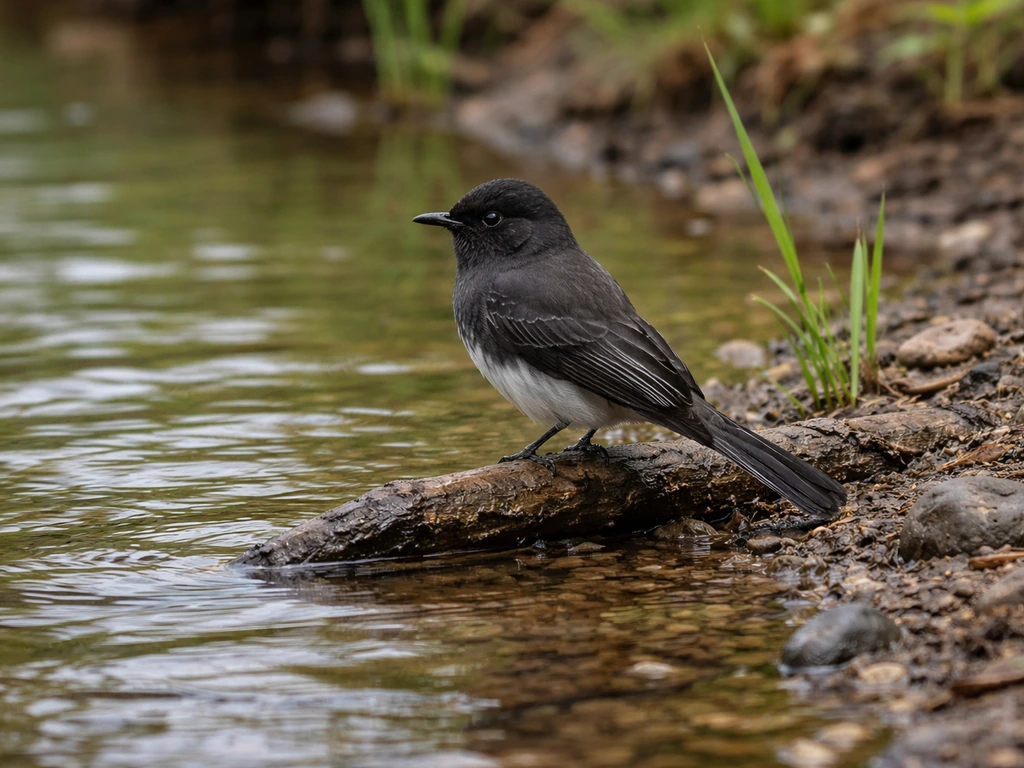
This is the bird's natural habitat, so a sighting near a creek or pond carries the full emotional and intuitive symbolism of water combined with the phoebe's energy. If you've been avoiding a feeling or pushing down an emotional truth, this encounter is a gentle but clear prompt to stop wading in the shallows and get honest with yourself.
Landing near you or on you
This is a high-contact encounter and spiritually it carries more weight. A bird that chooses to land on or extremely close to you is crossing a boundary it usually keeps. Most traditions interpret this as a direct personal message, either from your own higher self or from a guide or ancestor. Ask yourself: what were you thinking about in the moments before it landed? That thought is worth writing down.
Hearing the song or call

The black phoebe's rising-then-falling song (that "fi-bee" or "sa-wee/sa-sew" pattern) is rhythmically significant. Rising energy followed by grounding it back down suggests a message about balance, specifically about not staying in heightened states indefinitely. If you heard it singing insistently, consider where in your life you've been running too hot, too anxious, or too elevated for too long. The bird is modeling the return to ground.
Tapping at a window
Window tapping across many spiritual traditions signals that something from outside your current awareness is trying to get in. It can be a message you've been ignoring, a change that's coming whether you prepare or not, or a nudge from a deceased loved one. With the black phoebe specifically, the territorial and communicative nature of the bird adds a layer: someone or something is trying to make its presence known to you clearly. Don't dismiss it.
Nesting at or near your home
Black phoebes build mud nests plastered to sheltered spots including the eaves of buildings, so this is not an uncommon event. Spiritually, a bird choosing to nest at your home is considered protective and positive in almost every tradition. It suggests your home is a safe space and that new beginnings, creative projects, or actual new family growth may be on the horizon. Do not disturb an active nest. Let it complete its cycle.
Appearing unexpectedly in unusual places
If a black phoebe turns up far from water or in an unexpected urban context, the liminal symbolism intensifies. The bird is out of its ordinary zone, and so, the message implies, are you. This kind of encounter often shows up during major life transitions: career changes, relationship shifts, grief, or spiritual awakenings. The message tends to be: you are in between chapters, and that's okay.
Black bird symbolism: what to borrow and what to skip
Because the black phoebe is predominantly dark, people often layer on general black bird symbolism wholesale. Some of that applies, but not all of it. Let's sort through it.
| Black Bird Symbolism Theme | Applies to Black Phoebe? | Why or Why Not |
|---|---|---|
| Death omens / bad luck | Mostly no | This is rooted in crow and raven lore. The black phoebe's dual coloring (black and white) and water association shift it away from dark omen territory. |
| Mystery and the unknown | Yes, partially | The black phoebe's liminal habitat and plaintive song do carry a mystery quality, but it's more introspective than ominous. |
| Transformation and change | Yes, strongly | Black as a color of transformation applies well here, especially combined with the bird's tail-wagging readiness and precision action. |
| Ancestral messages | Yes | The phoebe family name and the bird's persistent, attention-grabbing song make this a widely held interpretation across multiple traditions. |
| Protection | Yes | The black phoebe's territorial aggression and its habit of nesting in sheltered human structures both support protective symbolism. |
| Witchcraft or dark magic associations | No | These associations belong to crows, ravens, and black cats. They don't transfer to the black phoebe. |
The short version: borrow the transformation, ancestral communication, and protection themes from general black bird lore. Skip the omen-of-death framing. The black phoebe's white belly is symbolically significant, it marks this as a bird of contrast and balance, not of pure darkness. For comparison, consider how other distinctive-looking birds like the hoopoe bird spiritual meaning also resist simple "dark or light" categorization because their physical complexity mirrors their symbolic nuance.
When timing and repetition make the message louder
A single black phoebe sighting is worth noticing. Multiple sightings over days or weeks are worth taking seriously. Repetition in spiritual encounters is generally read as amplification: the message is still waiting to be received. Ask yourself whether you've been seeing this bird repeatedly, and if so, how long that's been going on.
Timing also matters. The black phoebe is mostly a permanent resident in its range, so unlike migratory birds, its presence isn't season-specific in most areas. But if you're seeing it at a particular time of day repeatedly, early morning encounters often relate to new beginnings and clarity, while dusk encounters lean toward reflection, closure, and transition. If you're seeing it during a personally significant period like a birthday, an anniversary of a loss, or the start of a new project, those personal markers amplify the meaning.
Your current life situation is the most important interpretive filter you have. A Reddit post in r/LosAngeles also draws on blank" rel="noopener noreferrer">user-provided species and range details for black phoebes in the Los Angeles area, showing where this bird has been spotted. A black phoebe encounter during a period of grief reads differently than the same encounter during a creative breakthrough. Neither reading is wrong. The bird doesn't change; your lens does. Some birds are known for carrying messages that seem to shift meaning based on where the observer is spiritually, much like the potoo bird spiritual meaning, which similarly prompts deep self-inquiry rather than delivering a fixed verdict.
How different spiritual traditions read this bird
No single tradition owns the black phoebe's meaning, and that's worth acknowledging before you commit to one interpretation. Here's a quick cultural map.
- Native American traditions: Many Southwestern tribes have relationships with water birds as messengers between the physical and spirit worlds. A bird that lives at the water's edge occupies a sacred threshold. Specific tribal meanings vary and should be explored with respect for their origin communities rather than generalized.
- Celtic tradition: Black birds in Celtic lore are often associated with the Otherworld and with liminal crossing points. The phoebe's edge-of-water habitat maps naturally onto Celtic symbolism of rivers and streams as borders between worlds.
- Christian tradition: Birds in Christian symbolism often represent the soul or the Holy Spirit. A bird that persists near your home or returns repeatedly has been interpreted as a soul visiting or a spiritual blessing on the household.
- Eastern philosophy: In Taoist and Buddhist frameworks, the black phoebe's behavior, watching patiently and acting with precision rather than force, is itself the teaching. The bird embodies wu wei (effortless action) and the value of waiting for the right moment.
- General shamanic and spirit guide traditions: If you work with animal totems or spirit guides, the black phoebe as a guide signals it's time to work with your emotional body, refine your intuition, and practice purposeful stillness.
You don't need to pick one tradition and stick with it. Most people find that one framing resonates more than others, and that's your signal. Just as a honeyeater bird spiritual meaning draws on multiple cultural threads without requiring a single "correct" answer, the black phoebe's symbolism is generous enough to hold more than one truth at a time.
Practical next steps: what to actually do today
Spiritual encounters are most useful when they lead to real reflection or real change. Here are concrete actions you can take today.
Journaling prompts

Grab a notebook and write freely in response to these. Don't edit yourself; write what comes first.
- What was I thinking or feeling in the moment I noticed the black phoebe? Write the thought down exactly.
- Where in my life right now am I being called to be more precise or intentional rather than reactive?
- What emotion have I been avoiding or pushing down? What would it look like to let it surface?
- Is there a boundary I've been hesitating to set? With whom, and what's the cost of waiting?
- If this bird were carrying a message from someone who loves me and is no longer here, what would they most want me to hear right now?
Meditation and grounding practice
The black phoebe's connection to water makes water-based meditation especially fitting. If you can sit near a creek, pond, or even a fountain for ten minutes, do it. Breathe slowly and let your awareness drop below your thoughts to what you're actually feeling in your body. If you can't access natural water, running your hands under cool water while setting a clear intention works as a simple grounding ritual. State out loud or internally what you're releasing and what you're calling in.
Cleansing and protection practices
If the black phoebe's appearance felt protective or you're in a period of transition, a simple home or personal energy cleanse is appropriate. Open windows to let air move through your space. Burn herbs like sage, cedar, or rosemary if that aligns with your tradition. Set a verbal intention for what you want to clear and what you want to welcome. The bird's dual coloring, dark absorbing what needs to go, white releasing what's clear, is a useful visual anchor for this kind of practice.
Deepening your awareness of bird signs
If this encounter sparked broader curiosity about bird symbolism, it's worth exploring how other birds in your environment carry meaning. Birds with distinctive voices and behaviors, like how the lyre bird spiritual meaning centers on mimicry and the power of voice, or how the pee wee bird spiritual meaning touches on persistence and small but powerful messages, can all deepen your interpretive vocabulary. The more you practice reading birds in context, the clearer each encounter becomes.
If the encounter feels dark: protecting your energy and handling difficult situations
Not every bird encounter feels positive, and it's worth being honest about that. If you felt unsettled or fearful when you saw the black phoebe, that's data too. Don't force a positive interpretation onto a moment that felt wrong.
When it feels like a warning
If your gut reaction was that this was a warning, sit with it. Ask what area of your life feels unresolved, threatened, or about to shift. The black phoebe's territorial aggression and its water-edge habitat both carry an element of vigilance. A warning reading isn't necessarily negative; it may simply be an invitation to pay attention and prepare rather than stay passive. Some birds in folklore carry this dual-natured energy. The loerie bird spiritual meaning, for example, also moves between celebration and alert depending on the context of the encounter.
Finding a dead black phoebe
Finding any dead bird is startling, and the spiritual weight of it is real. In most traditions, a dead bird signals the end of a cycle rather than literal death or disaster. With the black phoebe specifically, the end-of-cycle message might relate to an emotional pattern you've been carrying, a relationship that has run its course, or a phase of life that is genuinely complete. Give yourself space to acknowledge whatever feels like it's ending. Then let it go.
On the practical side: do not handle a dead bird with bare hands. Use disposable gloves or a plastic bag turned inside out. If it's on your property, place it in a sealed bag and dispose of it in an outdoor trash bin. Wash your hands thoroughly afterward. If you want to mark the moment spiritually, you can say a simple acknowledgment of thanks for the message before disposing of the bird.
Finding an injured black phoebe
If the bird is alive but injured (perhaps from a window strike or a cat encounter), your ethical response is part of the spiritual one. Contact a licensed wildlife rehabilitator in your area. In the U.S., the Wildlife Rehabilitators directory or a call to your local animal control office will connect you to the right resource. While you wait for help, place the bird gently in a ventilated box lined with a soft cloth in a dark, quiet space. Do not give it food or water, which can cause additional harm. The act of caring for an injured wild creature is itself a form of spiritual reciprocity: you received a message, now you're giving back.
Protecting your energy if the encounter felt draining
If any bird encounter leaves you feeling anxious, heavy, or energetically off, return to basics. Ground yourself physically: walk barefoot on grass or soil if you can, hold something cold in your hands, or do a few minutes of slow breathing with emphasis on the exhale. Set a clear spoken intention that you release any energy that doesn't belong to you and welcome clarity and protection into your space. Then move on with your day. You don't have to marinate in an encounter to honor it. Sometimes acknowledging it and then returning to ordinary life is exactly the right response.
FAQ
If I only saw a black phoebe once, should I still treat it as a spiritual message?
Yes, but keep it light and specific. A single sighting is often guidance or a prompt, not a certainty, so focus on one question to answer in your notebook (for example, “What boundary or emotional truth is asking for honesty right now?”) rather than trying to predict an outcome.
What should I do if the black phoebe keeps showing up at the same place every day?
Use repetition as a signal to act locally. Notice what is happening at that exact spot each time (work commute, a doorway, near a window, near a water feature) and choose one small behavior change tied to it, like pausing before a reaction or speaking a needed sentence.
How can I tell whether the message is about me, or about someone else?
If the bird landed extremely close or seemed to “engage” with you, interpret it as personal first, then relational second. Ask what you were thinking about immediately before the moment, then check whether the “next step” you need is something you can do without controlling another person.
Does the spiritual meaning change if the black phoebe is singing versus calling quietly?
Generally, singing points to timing and balance (for example, rising energy returning to ground), while sharp “tsip” or urgent chases feel more like alertness. If you notice repeated urgent calls near you, consider it a nudge to slow down and prepare, not to immediately take bold action.
What if I felt fear or dread when I saw the black phoebe?
Treat the emotion as part of the message, not an obstacle. Choose one unresolved area that matches the fear, then do a grounding step plus a concrete preparation step (like making a plan, setting a boundary, or resolving a pending conversation) so the anxiety converts into action.
Is it a bad sign if a black phoebe hits my window or shows up stunned?
Not necessarily, but it is a practical emergency first. If it is alive, contact a wildlife rehabilitator or local animal control, and keep it in a dark, ventilated box. Avoid giving food or water, and avoid handling more than necessary, since stress can worsen injuries.
What if a black phoebe is nesting on my property, but I’m worried about it being disruptive?
Do not disturb an active nest, even if it feels inconvenient. If it’s near a high-traffic entry, create a temporary quiet path away from the nest area, and watch from a distance until fledglings leave, so the birds remain safe and you still respect the spiritual “protection” theme.
How should I interpret seeing a black phoebe far from water or in a crowded city setting?
Use it as a “liminal mismatch” cue. Because it is out of its usual element, the message often points to being out of your comfort zone or in between phases, so ask what part of your life is currently “not where it belongs” and make one adjustment to bring it back into alignment.
Can I over-interpret it and get stuck?
Yes, that happens when you try to force a single definitive prediction. Limit your interpretation to one reflection question and one action, then return to normal life. If you catch yourself spiraling, do a short grounding routine and postpone any major decisions until you feel steady again.
What’s the best way to document the encounter so the meaning becomes clearer?
Record four details each time: time of day, location (near water, window, doorway, etc.), bird behavior (lingering, singing, tail wagging, landing distance), and your own state in the minutes before. Patterns across these four variables usually reveal the “lens” your situation is using.
Next Article
Phoebe Bird Spiritual Meaning: Encounters, Signs, and Next Steps
Phoebe bird spiritual meaning, signs and steps to interpret encounters, distinguish intuition from normal behavior, and